

Cambridge IGCSE First Language English 0500: Complete Guide to Papers & Preparation
Cambridge IGCSE First Language English 0500: Your Complete Guide
Cambridge IGCSE First Language English (0500) is for learners who use English as a first language. It tests reading, writing, and comprehension through set components. This guide explains the paper options, what you need to choose, how hard it is, and how to prepare.
What is IGCSE English 0500?
0500 develops reading and writing in English. You answer questions on unseen texts and produce extended writing (e.g. summaries, essays, arguments). It is widely used for entry to A-Level, IB, and university.
Papers and components you need to choose
0500 is modular. You take:
- Paper 1 (Reading): Comprehension and use of language — required.
- Paper 2 (Writing): Directed writing and composition — OR
- Paper 3 (Coursework): Coursework portfolio (set and marked by your school) — OR
- Component 4 (Speaking and Listening): Optional; reported separately.
So you need Paper 1 plus either Paper 2 (exam) or Paper 3 (coursework). Your school decides whether to offer the exam route or the coursework route. For portfolio task examples, see Cambridge English Language coursework examples.
Calculator use
English 0500 does not use calculators. All papers are reading and writing only.
How hard is 0500? Is it popular?
- Difficulty: 0500 is demanding. It expects strong comprehension, inference, and formal writing. Extended writing and time management are common challenges.
- Popularity: 0500 is one of the most popular IGCSE First Language English codes. It is well recognised by schools and universities.
Top revision tips for 0500
- Practise past papers for Paper 1 and Paper 2 under timed conditions.
- Focus on summary and comprehension — marks are often lost on short, precise answers.
- Plan and draft longer writing; leave time to edit.
- Read widely to build vocabulary and awareness of different text types.
How Tutopiya supports IGCSE English 0500 students
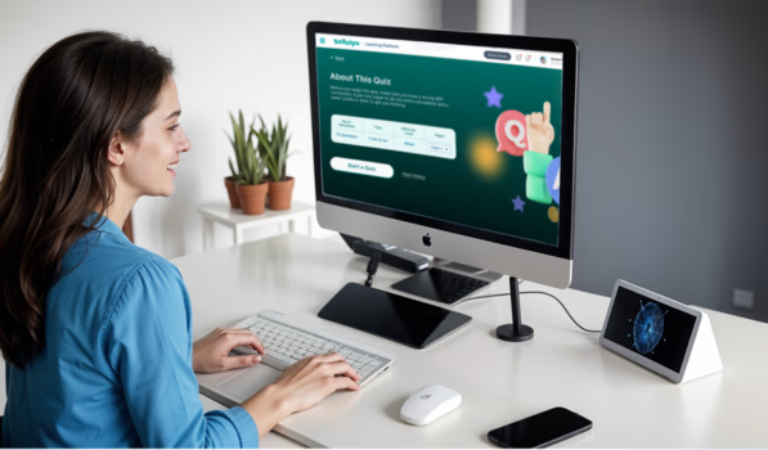
Tutopiya specialises in IGCSE and supports First Language English 0500. Our resources platform includes 200,000+ past papers, AI practice, and revision notes developed over 8+ years. Our tutors include ex- and current international-school teachers and IGCSE board examiners (subject-dependent). You can use the platform for 0500 past papers and revision, and book a free trial with an IGCSE English tutor to work on comprehension, writing, and exam technique.
Experience Tutopiya's Platform
Access IGCSE English resources and book a free tutor trial.
Join 500,000+ students achieving exam success
This guide is for information only. Check the latest syllabus and components with your school and Cambridge International.
Ready to Excel in Your Studies?
Get personalised help from Tutopiya's expert tutors. Whether it's IGCSE, IB, A-Levels, or any other curriculum — we match you with the perfect tutor and your first session is free.
Book Your Free TrialWritten by
Tutopiya Team
Educational Expert
Related Articles
Best IGCSE Tuition Options in Al Ain: A Parent's Guide
How Al Ain parents can compare IGCSE tuition: online one-to-one tutors, tuition centres, home tutors and marketplaces. Cambridge vs Edexcel, exam series, what comes after IGCSE, and questions to ask.

Best IGCSE Tuition Options in Dammam: A Parent's Guide
How Dammam parents can compare IGCSE tuition: online one-to-one tutors, tuition centres, home tutors and marketplaces. Cambridge vs Edexcel, exam series, what comes after IGCSE, and questions to ask.

Best IGCSE Tuition Options in Gaborone: A Parent's Guide
How Gaborone parents can compare IGCSE tuition: online one-to-one tutors, tuition centres, home tutors and marketplaces. Cambridge vs Edexcel, exam series, what comes after IGCSE, and questions to ask.