

PSLE Chinese Home Tuition in Singapore
Quick answer: PSLE Chinese home tuition in Singapore gives your child focused, 1-to-1 help with the MOE Chinese syllabus at home — targeting composition, comprehension, oral and listening, especially for households where Chinese isn’t the main spoken language. Most families start in P5, and the smartest way to begin is a free online trial to meet a matched tutor before any in-person lessons or payment.
For many Singapore families, Chinese is the subject that quietly drags down the PSLE Achievement Level (AL) score — not because the child isn’t able, but because there’s little Chinese spoken at home, so vocabulary and oral fluency never quite catch up. Language builds through exposure and correction, both of which a 1-to-1 setting delivers far better than a group class. That is exactly why PSLE Chinese home tuition is one of the most requested subjects in Singapore. Below is a practical guide to what a Chinese tutor should cover, when to start, and how to hire without cold-calling agencies or paying cash before you’ve met the tutor.
What good PSLE Chinese home tuition covers
The PSLE Chinese exam spans writing, language use and comprehension, listening, and oral, with a Higher Chinese option for stronger pupils. A strong tutor works on the components where your child actually loses marks.
| Weak area | What a PSLE Chinese home tutor focuses on |
|---|---|
| 作文 (Composition) | Picture composition (看图作文) — planning, sequencing events, and using varied vocabulary and idioms rather than repeating simple phrases. |
| 理解 (Comprehension) | Open-ended questions, inferring meaning, and answering fully in correct Chinese sentence structure. |
| 语法 (Grammar & cloze) | Sentence patterns, measure words, and comprehension cloze where meaning drives the answer. |
| 听力 (Listening) | Following spoken passages and selecting the right response under time pressure. |
| 口试 (Oral) | Reading aloud with correct tones and fluency, plus stimulus/video-based conversation with developed answers. |
| 词语 (Vocabulary) | Building a working bank of words, phrases and 成语 (idioms) the pupil can actually use, not just recognise. |
The common thread is usable language. Many pupils recognise words but can’t produce them under pressure — in composition or when speaking. A 1-to-1 home tutor speaks with your child, corrects tone and phrasing in real time, and drills vocabulary until it becomes active rather than passive — impossible for one child in a full classroom.
When to start PSLE Chinese tuition
- P4 or earlier: Strongly worth it if there’s little Chinese at home. Language needs runway, and early exposure prevents a widening gap.
- P5: The most common starting point. Composition and oral demands rise, and there’s a full year to build fluency before P6.
- P6: Focus narrows to exam technique, model compositions and oral practice. An ex-MOE or NIE-trained tutor is most valuable here for marking-scheme insight.
Because Chinese is a language, consistency beats cramming — regular weekly practice matters more than last-minute intensives. If you’re unsure whether tuition is needed at all, our guide on the signs your child needs a tutor can help you decide.
Why 1-to-1 home tuition suits PSLE Chinese
Language learning is built on conversation and correction, and both need patience and one-on-one attention. A home tutor talks with your child, hears every mispronounced tone, and rebuilds vocabulary and confidence without the child feeling exposed in front of peers — a real barrier for pupils who feel behind in Chinese. Learning at home also lets oral practice happen in a relaxed, familiar setting. This targeted approach sits at the heart of the wider PSLE home tuition approach, where the goal is always the weakest component, not a generic recap.
How to hire a PSLE Chinese home tutor the smart way
The sensible move is to meet the tutor online first, before anyone comes to your home:
- Book a free online trial — no payment, no commitment.
- Watch the tutor teach and hold a short conversation with your child.
- Confirm the tutor you like, then enrol in a monthly plan.
- Lessons move in-person to your home.
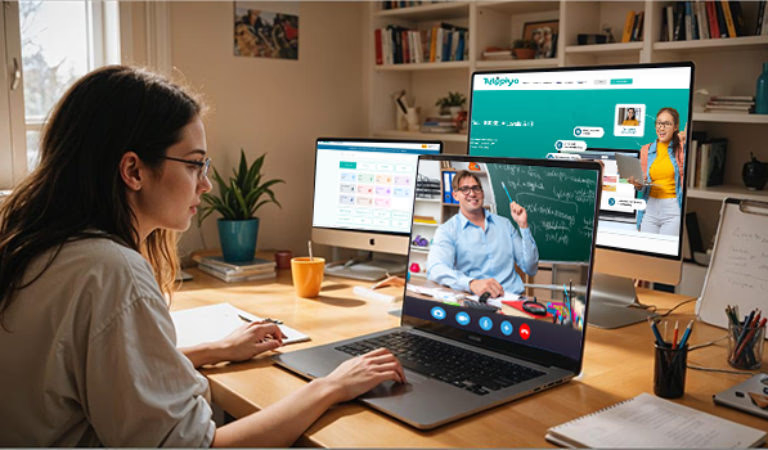
This is exactly how the Tutopiya hybrid home tuition model works — you vet a Singapore-based tutor with zero risk before committing.
No cash, and a full record of every lesson
Traditional Chinese tuition means monthly cash or bank transfers and no paper trail of what was actually taught. Tutopiya replaces that with:
- Monthly card payments — no ATM runs, no cash envelopes.
- Credits deducted only per completed lesson — you pay for classes that actually happened.
- A full report of every lesson held, missed, rescheduled or cancelled, so you can see which components were covered.
For a language subject where steady weekly practice is what moves the grade, that accountability keeps preparation on track.
The bottom line
PSLE Chinese home tuition works best when it’s targeted (composition, oral and the specific weak component), timely (early and consistent, usually from P5 or before if exposure is low), and matched to the goal (an ex-MOE tutor for exam-year technique, an experienced full-time tutor for foundations). Before committing to anyone, try a free online trial so you can see the tutor talk with your child — then move lessons in-person once you’re confident.
Want the wider picture? Read our complete guide to home tuition in Singapore, or meet a matched PSLE Chinese tutor with a free online trial today.
Frequently asked questions
Why do so many Singapore pupils struggle with PSLE Chinese? +
For many English-speaking households, Chinese is a second language with little home exposure, so vocabulary, oral fluency and composition lag behind. Pupils lose marks on 看图作文 (picture composition), 口试 (oral) and comprehension. A 1-to-1 home tutor rebuilds vocabulary and speaking confidence at the child's own pace.
What does a PSLE Chinese home tutor actually teach? +
A good PSLE Chinese tutor covers 作文 (composition), 理解 (comprehension), 语法 (grammar and cloze), 听力 (listening) and 口试 (oral — reading aloud and video-based conversation). They build a usable 词语 (vocabulary and idiom) bank and train the answering technique the MOE paper expects, including Higher Chinese where relevant.
When should my child start PSLE Chinese tuition? +
Most families start PSLE Chinese home tuition in P5, when composition and oral demands rise. For a pupil with little Chinese exposure at home, starting in P4 — or earlier — helps because language needs time and repetition to build. Consistency matters more than last-minute cramming for a language subject.
How much does PSLE Chinese home tuition cost in Singapore? +
Typical market rates for primary 1-to-1 home tuition run about S$25–S$40/hour with a part-time tutor and up to S$50–S$70/hour with an ex-MOE teacher. See our full home tuition cost guide for the level-by-level breakdown.
How do I start PSLE Chinese home tuition without paying upfront? +
Start with a free online trial to meet a matched Singapore-based tutor and see them teach your child before you commit. If it's a good fit, you enrol in a monthly plan and lessons move in-person to your home. View PSLE Chinese home tutors and book a free trial here.
Written by
Tutopiya Singapore Education Desk
Singapore home tuition · PSLE, O-Level & A-Level (MOE syllabus)
The Tutopiya Singapore Education Desk covers home tuition, the MOE syllabus and exam preparation for Singapore families — from PSLE through the GCE O-Level and A-Level.
Related Articles
A-Level Project Work (PW) Home Tuition in Singapore
Project Work (PW) tuition in Singapore helps JC students structure research, the written report and the oral presentation - a tutor guides the work without doing it for them.

Assessment Books vs Home Tuition in Singapore
Assessment books vs tuition in Singapore - when the ten-year-series and self-study is enough, when a home tutor is worth it, and how to combine both effectively.

DSA Preparation with Home Tuition in Singapore
How Direct School Admission (DSA-Sec and DSA-JC) works in Singapore, what tuition can and cannot do, and how a home tutor supports the academic and portfolio side.