

Paying Monthly by Card for Tuition in Singapore
Quick answer: Paying tuition monthly by card in Singapore means enrolling on a monthly plan instead of handing over cash each session. Your payment becomes a pool of lesson credits, and a credit is deducted only when a class is actually completed — so cancelled or rescheduled lessons aren’t charged. You get an automatic statement trail, a report per lesson, no ATM runs, and payment that tracks teaching that really happened rather than money spent on promises.
Most Singapore families still pay tutors the old way: cash or a monthly bank transfer, in advance. It feels normal until a lesson is skipped after you’ve paid, or you’re trying to remember what you actually got for last month’s envelope. Paying monthly by card — on a credits model — quietly fixes both problems. Here’s how it works and why it’s worth switching.
What “monthly by card” really means
It’s not just swapping cash for a card swipe. The model changes what you’re paying for:
- You enrol on a monthly plan, charged automatically to your card.
- The payment becomes lesson credits — a pool you draw down as classes happen.
- A credit is deducted only per completed lesson. No lesson, no deduction.
- Every class produces a report of what was taught and whether it was held.
So instead of paying for time booked and hoping it’s taught, you pay for time actually taught. That single shift is where all the safety comes from.
Card vs cash: what changes for you
| Factor | Monthly cash / transfer | Monthly by card (credits) |
|---|---|---|
| Payment record | Manual, easy to lose | Automatic statement trail |
| Lesson record | Usually none | Report each completed class |
| Missed lessons | Often prepaid, lost | Not charged — credit stays |
| Monthly effort | ATM / transfer each time | Automatic on the plan |
| Dispute protection | Goodwill only | Documented lesson-by-lesson |
| Safety | Cash to a stranger | No cash changes hands |
The takeaway is simple: cash is familiar but leaves you exposed, while card-on-a-plan turns a loose monthly arrangement into a documented, accountable one.
Why credits-per-lesson protects your money
The biggest weakness of prepaid cash is that the money is gone the moment you hand it over — whether or not every lesson happens. A credits model reverses that. Your monthly card payment is held as credits and released only per delivered lesson. If a class is cancelled or rescheduled, no credit is used, so you’re never subsidising tuition that didn’t take place.
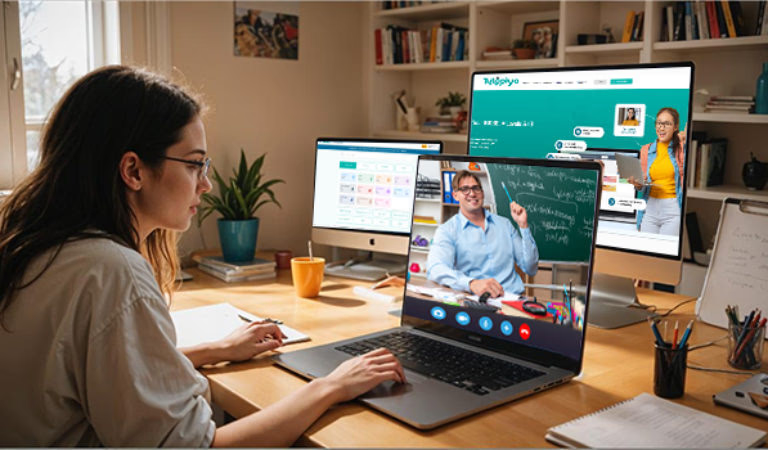
This is exactly how Tutopiya’s monthly card model works. You start with a free online trial to meet a matched Singapore-based tutor, then enrol on a monthly plan paid by card — no cash, no bank transfers. Credits are deducted only per completed lesson, lessons move in-person to your home, and you receive a full report of every class held, missed, rescheduled or cancelled. The result: no ATM runs, a complete paper trail, and payment that tracks reality instead of promises.
The everyday convenience nobody talks about
Beyond safety, monthly card billing removes a surprising amount of friction:
- No monthly cash withdrawals or bank transfers to remember.
- No fumbling for exact change or awkward “did I pay you yet?” moments.
- One clean statement for the whole term’s tuition.
- A lesson record you can actually point to at exam time.
- Nothing to reconcile from memory or a WhatsApp thread.
For exam years like P6, Sec 4/5 and JC2 — when you may be running several months of intensive lessons — that clarity is worth as much as the safety.
What to check before you commit to any payment method
Whatever you choose, protect your spend with a few questions:
- Am I paying for time booked or time taught? Prefer the latter.
- Is there a record of lessons and payments? Insist on both.
- What happens to my money if a lesson is missed? Clarify before, not after.
- Is there anything to reconcile at month-end? Automatic beats manual.
The bottom line
Paying monthly by card in Singapore isn’t just tidier than cash — on a credits model, it’s genuinely safer. You get an automatic record, a report per lesson, no monthly ATM runs, and payment that’s only ever deducted for classes that actually happened. It turns tuition spending from an act of goodwill into a tracked, accountable arrangement.
For the wider picture, compare card vs cash payment in detail, read the complete home tuition guide, and see typical figures in the home tuition cost guide.
Want billing that tracks lessons, not promises? Start with a free online trial and see how monthly card payment works before you commit a cent.
Frequently asked questions
How does paying tuition monthly by card in Singapore work? +
You enrol on a monthly plan and pay by card instead of handing over cash each session. The plan becomes a pool of lesson credits, and a credit is deducted only when a class is completed. There are no ATM runs and no bank transfers to a stranger — just a clean, automatic monthly billing record.
Do I pay for lessons that get cancelled or rescheduled? +
No. On a credits model, a credit is only deducted when a lesson is actually delivered. If a class is missed, cancelled or rescheduled, no credit is used for it. Your monthly card payment tracks lessons that really happened, unlike prepaid cash that's gone whether or not the class took place.
Is paying by card safer than cash for home tuition? +
Yes, in the ways that matter. Card-on-a-plan gives you an automatic statement trail, a lesson report each class, and payment tied to delivery. Cash leaves no record, offers no protection if a class is skipped after payment, and forces monthly logistics. Card converts a loose arrangement into a documented one.
What if I need to pause or stop the monthly plan? +
Because payment is held as credits and released per completed lesson rather than spent in a lump sum upfront, you're never locked into paying for teaching that hasn't happened. Unused credits reflect lessons not yet taught, which makes a card plan far cleaner to manage than prepaid monthly cash.
How do I start paying by card for home tuition? +
Begin with a free online trial to meet a matched Singapore-based tutor, then enrol on a monthly card plan. Credits are deducted per completed lesson and every class comes with a report. View home tutors and book a free trial here.
Written by
Tutopiya Singapore Education Desk
Singapore home tuition · PSLE, O-Level & A-Level (MOE syllabus)
The Tutopiya Singapore Education Desk covers home tuition, the MOE syllabus and exam preparation for Singapore families — from PSLE through the GCE O-Level and A-Level.
Related Articles
A-Level Project Work (PW) Home Tuition in Singapore
Project Work (PW) tuition in Singapore helps JC students structure research, the written report and the oral presentation - a tutor guides the work without doing it for them.

Assessment Books vs Home Tuition in Singapore
Assessment books vs tuition in Singapore - when the ten-year-series and self-study is enough, when a home tutor is worth it, and how to combine both effectively.

DSA Preparation with Home Tuition in Singapore
How Direct School Admission (DSA-Sec and DSA-JC) works in Singapore, what tuition can and cannot do, and how a home tutor supports the academic and portfolio side.