

IP (Integrated Programme) Home Tuition in Singapore
Quick answer: IP home tuition in Singapore supports Integrated Programme students through the demands of the through-train route - deeper content, continuous school-based assessments, and the eventual transition to A-Level or IB. Because IP students skip the O-Level, small gaps can go unnoticed for years, so a home tutor keeps standards high and foundations solid throughout. The easiest way to begin is a free online trial to meet a matched tutor before any in-person lessons or payment.
The Integrated Programme is a six-year through-train in top Singapore schools where students skip the O-Level exam and move straight to the A-Level or IB. It sounds like less pressure - one fewer national exam - but in practice IP runs at greater breadth and depth, and grades rest on continuous school-based assessments rather than a single checkpoint. That is why IP home tuition in Singapore is increasingly common. Below is a practical guide to how home tuition supports IP students and how to hire without cold-calling agencies or paying cash before you have met anyone.
Why IP students need tailored home tuition
The IP route has three features that make targeted 1-to-1 help valuable.
| IP feature | Why it matters for tuition |
|---|---|
| No O-Level checkpoint | Small gaps are not exposed by a national exam, so they can quietly compound for years. |
| School-based assessments | Term tests, projects and presentations all count - every component matters, continuously. |
| IP-specific rigour | Content runs deeper and faster than the mainstream O-Level track, with more independent work. |
| A-Level or IB transition | The final years are demanding, and a weak foundation shows quickly. |
The recurring theme is continuous accountability. Without a mid-point national exam, an IP student can drift without it being obvious until the A-Level or IB years land. A 1-to-1 home tutor gives an outside check on where your child actually stands - not just their term grade, but whether the understanding beneath it is solid.
Supporting school-based assessments and IP rigour
Map the school’s actual assessment schedule
IP schools weight continuous assessment heavily, so a good home tutor works from your child’s real assessment calendar - term tests, projects, presentations - rather than a generic exam. Each component gets prepared for on its own terms.
Meet the depth, not just the syllabus
IP content runs deeper than the mainstream track. A tutor who understands IP rigour pushes your child beyond surface answers into the analysis and independent thinking IP teachers expect, which is also the best preparation for the years ahead.
When IP students should start tuition
- Lower IP years (1 to 4): The most valuable starting point. Solid foundations here prevent gaps from compounding across the six-year track.
- Transition point: As the A-Level or IB years approach, tuition shifts toward the rigour and independence those years demand.
- Upper IP years (5 to 6): Targeted, exam-focused help ahead of prelims and the final A-Level or IB papers.
If you are unsure whether tuition is warranted at all, our guide on the signs your child needs a tutor can help you decide. For students heading to the A-Level track, our A-Level home tuition guide explains what that final stage demands.
Why home tuition suits IP students
IP students carry heavy, fast-moving timetables and significant independent work. A home tutor removes travel on packed evenings and adapts to one student’s specific needs - the exact topic or assessment where they are slipping - rather than a general syllabus. That undivided attention matters most on a track where no national exam flags weaknesses for you. For a fuller comparison, see home tuition vs tuition centre.
How to hire an IP home tutor the smart way
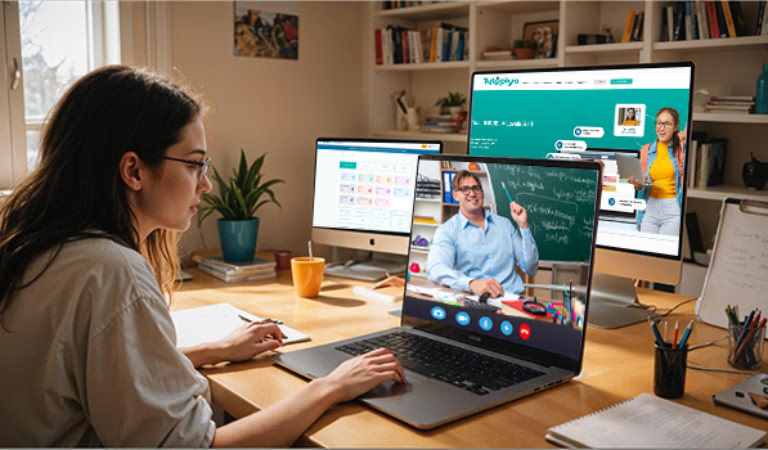
The sensible move is to meet the tutor online first, before anyone comes to your home:
- Book a free online trial - no payment, no commitment.
- Confirm they understand IP rigour and your child’s assessment schedule.
- Confirm the tutor you like, then enrol in a monthly plan.
- Lessons move in-person to your home.
This is exactly how the Tutopiya hybrid home tuition model works - you vet a Singapore-based tutor with zero risk before committing. For IP families especially, that trial is your chance to confirm the tutor can teach at the depth an IP student needs.
No cash, and a full record of every lesson
Traditional tuition means monthly cash or bank transfers with no paper trail of what was covered. Tutopiya replaces that with:
- Monthly card payments - no ATM runs, no cash envelopes.
- Credits deducted only per completed lesson - you pay for classes that actually happened.
- A full report of every lesson held, missed, rescheduled or cancelled.
Across a six-year through-train, that accountability is exactly the outside check IP families value most.
The bottom line
IP home tuition works best when it is assessment-aware (built around the school’s continuous assessments, not a national exam), timely (usually from the lower IP years), and matched to the goal (foundations early, exam technique later). Before committing to anyone, try a free online trial so you can confirm the tutor understands IP rigour - then move lessons in-person once you are confident.
Want the wider picture from PSLE to JC? Read our complete guide to home tuition in Singapore, or see how much home tuition costs before you start.
Frequently asked questions
What is the Integrated Programme and how is it different? +
The Integrated Programme (IP) is a six-year through-train route where students skip the O-Level exam and progress straight to the A-Level or IB. Because there is no national mid-point exam, IP grades depend heavily on school-based assessments, and the curriculum runs at greater breadth and depth than the mainstream O-Level track.
Why do IP students need home tuition? +
IP students face IP-specific rigour - deeper content, more independent work and continuous school-based assessments that all count. Without an O-Level checkpoint, small gaps can go unnoticed until the A-Level or IB years. A home tutor helps close those gaps early, supports project and inquiry work, and keeps standards high across the through-train.
How does home tuition support IP school-based assessments? +
Because IP schools weight continuous assessment heavily, every term test, project and presentation matters. A home tutor maps your child's actual school assessment schedule, prepares them for each component, and marks work against the depth IP teachers expect - rather than teaching to a generic exam that IP students do not sit.
When should IP students start tuition before A-Level or IB? +
Ideally in the lower IP years, so foundations are solid before the demanding A-Level or IB years. Starting early prevents small gaps from compounding across a six-year track. Students already in IP Year 5 or 6 can still benefit from targeted, exam-focused help ahead of prelims and the final papers. Match the tutor to the goal.
How do I start IP home tuition without paying upfront? +
Start with a free online trial to meet a matched Singapore-based tutor and confirm they understand IP rigour before you commit. If it is a good fit, enrol in a monthly plan and lessons move in-person to your home, with credits deducted only per completed lesson. Find an IP home tutor and book a free trial here.
Written by
Tutopiya Singapore Education Desk
Singapore home tuition - PSLE, O-Level & A-Level (MOE syllabus)
The Tutopiya Singapore Education Desk covers home tuition, the MOE syllabus and exam preparation for Singapore families - from PSLE through the GCE O-Level and A-Level.
Related Articles
A-Level Project Work (PW) Home Tuition in Singapore
Project Work (PW) tuition in Singapore helps JC students structure research, the written report and the oral presentation - a tutor guides the work without doing it for them.

Assessment Books vs Home Tuition in Singapore
Assessment books vs tuition in Singapore - when the ten-year-series and self-study is enough, when a home tutor is worth it, and how to combine both effectively.

DSA Preparation with Home Tuition in Singapore
How Direct School Admission (DSA-Sec and DSA-JC) works in Singapore, what tuition can and cannot do, and how a home tutor supports the academic and portfolio side.