

Home Tuition for Children with Learning Needs in Singapore
Quick answer: Special needs home tuition in Singapore gives a child with mild learning needs — dyslexia, ADHD, or a slower processing pace — patient, structured 1-to-1 support in the calm of their own home, where there’s no crowd to compete with and no pace to keep up with. A good home tutor supports learning day to day; they aren’t a replacement for a specialist. The safest way to begin is a free online trial, where you watch how gently a matched tutor works with your child before committing anything.
If your child learns differently, a normal classroom can feel like the wrong shape for them — too fast, too loud, too much at once. That doesn’t mean they can’t learn well. It usually means they need learning delivered differently: slower, quieter, in smaller pieces, with someone paying attention only to them. That is exactly what patient 1-to-1 home tuition is built to do. Here’s an honest look at how it helps, and when to reach for specialist support too.
Why a busy classroom is the wrong shape for some children
A MOE class of thirty to forty moves at the pace of the middle, with one voice for everyone. For a child with mild learning needs, several things go wrong at once:
- Too fast. A child who processes more slowly loses the thread and can’t stop the class to catch up.
- Too distracting. For a child with attention difficulties, a crowded room is a wall of noise to fight through before any learning begins.
- Too public. A child who reads or writes with difficulty won’t risk being wrong in front of peers, so they go quiet and disengage.
None of this is about ability. It’s about environment. Change the environment, and the same child can look completely different.
What patient 1-to-1 home tuition does differently
One-to-one at home removes the crowd and the pace pressure, and lets the lesson bend around the child instead of the other way round:
| Classroom (1-to-40) | 1-to-1 home tuition | |
|---|---|---|
| Pace | Fixed for the group | Slowed to your child |
| Distraction | High, unavoidable | Minimal, familiar setting |
| Task size | Whole worksheet at once | Broken into small steps |
| Attention | Shared 40 ways | Fully on your child |
| Mistakes | Public, risky | Private, safe |
| Reading pace | Class average | Your child’s own |
A tutor working one-to-one can watch your child’s focus in real time, switch activities before they drift, repeat without impatience, and celebrate small wins that a busy classroom would never pause for. For a child with dyslexia or ADHD, that patience is often the whole difference between shutting down and staying in the game.
Knowing when to bring in specialist help
Here’s the honest part every parent deserves. A home tutor is not an educational psychologist, a speech-and-language therapist, or a special-education specialist. Tuition supports learning; it does not diagnose or treat. For a child with mild learning support needs, a patient tutor is frequently exactly the right level of help. But some signs point to specialist assessment first:
- Persistent difficulty across every subject, not just one or two.
- Ongoing struggles with reading, focus, memory or emotional regulation.
- Difficulties that haven’t shifted at all despite consistent, patient support.
If that sounds like your child, speak to their school or a professional about a formal assessment. A diagnosis isn’t a label to fear — it unlocks the right kind of support. Many families do both: specialist guidance for the underlying need, plus patient 1-to-1 tuition at home for the day-to-day learning.
Starting safely with a free trial
The worry for parents of a child with learning needs is often the same: will the tutor be patient enough, and will my child feel judged? A free-trial-first approach is built for exactly that question. Here’s how to begin without risk:
- Book a free online trial. No payment, no commitment, nobody at your door.
- Share the real picture. Level, subject, and honestly what your child finds hard — and any diagnosis you have.
- Watch how they teach. See whether the tutor slows down, breaks things up, and stays gentle when your child struggles.
- Let your child’s comfort decide. Did they feel safe and understood, not rushed? That matters more than anything on paper.
- Only proceed if it fits. If the patience isn’t there, you simply don’t continue.
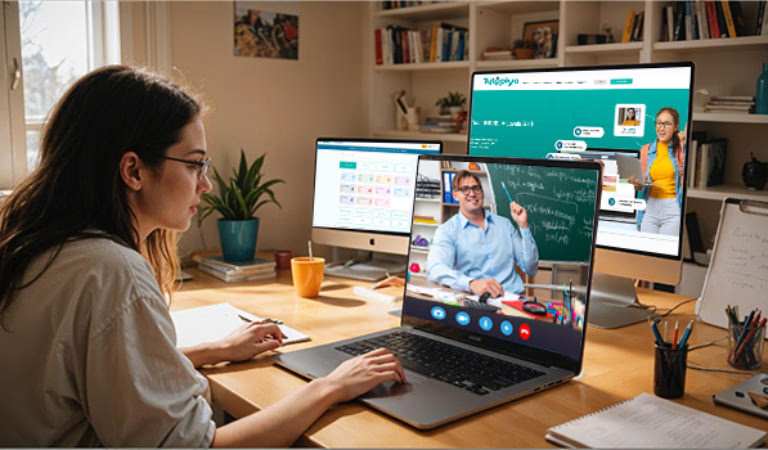
This is how the Tutopiya home tuition model is designed to work: you meet and vet a matched Singapore-based tutor online first, watch them teach with zero risk, and only move to in-person home lessons once you’re confident it’s the right fit. You pay by card on a monthly plan — no cash — credits are deducted only for lessons actually completed, and every class comes with a full report so you can follow your child’s progress closely.
A gentle, honest note for parents
Progress for a child with learning needs is rarely a straight line, and no honest tutor will promise a transformation in a fortnight. What patient 1-to-1 home tuition can reliably offer is a calmer place to learn, someone whose full attention is on your child, and small, steady wins that rebuild their willingness to try. Pair that with specialist help where it’s needed, give it time, and judge by whether your child is more settled and more willing — not just by the marks.
The bottom line
A child who learns differently isn’t a child who can’t learn — they usually just need learning shaped differently. Special needs home tuition in Singapore offers exactly that: a patient tutor, a quiet home, small steps, and full attention, with no crowd to fight through. Use it for mild needs, pair it with specialists for complex ones, and start with a free trial so you can see the patience for yourself before you commit a cent.
For more, see the complete home tuition guide, read how home tuition helps weak students, and check typical rates in the home tuition cost guide.
Not sure your child will click with a tutor? Start with a free online trial and watch a patient, matched Singapore-based tutor work with them before you decide anything.
Frequently asked questions
Can home tuition help a child with dyslexia or ADHD? +
Yes. Special needs home tuition works because a patient 1-to-1 tutor can slow the pace, break tasks into smaller steps, and remove the distractions of a busy classroom. For mild learning needs like dyslexia or ADHD, this focused, low-pressure setting often helps a child engage and progress in ways a class of 40 simply can't allow.
Is a home tutor the same as a specialist or therapist? +
No — and it's important to be clear. A home tutor supports learning and academic content with patience and structure; they are not a substitute for an educational psychologist, speech therapist or a formal diagnosis. For many children with mild needs, a good tutor is exactly right. When needs are more complex, tuition works best alongside specialist help.
How does 1-to-1 at home suit a child with attention difficulties? +
A child who struggles to focus in class often does far better one-to-one at home. There's no crowd to distract them, the tutor can read their attention and switch activities before they drift, and lessons can be kept short and structured. The familiar home setting also lowers anxiety, which helps a restless or overwhelmed child settle.
When should I seek specialist help instead of just tuition? +
If your child shows persistent difficulty far beyond one subject — with reading, focus, memory or emotional regulation across the board — it's worth speaking to your school or a professional for assessment. Tuition supports learning, but a formal diagnosis unlocks the right support. Many families do both: specialist guidance plus patient 1-to-1 tuition at home.
How do I start home tuition for a child with learning needs? +
Book a free online trial, share your child's level, subject and needs honestly, and meet a matched Singapore-based tutor. Watch how patiently they work with your child before you decide, then move to in-person home lessons if it fits. View home tutors and book a free trial here.
Written by
Tutopiya Singapore Education Desk
Singapore home tuition · PSLE, O-Level & A-Level (MOE syllabus)
The Tutopiya Singapore Education Desk covers home tuition, the MOE syllabus and exam preparation for Singapore families — from PSLE through the GCE O-Level and A-Level.
Related Articles
A-Level Project Work (PW) Home Tuition in Singapore
Project Work (PW) tuition in Singapore helps JC students structure research, the written report and the oral presentation - a tutor guides the work without doing it for them.

Assessment Books vs Home Tuition in Singapore
Assessment books vs tuition in Singapore - when the ten-year-series and self-study is enough, when a home tutor is worth it, and how to combine both effectively.

DSA Preparation with Home Tuition in Singapore
How Direct School Admission (DSA-Sec and DSA-JC) works in Singapore, what tuition can and cannot do, and how a home tutor supports the academic and portfolio side.