

Home Tuition During the School Holidays in Singapore
Quick answer: Home tuition during the school holidays in Singapore keeps learning steady across all four breaks - March, June, September and the year-end - rather than letting momentum go cold. The goal is not to fill the holidays with tuition, but to protect habits, close the term’s gaps and build ahead, while still leaving real rest. The easiest way to start is a free online trial to meet a matched tutor and agree a plan before any in-person lessons or payment.
Singapore’s school year has four breaks, and each one is quietly a turning point. Term-time is busy enough that gaps rarely get fixed while school is running; the holidays are when there is finally room to reset. Used well, home tuition during the school holidays turns each break into a step forward. Used badly - or ignored - long breaks can leave a child rusty and behind before the new term has even begun. Below is a practical guide to planning every holiday, not just the June one.
A holiday-by-holiday plan for the Singapore school year
Each break has a different length and purpose, so the smart move is to match the effort to the break rather than treating them all the same.
| Break | Length | Best use |
|---|---|---|
| March | One week | Light rhythm - reset habits and fix small gaps from Term 1. |
| June | Four weeks | Deep work - close gaps, build ahead, start exam technique. |
| September | One week | Sharpen - exam technique and timed practice before finals. |
| Year-end | Six weeks | Reset and prepare - consolidate, and build ahead for the new year. |
The principle running through all four is consistency over cramming. A short, regular rhythm through a break beats a frantic push at the end. That is as true of the one-week March break as the six-week year-end one.
Building holiday learning habits that stick
Keep a regular touchpoint
The biggest risk over a long break is not forgetting content - it is losing momentum. A home tutor keeps a steady weekly touchpoint so the routine never fully switches off, then re-activates the last term’s material so nothing goes cold.
Protect rest, too
Habits stick when they are sustainable. A good holiday plan balances focused sessions with genuine downtime and family time. Home tuition helps here - lessons come to you, so no holiday hours are lost to travelling across the island on a hot afternoon.
Match the holiday to your child’s goal
Every child enters a break in a different place. Some need to catch up on topics they never quite grasped; others are solid and ready to build ahead. A home tutor’s first job is to diagnose which - then design the holiday accordingly. For an exam-year student, the June break is the big one, and our guide to June holiday intensive tuition covers that four-week window in depth. For everyone else, a lighter rhythm across all four breaks does the steady work.
If you are unsure whether your child needs the extra help at all, our guide on the signs your child needs a tutor can help you decide before you plan the break.
Why home tuition fits the holidays well
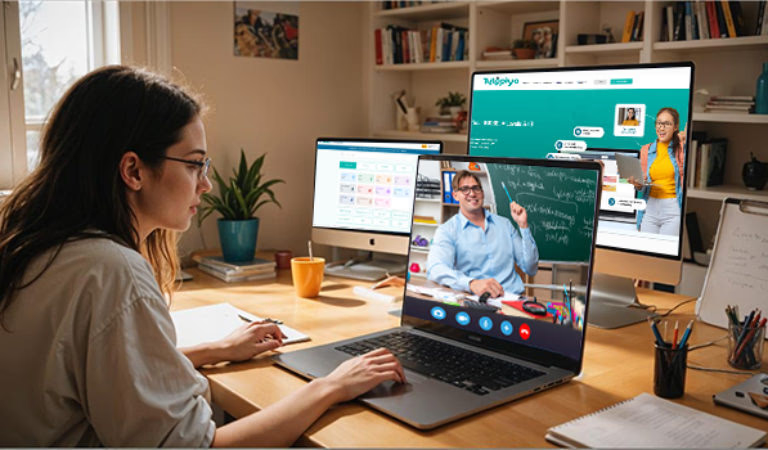
Holidays reward flexibility, and 1-to-1 home tuition adapts to exactly what your child needs - the specific gaps, the specific pace, the right intensity for the break. The Tutopiya hybrid home tuition model makes it easy to set up quickly: you meet the tutor online first through a free trial, agree the holiday plan, watch them teach your child, and move lessons in-person once you are confident. You vet a Singapore-based tutor with zero risk - no agencies to chase during the break, no cash upfront.
No cash, and a full record of every lesson
Holiday blocks can mean more sessions than usual, so tracking them matters. Traditional tuition means monthly cash and a fuzzy memory of what the break covered. Tutopiya replaces that with:
- Monthly card payments - no ATM runs, no cash envelopes.
- Credits deducted only per completed lesson - you pay for classes that actually happened.
- A full report of every lesson held, missed, rescheduled or cancelled.
Over any holiday, that record shows exactly what was closed, consolidated and built ahead.
The bottom line
Home tuition during the school holidays works when it is matched to the break (light for short holidays, deep for June and year-end), consistent (steady rhythm over end-of-break cramming), and balanced (real rest protected). Use all four breaks well and your child never starts a term rusty. Start by meeting a Singapore-based tutor through a free online trial and agree the plan before you commit to anything.
Want the wider picture? Read our complete guide to home tuition in Singapore, or see how much home tuition costs before you plan the break.
Frequently asked questions
Why use home tuition during the school holidays? +
The Singapore school year has four breaks - March, June, September and the year-end - and each one is a chance to reset without daily school pressure. Home tuition during the school holidays keeps learning habits steady, closes gaps from the term just finished, and builds ahead into the next, so your child returns to school on the front foot rather than rusty.
Should holiday tuition be intensive or light? +
It depends on the break and the goal. Short breaks like March and September suit a lighter, habit-keeping rhythm - one or two sessions a week to stay sharp. Longer breaks allow deeper catch-up and building ahead. A home tutor sets a plan that keeps progress going while protecting real rest and family time.
How do I stop my child losing learning over long breaks? +
The risk over long breaks is losing momentum, not just content. The fix is a light, consistent rhythm rather than cramming at the end. A home tutor keeps a regular touchpoint through the break, sets short practice between sessions, and re-activates the last term's material so nothing goes cold before the new term starts.
Which holiday matters most for exam-year students? +
For P6, Sec 4 or 5 and JC2 students, the June break is the big one - the last long runway before prelims and the national exams. September is for sharpening exam technique. But even short breaks matter in an exam year, because momentum lost is hard to rebuild. A home tutor helps you use each break for its purpose.
How do we set up holiday home tuition quickly? +
Start with a free online trial to meet a matched Singapore-based tutor and agree a holiday plan before committing. If it fits, you enrol in a monthly plan and lessons can move in-person to your home, with credits deducted only per completed lesson. View home tutors and book a free trial here.
Written by
Tutopiya Singapore Education Desk
Singapore home tuition - PSLE, O-Level & A-Level (MOE syllabus)
The Tutopiya Singapore Education Desk covers home tuition, the MOE syllabus and exam preparation for Singapore families - from PSLE through the GCE O-Level and A-Level.
Related Articles
A-Level Project Work (PW) Home Tuition in Singapore
Project Work (PW) tuition in Singapore helps JC students structure research, the written report and the oral presentation - a tutor guides the work without doing it for them.

Assessment Books vs Home Tuition in Singapore
Assessment books vs tuition in Singapore - when the ten-year-series and self-study is enough, when a home tutor is worth it, and how to combine both effectively.

DSA Preparation with Home Tuition in Singapore
How Direct School Admission (DSA-Sec and DSA-JC) works in Singapore, what tuition can and cannot do, and how a home tutor supports the academic and portfolio side.