

Teaching Your Child Yourself vs Hiring a Home Tutor
Quick answer: In the DIY vs home tutor decision, teach your child yourself when you have the time, subject confidence and a calm study dynamic — usually at the lower primary levels. Hire a home tutor when the subject is beyond you, when time is short, or when helping strains the relationship. For most Singapore families the honest answer is a mix: parent support day-to-day, a tutor for the subjects and exam years that need expertise.
Every Singapore parent has wondered it at some point over a maths worksheet: should I just teach this myself? Sometimes the answer is yes. But it’s worth deciding deliberately rather than by default — here’s how.
When teaching your child yourself works
DIY is genuinely the better choice when several of these are true:
- You have the time. Consistent, unhurried sessions beat a rushed 20 minutes after a long workday.
- You know the subject. Lower-primary Maths, English and reading are well within most parents’ reach.
- The dynamic stays calm. If study time doesn’t turn into a battle, you have a real advantage a stranger can’t match: you know your child.
- The goal is foundations, not exam technique. Building habits and confidence is something a supportive parent does brilliantly.
At P1–P4 level, for many families, a patient parent is all that’s needed.
When to hire a home tutor instead
Hiring makes more sense when one or more of these apply:
- The subject is beyond you. A-Maths, H2 Chemistry, H2 Maths and other senior subjects demand specialist knowledge of the current MOE syllabus and marking schemes.
- You’re short on time. Between work and other children, “I’ll do it myself” often becomes “we never got to it.”
- Teaching strains the relationship. If homework help ends in tears or arguments, a neutral tutor removes the emotional charge — this is one of the most common reasons parents switch.
- It’s an exam year. P6, Sec 4/5 and JC2 reward exam technique that a subject expert delivers far faster than trial-and-error at home.
DIY vs home tutor: an honest comparison
| Factor | Teach it yourself | Hire a home tutor |
|---|---|---|
| Money cost | None | Market rate per hour |
| Time cost | High (yours) | Low |
| Subject depth | Limited to what you know | Specialist, syllabus-current |
| Exam technique | Hard to teach | A tutor’s core strength |
| Emotional dynamic | Can cause friction | Neutral |
| Best for | Lower levels, foundations | Tough subjects, exam years |
Look at how your situation lines up. If most rows point left, keep teaching. If the subject depth, exam-technique and emotional-dynamic rows push you right, it’s time to bring in help.
The best answer is often “both”
You don’t have to choose all-or-nothing. The most cost-effective approach for many families is a hybrid of effort:
- You handle daily homework support, reading and revision habits.
- A tutor takes the one or two subjects you can’t teach well — or the exam-year technique that moves grades.
This keeps spending focused (see the 2026 cost guide for what a single subject costs) while getting expert help exactly where it counts. If you’re unsure your child even needs a tutor yet, our guide to signs your child needs a tutor can help you read the situation.
Testing the switch without committing
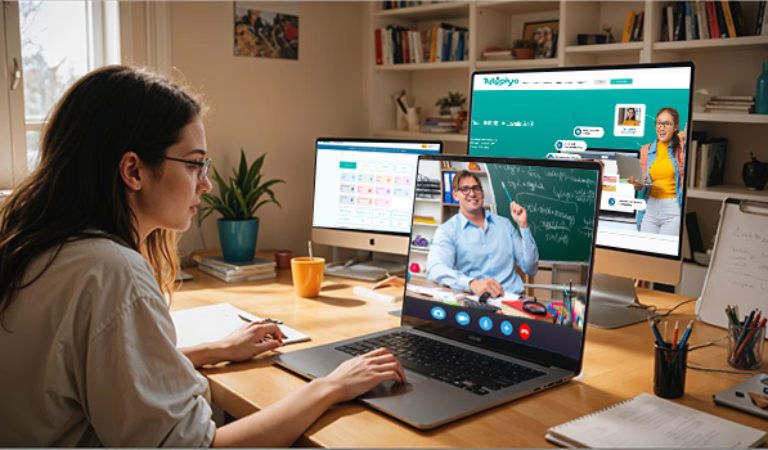
If you’re leaning toward hiring but not sure it’ll beat doing it yourself, you don’t have to guess. On the Tutopiya home tuition platform you start with a free online trial — watch how a Singapore-based tutor works with your child, at no cost and no commitment. If it clearly helps, lessons move in-person to your home; you pay by card on a monthly plan, credits are deducted only per completed lesson, and every class comes with a full report so you can see the difference against what you were doing at home.
The bottom line
Teaching your child yourself is a real, valid option — and often the right one at the lower levels when you have the time, the subject confidence and a calm study dynamic. Hire a home tutor when the subject outgrows you, time runs short, exams loom, or helping is hurting the relationship. And remember it needn’t be either/or: parent support plus a targeted tutor is frequently the smartest, most economical mix.
For more, see is home tuition worth it and the complete home tuition guide.
Curious whether a tutor would beat DIY for your child? Start with a free online trial and find out at no cost.
Frequently asked questions
Should I teach my child myself or hire a home tutor in Singapore? +
Teach your child yourself when you have the time, subject confidence and a calm dynamic at the lower levels. Hire a tutor when the subject is beyond you (A-Maths, H2 sciences), when you're short on time, or when helping strains the parent-child relationship. Many families do both — parent for daily support, tutor for the tough subjects.
Is teaching my own child cheaper than a tutor? +
In money, yes — DIY costs nothing but your time. But time has a real cost, and so does teaching a subject you're unsure of, especially against the current MOE syllabus and marking schemes. For exam years and technical subjects, a tutor often gets results faster, which can make the spend worthwhile.
Why does teaching my own child often lead to arguments? +
Because the parent-child relationship carries emotional weight that a tutor's doesn't. Frustration, high expectations and homework battles can turn study time into conflict. A neutral tutor removes that tension, which is one of the most common reasons Singapore parents switch from DIY to a home tutor.
Can I mix teaching my child myself with a tutor? +
Absolutely, and many families do. Support daily homework and revision yourself, and bring in a tutor for the specific weak subject or exam-year technique you can't cover. This keeps costs down while getting expert help exactly where it's needed.
How do I try a tutor before deciding to switch from DIY? +
Start with a free online trial so you can see how a tutor works with your child before paying anything, then move in-person if it helps. View home tutors and book a free trial here.
Written by
Tutopiya Singapore Education Desk
Singapore home tuition · PSLE, O-Level & A-Level (MOE syllabus)
The Tutopiya Singapore Education Desk covers home tuition, the MOE syllabus and exam preparation for Singapore families — from PSLE through the GCE O-Level and A-Level.
Related Articles
A-Level Project Work (PW) Home Tuition in Singapore
Project Work (PW) tuition in Singapore helps JC students structure research, the written report and the oral presentation - a tutor guides the work without doing it for them.

Assessment Books vs Home Tuition in Singapore
Assessment books vs tuition in Singapore - when the ten-year-series and self-study is enough, when a home tutor is worth it, and how to combine both effectively.

DSA Preparation with Home Tuition in Singapore
How Direct School Admission (DSA-Sec and DSA-JC) works in Singapore, what tuition can and cannot do, and how a home tutor supports the academic and portfolio side.