
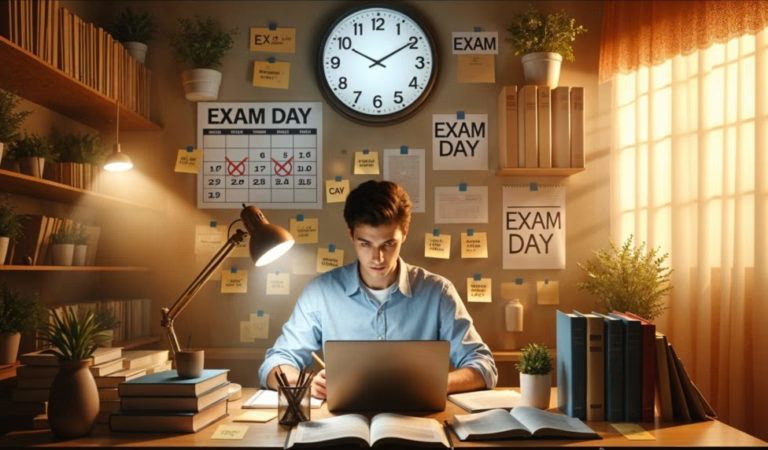
Assessment Books vs Home Tuition in Singapore
Quick answer: The assessment books vs tuition decision comes down to one question: does your child need more practice, or better understanding? Assessment books and the ten-year-series are excellent, low-cost practice for a child who already grasps the concepts. A home tutor is worth it when your child keeps repeating the same mistakes, cannot explain their working, or freezes on unfamiliar questions - because a book cannot diagnose why.
Every Singapore parent has a shelf of assessment books. They are cheap, plentiful and align with the MOE syllabus, so they feel like the obvious first move. Often they are the right one. But piling on more books rarely rescues a child who has misunderstood something at the root. Below is an honest look at when each works, and how to combine them.
Assessment books vs tuition: what each is good at
| Factor | Assessment books / self-study | Home tuition (1-to-1) |
|---|---|---|
| Cost | Low - a few dollars per book | Higher - per hour |
| Best for | Practice, drilling, exam familiarity | Diagnosis, technique, closing real gaps |
| Feedback | Only as good as the worked solutions | Instant, personalised correction |
| Motivation | Relies on the child’s self-discipline | Tutor keeps momentum and accountability |
| Diagnosis | None - the book cannot see the mistake | Tutor pinpoints where marks are lost |
| Works when | Child understands but needs reps | Child is stuck, anxious, or plateaued |
When assessment books are enough
For many children, especially in lower primary and for topics they already understand, self-study with good books is genuinely sufficient.
- The concept is solid, the child just needs reps. More timed practice builds speed and confidence.
- Your child self-marks honestly and learns from the worked solutions.
- You are close to the exam and want past-year exposure - the ten-year-series is built exactly for this.
- Budget is tight and the gap is small.
The key is quality, not quantity. A topical book with clear worked solutions beats three thick books with answer keys that only show the final number. Match every book to the current MOE syllabus and your child’s exact level.
When a home tutor is worth it
Books have one hard limit: they cannot see your child make a mistake, so they cannot tell you why it happened. That is where 1-to-1 home tuition earns its cost.
- The same errors keep recurring despite pages of practice - a sign the underlying concept is wrong, not the effort.
- Your child cannot explain their working, only guess at answers.
- They freeze on unfamiliar or multi-step questions - technique, not content, is the gap.
- Marks have plateaued no matter how many books you buy.
- Motivation has collapsed and no amount of self-study happens without a fight.
A tutor diagnoses the root cause in one focused session, something an assessment book will never do across a hundred pages.
The smartest approach: combine both
For most families the best value is not one or the other - it is using them together, with each doing what it does best.
The tutor diagnoses the gaps and teaches technique; assessment books do the drilling between lessons. Your child practises targeted pages the tutor assigns, brings the marked work back, and the tutor corrects the misunderstandings. Because self-study fills the volume, you buy fewer tutor hours - the diagnosis and marking come from the tutor, the reps come from the book.
If you decide to bring in a tutor, the low-risk way to test whether the problem is practice or understanding is Tutopiya’s hybrid home tuition: you start with a free online trial to meet a matched, Singapore-based tutor and see whether they can pinpoint what the books have been missing. If it is a good fit, lessons move in-person to your home, you pay by card on a monthly plan (no cash), credits are deducted only per completed lesson, and you get a full report of every class - so you can see the diagnosis and the plan, not just hope.
How to decide this term
- Watch how your child fails. Careless slips on known topics point to more practice; blank stares or repeated conceptual errors point to a tutor.
- Check the marking. If nobody is correcting the mistakes properly, more books will not help - fix the feedback first.
- Start cheap, escalate if stuck. Try targeted assessment books first. If marks stay flat after a few weeks, that is your signal to bring in a tutor.
- Weigh total spend. A few tutor hours plus books can beat endless books that never move the grade. For real market rates, see the home tuition cost guide.
The bottom line
Assessment books vs tuition is rarely a straight either-or. Books are unbeatable value for a child who understands the material and needs reps, and the ten-year-series is essential exam preparation. But a book cannot diagnose, correct or motivate - and when those are the missing pieces, a tutor moves a child faster than any amount of self-study. The families who spend well use both: the tutor for understanding, the books for practice. For the full picture across levels, see our complete guide to home tuition in Singapore.
Not sure if it is practice or understanding? Start with a free online trial and let a matched Singapore-based tutor diagnose it before you pay anything.
Frequently asked questions
Are assessment books enough, or does my child need a home tutor? +
It depends on the gap. If your child understands the concepts and just needs practice, assessment books and the ten-year-series are often enough. If they keep making the same mistakes, cannot explain their working, or freeze on unfamiliar questions, a tutor who can diagnose the root cause usually helps more than another workbook.
Which assessment books are best for PSLE and O-Level? +
There is no single best brand. Choose topical books for building weak areas and the ten-year-series (past-year papers) for timed exam practice closer to the exam. Match the book to the current MOE syllabus and your child's exact level, and prioritise quality worked solutions over the number of questions.
Can assessment books and home tuition work together? +
Yes, and this is often the most cost-effective approach. A tutor diagnoses the gaps and teaches technique, then assigns targeted pages from assessment books as practice between lessons. The books do the drilling; the tutor does the diagnosis and marking. You buy fewer tutor hours because self-study fills the gaps.
Why does my child do assessment books but marks do not improve? +
Usually because the mistakes are never corrected properly. Working through pages without accurate marking and feedback repeats the same errors. Improvement comes from understanding why an answer was wrong, not from volume. This is exactly where a tutor or good worked solutions makes the difference.
How do I try a home tutor before buying more assessment books? +
Start with a free online trial lesson to meet a matched Singapore-based tutor and see whether the problem is practice or understanding. If it is a good fit, lessons move in-person and you pay by card per completed lesson. View home tutors and book a free trial here.
Written by
Tutopiya Singapore Education Desk
Singapore home tuition - PSLE, O-Level & A-Level (MOE syllabus)
The Tutopiya Singapore Education Desk covers home tuition, the MOE syllabus and exam preparation for Singapore families - from PSLE through the GCE O-Level and A-Level.
Related Articles
A-Level Project Work (PW) Home Tuition in Singapore
Project Work (PW) tuition in Singapore helps JC students structure research, the written report and the oral presentation - a tutor guides the work without doing it for them.

DSA Preparation with Home Tuition in Singapore
How Direct School Admission (DSA-Sec and DSA-JC) works in Singapore, what tuition can and cannot do, and how a home tutor supports the academic and portfolio side.

H1 Economics Home Tuition in Singapore (A-Level)
H1 Economics home tuition in Singapore helps JC1-JC2 students master microeconomics, macroeconomics and case-study and essay technique under the MOE syllabus. See how it works.