

1-to-1 vs Small Group Tuition in Singapore: Which to Choose?
Quick answer: The 1-to-1 vs small group tuition decision balances undivided attention against cost. 1-to-1 tuition puts 100% of the lesson on your child — best for struggling students, specific gaps, or exam-year technique. Small group tuition (2–4 students) splits the fee, so it’s cheaper and adds discussion and peer motivation — best for confident learners who don’t need a fully tailored pace.
This is a finer choice than home-versus-centre — both formats can be excellent, and a good small group sits much closer to 1-to-1 than a big class does. Here’s how to tell which one fits your child.
1-to-1 vs small group tuition: side-by-side
| Factor | 1-to-1 tuition | Small group (2–4 students) |
|---|---|---|
| Attention | 100% on your child | Shared, but still fairly close |
| Pace | Fully tailored | Tailored to the group, with some flex |
| Cost per student | Higher | Lower (fee split across the group) |
| Peer discussion | None | Yes — questions and ideas from peers |
| Question response | Instant, private | Quick, but shared with others |
| Best for | Struggling, specific gaps, exam technique | Confident, discussion-driven learners |
| Distraction risk | Very low | Low if the group is well-matched |
When a small group is the sweet spot
A well-run small group of 2–4 is genuinely underrated — it keeps much of the individual attention while adding things 1-to-1 can’t.
- Peer discussion sharpens thinking. Hearing another student’s question or approach can unlock understanding.
- Healthy benchmarking. Confident students often push harder when they can gauge their standing.
- Lower cost. Splitting the fee across a few students makes consistent coaching more affordable.
- Less pressure. Some children freeze under the full glare of 1-to-1 and relax in a small group.
The catch is matching: a small group only works if the students are close in ability and pace. A mismatched group quietly recreates the problems of a large class.
When 1-to-1 is worth the premium
For students who need precision, 1-to-1 tuition is the clear winner.
- The whole lesson targets one child’s gaps — nothing is spent on material they already know.
- Foundations can be rebuilt without holding anyone up.
- Exam-year technique — P6, Sec 4/5, JC2 — gets the individual marking-scheme coaching that moves borderline grades.
- Shy or anxious children ask freely with no audience.
If your child is genuinely behind or has stubborn misconceptions, the extra cost of 1-to-1 usually pays for itself in faster progress.
The value calculation
Small group is cheaper per student, but the honest measure is cost to reach the target grade. In a group of four, your child gets roughly a quarter of the tutor’s focus; if they need more than that, the “cheaper” option can take longer overall. Weigh total spend against pace — our home tuition cost guide sets out the 2026 ranges.
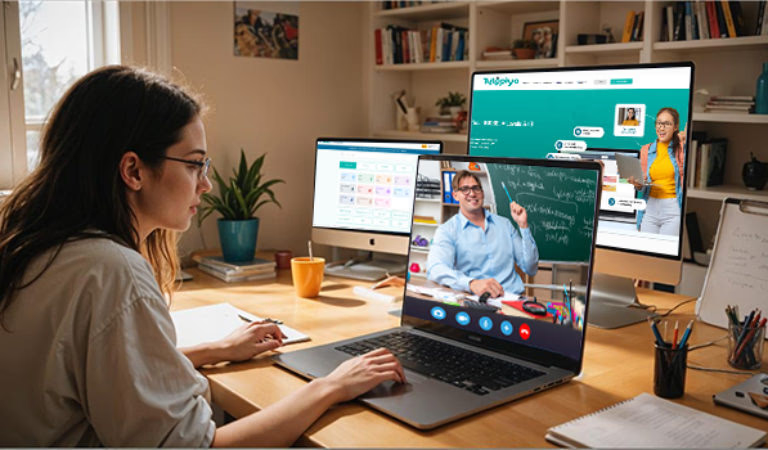
If you land on 1-to-1, the delivery model matters as much as the format. Tutopiya’s hybrid home tuition lets you meet a matched Singapore-based tutor in a free online trial first, then move lessons in-person to your home. You pay by card on a monthly plan, credits are deducted only per completed lesson, and you get a full report of every class — so undivided attention comes with real accountability, not monthly cash.
How to decide
- Diagnose the need. Specific gaps or exam technique → 1-to-1. Confident and discussion-driven → small group.
- Confirm the group size and match. A true 2–4 group of similar-ability students; anything larger dilutes fast.
- Compare total cost, not per-hour price. More focused hours can beat more shared ones.
- Trial either format first. A free trial shows fit better than any description.
The bottom line
1-to-1 vs small group tuition comes down to how much tailored attention your child needs. A well-matched small group is a strong, affordable middle ground for confident learners; 1-to-1 is worth the premium for struggling students and exam-year precision. For the wider comparison against centres and online, see our complete guide to home tuition in Singapore or our take on home tuition vs group tuition.
Leaning towards 1-to-1? Start with a free online trial and meet a matched Singapore-based tutor before you pay anything.
Frequently asked questions
Is 1-to-1 tuition better than small group tuition? +
For a child who needs a fully tailored pace, close attention or exam-year technique, 1-to-1 tuition is better because 100% of the lesson targets their gaps. For a confident child who benefits from discussion and peer benchmarking — and where budget matters — a well-run small group of 3–4 can deliver most of the benefit at a lower cost.
How big is a 'small group' in Singapore tuition? +
A genuine small group is usually 2–4 students, occasionally up to 6. Beyond that, it starts behaving like a normal class and the individual attention drops sharply. Always confirm the exact maximum class size before you enrol — 'small group' is used loosely by some providers.
Is small group tuition much cheaper than 1-to-1? +
Yes — small group splits the tutor's fee across students, so per-student cost is lower than 1-to-1. The saving is real, but weigh it against attention: in a group of four, your child gets roughly a quarter of the tutor's focus. See our cost guide for 2026 ranges.
Which is better for a struggling student? +
For a child who is genuinely behind or has specific misconceptions, 1-to-1 tuition almost always works better. The tutor can stop, diagnose and rebuild foundations without holding up other students — something a small group can only do to a limited extent.
How can I try 1-to-1 tuition risk-free? +
Book a free online trial with a matched Singapore-based tutor and watch them teach your child one-to-one — no payment, no commitment. If it's a good fit, enrol in a monthly plan and lessons move in-person to your home. View home tutors and book a free trial here.
Written by
Tutopiya Singapore Education Desk
Singapore home tuition · PSLE, O-Level & A-Level (MOE syllabus)
The Tutopiya Singapore Education Desk covers home tuition, the MOE syllabus and exam preparation for Singapore families — from PSLE through the GCE O-Level and A-Level.
Related Articles
A-Level Project Work (PW) Home Tuition in Singapore
Project Work (PW) tuition in Singapore helps JC students structure research, the written report and the oral presentation - a tutor guides the work without doing it for them.

Assessment Books vs Home Tuition in Singapore
Assessment books vs tuition in Singapore - when the ten-year-series and self-study is enough, when a home tutor is worth it, and how to combine both effectively.

DSA Preparation with Home Tuition in Singapore
How Direct School Admission (DSA-Sec and DSA-JC) works in Singapore, what tuition can and cannot do, and how a home tutor supports the academic and portfolio side.