

Unveiling the Secrets of Specialized Plant Cell Structure and Functions! | Cambridge IGCSE Biology
Unveiling the Secrets of Specialized Plant Cell Structure and Functions
In one of the previous videos, we learned about the basic plant cell and the structures in a typical plant cell.
Prefer watching? Catch the full explanation in the video below.
https://www.youtube.com/watch?v=ELDMFG17neU
What are Specialized Plant Cells?
Specialized plant cells have specific functions and adaptations suited to their roles. Here, we’ll explore three types of specialized plant cells:
1. Root hair cells found in the roots of plants
2. Xylem vessels which are part of the xylem tissue
3. Palisade mesophyll cells which are found in leaves
1. Root Hair Cells
Root hair cells are located in the roots and are specialized for absorbing water and mineral ions.
Unique Adaptations of Root Hair Cells:
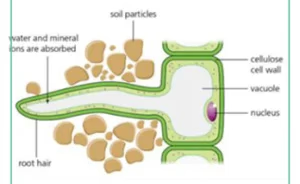
Root Hair Extension:
-
- Increases the cell’s surface area, ensuring maximum absorption.
Thin Cell Walls:
-
- Facilitates easy diffusion of water into the cells.
Lack of Chloroplasts:
-
- Since they are underground and do not photosynthesize, they don’t need chloroplasts.
2. Xylem Vessels
Xylem vessels transport water up the plant from the roots to the leaves.
Unique Adaptations of Xylem Vessels:
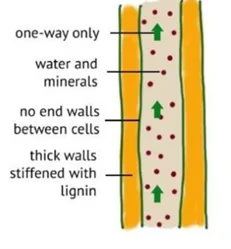
Continuous Column:
-
- Stacked cells with no top and bottom walls for uninterrupted water flow.
Hollow Dead Cells:
-
- Lack of organelles and cytoplasm ensures an unobstructed path for water.
Thickened Cell Walls with Lignin:
-
- Lignin increases cell wall rigidity and aids in mineral transport.
3. The Palisade Mesophyll Cell
Palisade mesophyll cells are found in the leaves and are crucial for photosynthesis.
Unique Adaptations of Palisade Mesophyll Cells:
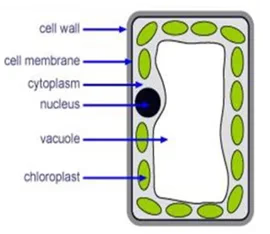
Packed with Chloroplasts:
-
- Maximizes photosynthesis.
Column-Shaped:
-
- Ensures maximum absorption of sunlight.
Revising Specialized Plant Cell Structure and Functions
This topic relies heavily on diagrams. Draw and label each part carefully. Before exams, quickly review them and refer to the functions of these cells.
Some questions on specialised plant cells and their functions can be found here as well, and you can time your answers to see if you can stick to the time limit given.
If you are struggling with IGCSE revision or Biology in particular, you can reach out to us at Tutopiya to join revision sessions or find yourself the right tutor for you.
Attempt the quiz to know where you stand!
Ready to Excel in Your Studies?
Get personalised help from Tutopiya's expert tutors. Whether it's IGCSE, IB, A-Levels, or any other curriculum — we match you with the perfect tutor and your first session is free.
Book Your Free TrialWritten by
Tutopiya Team
Educational Expert
Related Articles

A Level Remarks & Resits 2026: Cambridge & Edexcel IAL — Is It Worth It?
Cambridge International A Level and Edexcel IAL remark and resit options for 2026. Deadlines, process, whether your grade can go down, and how to decide between a remark and a resit.

International A Level Results Day 2026: What to Do Next (Cambridge & Edexcel IAL)
Cambridge International A Level (11 Aug) and Edexcel IAL (13 Aug) 2026 results are out. What to do next — UCAS Track, Clearing, Adjustment, and options if results weren't what you hoped for.

Cambridge Textbook vs Interactive Learning: Which Improves Exam Scores?
Cambridge Textbook vs Interactive Learning: Which Improves Exam Scores? — a practical, in-depth guide for IGCSE families comparing IGCSE textbook PDF / Cambridge textbook PDF downloads with Tutopiya’s Learning Portal (as low as SGD 84/year (~SGD 7/month)).