
University of the West of England, Bristol – University Guide for GCC and Southeast Asian Students
Overview
The University of the West of England, Bristol (commonly UWE Bristol) is a large, modern, applied UK university that can be a strong option for international students who want practical degrees, good facilities and life in one of England’s most popular student cities — without the ultra-selective entry bar or higher fees of the University of Bristol.
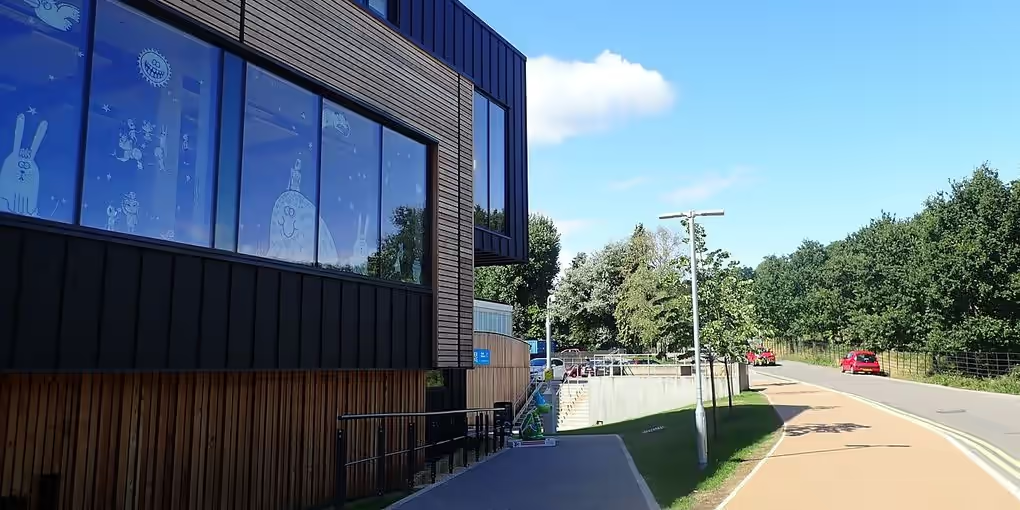
UWE’s main teaching base is the Frenchay campus on the northern edge of Bristol, complemented by city-centre sites for selected programmes. For families from the GCC and Southeast Asia, UWE is often shortlisted for its applied strengths in business, engineering, computing, film and media, health and architecture, combined with Bristol’s vibrant culture and lower prestige-driven pressure than Russell Group alternatives.
Families usually consider UWE less for elite branding and more for:
- Applied, industry-linked teaching and placement options
- A competitive international fee band (typically mid-£15k–£18k — always confirm the course page)
- Life in Bristol — a creative, multicultural city with strong graduate employment markets
- Strong value relative to the University of Bristol on cost and entry competitiveness
If your family is comparing UK options on applied value, city lifestyle and employability, UWE Bristol deserves a serious look.
Rankings snapshot (latest major league tables)
UWE Bristol is not typically selected as a prestige-first destination in the way families might approach the University of Bristol, Oxbridge or the strongest Russell Group names. Its positioning is more about applied teaching, student experience and professional pathways.
In recent major league tables:
- UK league tables: Commonly in the broader UK top 50–80 range depending on the table and year
- Global rankings: In the broader mid-ranked international band rather than the very top global tier
- Teaching and employability: UWE often performs relatively well in student satisfaction and graduate employment categories for a modern applied university
Practical takeaway for parents: UWE will not match the University of Bristol for prestige signalling — but that gap does not automatically mean a weaker student experience. Subject fit, placements, fees and Bristol city life often matter more at this level of university.
Popular degrees for GCC and Southeast Asian students
UWE offers a wide portfolio across its faculties. For students from the Gulf and Southeast Asia, interest tends to cluster around professionally oriented and creative-technical degrees.
Particularly strong and popular for
- Business and management — including marketing, accounting, finance and international business pathways
- Engineering — civil, mechanical, aerospace and related applied routes with industry links
- Computer Science / IT / computing-related programmes — popular with students targeting tech careers
- Film, media and creative industries — practical production and media programmes with strong facilities
- Health and allied health subjects — nursing and related professional routes
- Architecture and built environment — practical, professionally oriented study with portfolio requirements
Less commonly chosen (from this region)
- Pure prestige-signalling routes where families want the strongest brand recognition first
- Some niche humanities or highly research-led programmes better served by traditional research universities
Why these courses appeal to GCC and SEA families
Many families from these regions value:
- Clear links between the degree and employability
- Applied teaching with placement or industry project options
- Bristol’s creative, multicultural city lifestyle
- Lower tuition than many London or elite southern universities (confirm course pages)
- Professional accreditation or portfolio-building where relevant
Campus type and location
- City: Bristol, south-west England
- Main campus: Frenchay — large modern campus on the northern edge of the city
- Additional sites: City-centre locations for selected programmes (e.g. creative and some professional courses)
- Type: Modern applied university with a mix of campus and city-integrated teaching
Bristol is one of the UK’s most popular student cities — known for its music scene, harbour, creative industries and multicultural communities. UWE’s Frenchay campus offers a self-contained study base with good facilities, while selected programmes benefit from city-centre proximity.
Why location matters for international families
Bristol gives students:
- A vibrant, creative city with strong graduate employment markets
- Lower living costs than London (though higher than northern England)
- Good transport links to London, Cardiff and the south-west
- A multicultural environment with established Middle Eastern, South Asian and Southeast Asian communities
For many GCC and Southeast Asian families, UWE offers Bristol city lifestyle at a more accessible cost and entry level than the University of Bristol — but families should budget for southern England living costs.
Student demographic and culture
UWE has a large and notably international community — typically around 30,000+ students, with learners from many countries worldwide.
The culture tends to feel:
- Practical and career-oriented
- Diverse and internationally minded
- Modern and facility-focused
- Less prestige-driven than the University of Bristol or elite Russell Group names
That can suit students who want applied learning in a lively city without the intensity of ultra-selective entry.
Male to female balance
Balanced overall, with subject-level differences:
- Some engineering/computing cohorts lean more male
- Nursing, media and some business programmes are often more mixed or female-leaning
- Architecture cohorts are often relatively balanced
Who tends to thrive at UWE Bristol
Students who usually do well here are those who:
- Prefer applied learning and clear career pathways
- Want strong engineering, computing, media or health routes
- Enjoy Bristol’s creative, multicultural city lifestyle
- Value fees and entry competitiveness over elite prestige branding
Students whose main priority is the strongest possible prestige signal — especially the University of Bristol brand — may be happier aiming for Russell Group alternatives or using UWE as a solid plan B.
Accommodation options
UWE offers a range of university-managed accommodation on and near the Frenchay campus and in Bristol, with options such as:
- Standard single rooms
- En-suite rooms
- Studio options
- Shared flats in purpose-built student blocks
Bills are often included in hall contracts. Bristol accommodation costs are typically moderate for southern England — higher than the north, but generally below London.
Cost and budgeting notes for international families
Living in Bristol requires careful budgeting, but is usually more manageable than London. Families should plan for:
- Accommodation for the academic year
- Food, transport and personal expenses
- Occasional travel to London or other UK cities
- Visa-related living-cost evidence requirements (outside-London threshold applies)
For tuition figures, deposits and scholarships, see Fee structure below.
Fee structure
For GCC and Southeast Asian families, UWE Bristol is often positioned in a competitive mid-tier fee band — typically in the mid-£15,000–£18,000 range for international undergraduates, though exact figures vary by course and year. Always confirm the latest figures on the official course page and offer letter.
International tuition fees (indicative — confirm course pages)
| Level | Typical annual tuition |
|---|---|
| Undergraduate (international) | Commonly in the £15,000–£18,000 band depending on programme |
| Postgraduate taught | Often in a similar or slightly higher band by subject — confirm the course page |
| Postgraduate research | More variable by school — check the specific programme |
Useful points for parents:
- UWE’s fee structure is course-specific — engineering, health and some creative programmes may sit at different points within the band.
- Always use the exact course page fee for budgeting, not a generic university average.
- Compare net cost against the University of Bristol and London alternatives — UWE is often meaningfully cheaper on tuition.
Deposit, CAS and payment timing
If a student needs a CAS (Confirmation of Acceptance for Studies) for a UK Student Visa, UWE typically requires a deposit after an offer is accepted. That deposit usually counts toward the first year’s tuition.
Families should plan for:
- Offer received (conditional or unconditional)
- Deposit payment by the deadline stated in the offer
- CAS issued for the visa application
- Remaining tuition paid according to university payment options
Scholarships and fee reductions (high-level)
UWE commonly offers international scholarship and discount routes. Typical examples families should ask about include:
- Merit-based international scholarships (amounts often vary by academic profile)
- Regional or country-specific awards where advertised for a given intake
- Early deposit or payment discounts where published
Practical tip: scholarship eligibility and deadlines change by intake. Treat published ranges as planning guides, then confirm what appears in the student’s offer and scholarship communications.
Living costs beyond tuition
As an outside-London university, UK Student Visa financial evidence requirements are lower than for London courses, but Bristol living costs are still southern England norms. Families should budget separately for:
- On-campus or private accommodation in Bristol
- Food and daily expenses
- Local transport and travel
- Books, equipment or portfolio materials (especially for media, film and architecture)
- Flights and arrival costs
Admission procedure
UWE’s admissions process is relatively accessible compared with the University of Bristol or other ultra-selective institutions, but families still need to plan early — especially around English language evidence, portfolio submission (for creative/architecture routes), deposit timing and visas.
Undergraduate applications
Most international undergraduate applicants apply through:
- UCAS (common route for Year 1 entry), and/or
- University/international application channels or approved in-country representatives
Typical requirements include:
- Completion of around 12 years of schooling with a school-leaving qualification equivalent to UK A Levels (or accepted national equivalents from GCC/SEA systems)
- Meeting the course-specific academic requirements (subject grades matter for competitive programmes)
- A personal statement and supporting documents
- Portfolio for architecture, film and selected creative routes where specified
- English language evidence where needed
English language for many undergraduate courses is commonly around IELTS 6.0 overall (often with no band below 5.5), though health and some professional courses may ask for higher scores. Always check the exact course page.
Postgraduate applications
Postgraduate taught applications are usually made directly to the university via the course page or through approved representatives.
Typical requirements include:
- A relevant bachelor’s degree at a level broadly equivalent to a UK second-class honours degree
- Academic transcripts and degree certificate
- Personal statement / CV where requested
- References (often academic)
- English language evidence — commonly around IELTS 6.0–6.5, with higher requirements for some programmes
- Portfolio, interview or additional checks for selected creative, health or professional courses
Step-by-step pathway for international families
- Shortlist the course — confirm entry requirements, fees, intake month and any placement year option.
- Prepare academics and English — strengthen IGCSE/A Level (or equivalent) profiles early; book IELTS/accepted alternatives if needed.
- Submit the application — via UCAS for many undergraduate routes, or direct/representative routes for postgraduate.
- Receive an offer — conditional (e.g. pending grades/English) or unconditional.
- Accept the offer and pay the deposit — required for CAS in most visa cases.
- Receive CAS and apply for the Student Visa — usually no earlier than six months before the course start date.
- Arrange accommodation and arrival — university-managed halls at Frenchay are often the simplest first-year option.
Intakes and timing
- September is the main intake for most undergraduate and postgraduate programmes.
- Selected postgraduate courses may also offer January intakes — check the course page.
- Undergraduate UCAS timelines: equal-consideration deadlines are usually in January for September entry, with later applications possible subject to availability.
Documents checklist (typical)
- Academic transcripts and certificates
- Passport copy
- Personal statement
- Reference(s)
- English language test results (if required)
- Portfolio / CV / ATAS certificate only where the course asks for them
For GCC and SEA applicants: national curriculum results are assessed against UWE equivalency guidance. If grades fall short of direct entry, pathway or foundation programmes may be available — useful as a structured alternative rather than forcing an unrealistic first-choice offer.
Academic intensity and social life
Academic expectations are serious — especially on engineering, health and professionally accredited courses — but the overall atmosphere is practical and supportive rather than intensely competitive.
What students can expect:
- Teaching that emphasises applied skills, real-world projects and employability
- Access to modern specialist facilities (engineering labs, media production suites, health simulation environments and architecture studios)
- A mix of campus-based study at Frenchay and city-centre exposure for selected programmes
- Bristol’s rich social and cultural scene beyond campus boundaries
Social life in practice
UWE students benefit from Bristol’s reputation as a creative, music-focused, multicultural city. Social life blends campus societies with the wider city — harbour-side venues, festivals and a strong independent culture. London is around 1.5 hours by train for optional industry exposure.
Sports, societies and wider profile
UWE offers a broad mix of clubs and societies — typically including cultural societies, academic societies, faith groups, creative clubs and sports teams.
The wider profile is that of a large modern applied university in a popular student city:
- Strong on inclusion and international student life
- Practical and career-focused rather than traditional collegiate
- Good sports facilities and active student union programming
- Lower prestige profile than the University of Bristol but strong applied value
For GCC and SEA students, cultural and regional societies can be especially useful in the first term for settling in, finding community and building support networks quickly.
Careers and employer reputation
UWE’s clearest selling point is applied professional training in a strong graduate employment market. Bristol has growing tech, creative, engineering and health sectors, and UWE courses are frequently designed with industry input and placement options.
Where UWE Bristol can be especially sensible
- Students targeting business, engineering, computing, film/media, health or architecture pathways
- Families who want Bristol city lifestyle at lower cost and entry competitiveness than the University of Bristol
- Applicants who value hands-on learning and professional readiness as much as league-table rank
- Students who may use London access for internships while living in a more affordable city
Where families should be realistic
UWE will not carry the same brand weight as the University of Bristol or top Russell Group names in prestige-driven markets. That does not mean weak outcomes — it does mean families should evaluate:
- The specific course reputation and accreditation
- Placement opportunities where offered
- Portfolio/professional requirements (especially for media and architecture)
- Post-study work goals and location preferences
Used well, UWE can be an excellent “Bristol lifestyle + applied courses + value” choice rather than a prestige-first choice.
Who should shortlist UWE Bristol?
Consider shortlisting UWE Bristol if your child:
- Wants a UK degree with applied, career-facing programmes in a vibrant city
- Is interested in business, engineering, computing, film/media, health or architecture
- Prefers lower tuition and entry competitiveness than the University of Bristol
- Values Bristol’s creative, multicultural city lifestyle
- Is comfortable with a modern applied university rather than a traditional prestige brand
Consider other options first if your child:
- Needs the strongest possible prestige signal — especially the University of Bristol or Russell Group brand
- Is aiming for ultra-selective research universities as a non-negotiable first choice
- Needs the lowest possible living costs in the UK
- Is primarily motivated by top-tier global ranking bands rather than applied value
How Tutopiya helps
Tutopiya works with students aiming for UWE Bristol and other UK universities by:
- Strengthening grades in IGCSE and International A-Level subjects that matter for entry
- Building competitive academic profiles early enough for realistic university shortlists
- Preparing for admissions tests, English language goals, portfolios and interviews where relevant
- Helping families understand fees, deposits, scholarships and application timelines
- Providing reference letters for Tutopiya tutoring and homeschooling students to support university applications
- Offering unpaid internship opportunities that help students build practical experience for stronger applications
- Providing university counselling that weighs ranking, cost, course fit, location and progression honestly — including comparing UWE Bristol with the University of Bristol
If you’d like tailored advice for your child’s situation, you can talk to Tutopiya’s team about a joined-up plan covering both exam preparation and university admissions.
🎓 Free tool
Build your personalised shortlist for University of the West of England, Bristol →
See entry requirements matched to your own grades, tuition, deadlines and reach/target/safety tiering — free, no signup needed to browse.
Ready to Excel in Your Studies?
Get personalised help from Tutopiya's expert tutors. Whether it's IGCSE, IB, A-Levels, or any other curriculum — we match you with the perfect tutor and your first session is free.
Book Your Free TrialWritten by
Tutopiya Team
Related Articles

Heriot-Watt University Dubai – University Guide for GCC and Southeast Asian Students
Detailed guidance for international students from the Gulf and Southeast Asia considering Heriot-Watt University Dubai, including fees, admissions, campus life, accommodation and graduate outcomes.

University of Birmingham Dubai – University Guide for GCC and Southeast Asian Students
Detailed guidance for international students from the Gulf and Southeast Asia considering University of Birmingham Dubai, including fees, admissions, campus life, accommodation and graduate outcomes.

Abu Dhabi University – University Guide for GCC and Southeast Asian Students
Detailed guidance for international students from the Gulf and Southeast Asia considering Abu Dhabi University (ADU), including fees, admissions, campus life, accommodation and graduate outcomes.