
University of Queensland – University Guide for GCC and Southeast Asian Students
Overview
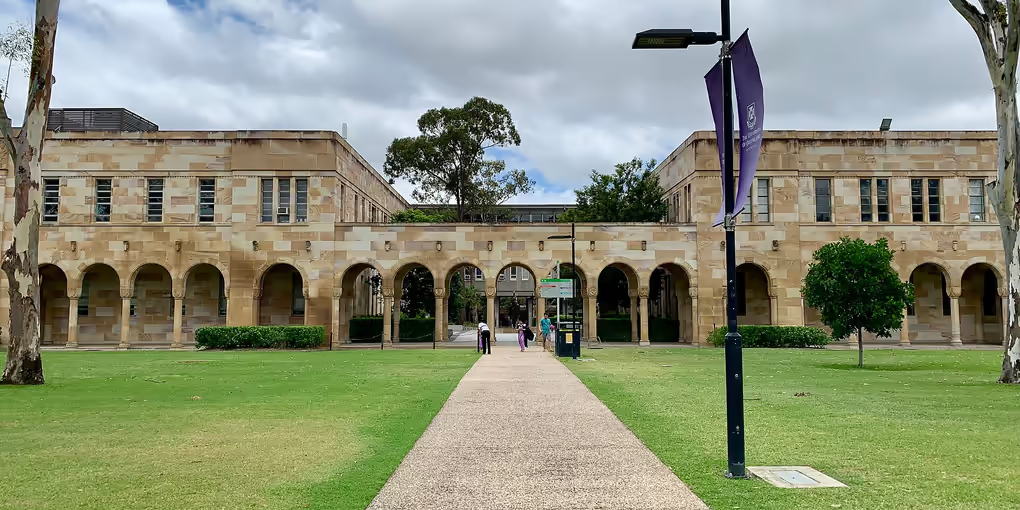
The University of Queensland (UQ) is one of Australia’s founding Group of Eight research universities, and its main St Lucia campus — a bend of the Brisbane River lined with jacaranda trees and sandstone cloisters around the Great Court — is regularly rated one of the most attractive university settings in the country. For GCC and Southeast Asian families, UQ tends to sit in a sweet spot: genuine global research strength, a warmer subtropical climate than the southern capitals, and a growing, increasingly liveable city that is investing heavily ahead of the 2032 Brisbane Olympics.
UQ ranks #42 in the QS World University Rankings 2026 and is internationally known for:
- Biomedical science and biotechnology — home to the Institute for Molecular Bioscience and a strong pipeline into medicine, dentistry and research careers
- Engineering — particularly civil, chemical, mining and mechatronic engineering, with close ties to Queensland’s resources and infrastructure sectors
- UQ Business School — AACSB and EQUIS accredited, with well-regarded undergraduate commerce and MBA programmes
- Law — a long-standing, highly regarded law school with strong bar admission outcomes
- Veterinary science — taught partly at UQ’s dedicated Gatton campus, one of the few full veterinary degrees in the region
- International tuition typically in the A$35,000–A$55,000 band per year depending on the programme (always confirm the exact figure on the official course page)
Families looking for a large, research-intensive Go8 university in a genuinely pleasant, growing subtropical city — without the cost intensity of Sydney or Melbourne — tend to find UQ a strong contender.
Rankings snapshot (latest major league tables)
UQ’s overall position of #42 globally (QS 2026) understates how strong specific subject areas are, and families should look past the single headline number where possible:
- Biological sciences and biomedicine — consistently ranked among the world’s top 50, underpinned by major research institutes and hospital partnerships
- Chemical and mining engineering — benefiting directly from Queensland’s resources industry and long-standing employer relationships
- Law — a top-tier Australian law school by graduate outcomes and academic reputation
- Business and management — strong performance in employer reputation surveys, helped by dual AACSB/EQUIS accreditation
- Education and psychology — well-regarded, research-active schools with strong practicum partnerships across Queensland
Practical takeaway for parents: UQ’s overall ranking is a reliable general signal, but subject-level tables matter more for biomedicine, engineering and law — check the specific discipline before comparing UQ against other Go8 universities.
Popular degrees for GCC and Southeast Asian students
Particularly strong and popular for
- Biomedical Science — a well-trodden pathway into UQ’s competitive graduate-entry Doctor of Medicine
- Engineering (Civil, Chemical, Mining, Mechatronic) — degrees with direct relevance to construction, energy and infrastructure sectors back home in the GCC
- Bachelor of Commerce / Business Management — a broad, employable degree from an accredited business school
- Law (dual degrees) — commonly combined with commerce or arts for a broader career base
- Veterinary Science — taught partly at the Gatton campus, appealing to the small but committed cohort interested in this specialised path
- Architecture and design — supported by studio-based teaching and strong industry links across Queensland
Less commonly chosen (from this region)
- Marine and environmental science majors that depend on extended fieldwork away from Brisbane
- Highly specialised creative-arts production courses better served by Melbourne or Sydney’s larger media industries
- Agricultural science routes centred exclusively at the Gatton campus, for families who specifically want a city-based experience
Why these courses appeal to GCC and SEA families
- Biomedicine-to-medicine pathways are well understood and clearly documented, which matters for families planning several years ahead
- Engineering degrees map directly onto skills in demand across GCC infrastructure, energy and construction sectors
- UQ’s dual accreditation business school gives commerce graduates a recognised credential internationally
- Brisbane’s subtropical climate feels far more familiar to Gulf and Southeast Asian students than Melbourne’s cooler winters
- A large, established international student community, particularly from Southeast Asia, that eases the transition for new arrivals
Campus type and location
- City: Brisbane, Queensland
- Type: Large riverside campus (St Lucia) plus a specialist agricultural and veterinary campus at Gatton, and a health sciences precinct at Herston
- Setting: A bend of the Brisbane River, roughly 20–30 minutes from the Brisbane CBD by bus, ferry (CityCat) or car
The St Lucia campus is genuinely self-contained, with sandstone heritage buildings around the Great Court sitting alongside modern research facilities, sports fields and a working botanic precinct. The CityCat ferry service along the river is a distinctive and popular way for students to commute into the city centre.
Why location matters for international families
- Brisbane’s subtropical climate — warm for most of the year with a mild, dry winter — suits students used to Gulf or Southeast Asian weather far better than the southern capitals
- The city is undergoing a major infrastructure and liveability push ahead of the 2032 Olympics, with new transport links and development around the university precinct
- Living costs are generally lower than Sydney and comparable to or below Melbourne, a meaningful factor for total cost of study
- Brisbane is a large, easy-to-navigate city rather than a sprawling metropolis — students can reach the CBD, airport and coast without long commutes
- The Gold Coast and Sunshine Coast are both under an hour away, giving students easy access to beaches and weekend breaks
For GCC and Southeast Asian families comparing Australian cities, Brisbane offers a genuinely practical middle ground: a real Go8 university experience without Sydney or Melbourne’s cost intensity.
Student demographic and culture
UQ enrols around 56,000 students, with one of the larger and more established international cohorts among the Go8, drawn heavily from China, India, Southeast Asia and, increasingly, the Middle East. The culture tends to feel:
- Research-driven and academically rigorous, but with a genuinely relaxed, outdoor-oriented social atmosphere
- Supported by a large, well-resourced international student office and orientation programme
- Sports and outdoor-activity-focused, helped by Brisbane’s climate and the riverside campus
- Less formal and status-conscious than some southern Go8 campuses
Male to female balance
Varies by faculty:
- Engineering and IT cohorts remain more male-dominated, though the gap is narrowing
- Veterinary science, biomedical science and law tend to lean more female
- Business and commerce sit closer to balanced
Who tends to thrive at UQ
Students who usually do well here are those who:
- Want a genuine Go8 research university without the price tag of Sydney or Melbourne
- Are targeting biomedicine, engineering, law or business, where UQ’s reputation is particularly strong
- Prefer a warm, subtropical climate and an active, outdoor lifestyle alongside study
- Are comfortable in a large but manageable city rather than needing a global megacity
- Value a well-established international student support network from day one
Students whose priority is a dense inner-city creative industry or finance scene may find Sydney or Melbourne a better fit — but for most mainstream degree choices, Brisbane offers a highly workable and comfortable alternative.
Accommodation options
UQ operates several residential colleges and university-affiliated accommodation around St Lucia, alongside a large private rental market in nearby suburbs. Typical arrangements include:
- Traditional residential colleges with meal plans and a strong pastoral and social community
- Self-catered UQ-affiliated apartment-style accommodation
- Private shared housing in suburbs such as Indooroopilly, Toowong and West End, all within easy reach of campus by bus or ferry
Because Brisbane’s rental market is generally less competitive than Sydney’s, most students find suitable housing without excessive lead time — though early booking is still recommended for the first year.
Cost and budgeting notes for international families
- Overall living costs sit below Sydney and generally at or below Melbourne, a meaningful saving over a multi-year degree
- Air conditioning and lighter clothing suit Brisbane’s climate better than layered winter wear
- Public transport (bus, train, CityCat ferry) covers most student journeys affordably
- Budget for occasional weekend travel to the Gold Coast, Sunshine Coast or interstate
For tuition figures, deposits and scholarships, see Fee structure below.
Fee structure
For GCC and Southeast Asian families, UQ typically sits in the A$35,000–A$55,000 per year range for undergraduate study, with veterinary science, medicine-adjacent programmes and some engineering specialisations at the higher end. Always confirm the latest figures on the official course page and offer letter — Australian universities review international fees annually.
International tuition fees (indicative, 2026 intake)
| Level | Typical annual tuition (AUD) |
|---|---|
| Undergraduate — Arts, Business, Commerce | Commonly around A$35,000–A$42,000 per year |
| Undergraduate — Engineering, Science | Commonly around A$42,000–A$50,000 per year |
| Undergraduate — Veterinary Science | Often A$50,000–A$55,000+ per year given clinical and laboratory intensity |
| Postgraduate coursework | Generally A$38,000–A$52,000 per year depending on discipline |
Useful points for parents:
- Fees are usually quoted per year and reviewed annually, so a four-year engineering degree will typically cost somewhat more in later years than in year one.
- Laboratory- and clinic-based programmes (veterinary science, some sciences) carry materials and placement costs beyond headline tuition.
- Postgraduate research degrees (Masters by Research, PhD) are priced separately and often attract scholarship support.
Deposit, Confirmation of Enrolment (CoE) and payment timing
Once an offer is accepted, UQ requires payment of the first instalment of tuition (or a deposit, depending on the offer) before issuing a Confirmation of Enrolment (CoE) — the document required to lodge a Student visa (subclass 500) application. Since January 2025, a valid CoE must generally be attached at the time of visa lodgement, so this step cannot be left until later.
Families should plan for:
- Offer received (conditional or unconditional)
- Tuition deposit or first-instalment payment made by the stated deadline
- CoE issued and registered on Australia’s PRISMS system
- Student visa (subclass 500) application lodged with the CoE attached
- Remaining tuition settled through UQ’s semester payment options
Scholarships and fee reductions (high-level)
UQ offers a range of international scholarship routes, including:
- Merit-based international scholarships tied to academic profile (commonly a percentage reduction on tuition for high-achieving applicants)
- Faculty-specific scholarships in engineering, science and business
- Country- or region-specific entry scholarships that vary by intake — GCC and Southeast Asian applicants should check current eligibility directly
Practical tip: scholarship value and eligibility windows change by intake — treat published figures as planning guides and confirm specifics through the offer and scholarship portal.
Living costs beyond tuition
Brisbane living costs are moderate by Australian standards, but subclass 500 financial evidence requirements still apply — as of 2026 the Department of Home Affairs expects proof of at least A$29,710 in living costs for the primary applicant, in addition to tuition and travel. Families should budget separately for:
- Accommodation for the academic year
- Overseas Student Health Cover (OSHC), mandatory for the visa duration
- Food, transport and personal expenses
- Flights and arrival costs, plus occasional interstate or regional travel
Admission procedure
Undergraduate applications
Most international undergraduate applicants apply directly to UQ, either independently or through an approved education agent — there is no UCAS-style centralised system in Australia. Typical requirements include:
- A recognised secondary qualification (national GCC/SEA curricula, IB Diploma or International A Levels are all individually assessed against UQ’s entry requirements)
- Meeting the programme-specific entry standard — biomedical science, veterinary science and some engineering majors are notably more competitive
- Academic transcripts, certificates and passport details
- English language evidence where required
English language for most undergraduate courses is commonly around IELTS 6.5 overall (no band below 6.0), with some professional programmes asking for a higher score. Students who fall short of direct entry can often progress through the UQ College foundation and pathway programmes. Always check the exact course page for the intended intake.
Postgraduate applications
Postgraduate coursework applications are made directly to UQ, via the course page or an approved representative.
Typical requirements include:
- A relevant bachelor’s degree with the specified minimum GPA
- Academic transcripts and degree certificate
- Personal statement or CV where requested
- English language evidence — commonly around IELTS 6.5, higher for some professional programmes
- Additional documentation for research-based Masters or PhD applications, including a research proposal
Step-by-step pathway for international families
- Shortlist the course — check entry requirements, fees, campus (St Lucia, Gatton or Herston) and intake month.
- Strengthen academics and English early — particularly important for biomedical science, veterinary science and engineering.
- Apply directly to UQ or through an approved agent.
- Receive an offer — conditional or unconditional.
- Accept the offer and pay the tuition deposit — required to trigger CoE issuance.
- Receive the CoE and apply for the Student visa (subclass 500) — the CoE must be attached at lodgement.
- Arrange accommodation — university-affiliated colleges are the simplest first-year option.
Intakes and timing
- Semester 1 (February) is the main intake across nearly all undergraduate and most postgraduate programmes.
- Semester 2 (July) offers a genuinely broad second intake for many degrees — more flexible than most UK equivalents.
- Some foundation and pathway programmes offer additional intake points throughout the year.
Documents checklist (typical)
- Academic transcripts and certificates
- Passport copy
- Personal statement or CV (where required)
- English language test results (if required)
- Research proposal (for research Masters/PhD applicants only)
- Proof of funds where requested ahead of the formal visa application stage
For GCC and SEA applicants: national curriculum results are assessed against UQ’s published equivalency guidance. Where grades fall short of direct entry, UQ College’s foundation and diploma pathways provide a structured route into first-year study.
Academic intensity and social life
Academic demands vary noticeably by faculty. Engineering and veterinary science involve heavy laboratory and practical components alongside lectures; biomedical science combines rigorous coursework with growing research exposure; business and commerce follow a more conventional lecture-and-tutorial structure with case studies and group work.
Assessment methods also vary: expect written exams and lab reports in science and engineering, case-study assignments in business, and clinical placements in veterinary science from the later years onward.
What students can generally expect:
- Large first-year lecture cohorts that narrow into smaller tutorial and lab groups
- Genuine research exposure available even at undergraduate level through UQ’s research institutes
- A relaxed, outdoor-oriented social calendar shaped by Brisbane’s climate
- A well-organised international student support structure from orientation onward
Social life in practice
St Lucia’s riverside campus, with its own sporting fields, cafes and green spaces, means much of student life happens on or near campus rather than requiring a long commute into the city. The CityCat ferry and Brisbane’s compact CBD make weekend trips into town straightforward when students want a change of scene.
Sports, societies and wider profile
UQ’s scale and campus give its sports and societies scene real depth:
- UQ Sport operates one of the largest university sporting programmes in Australia, spanning everything from rowing on the river to Australian rules football
- A large number of cultural, faith and regional societies support the international student community, including active Gulf and Southeast Asian student associations
- UQU (UQ Union) clubs and societies cover academic, professional and hobby interests across nearly every faculty
- Strong volunteering and community programmes, popular for building a well-rounded CV
For GCC and SEA students, joining a cultural or regional student association early is one of the fastest ways to build a support network alongside the wider UQ community.
Careers and employer reputation
UQ carries genuine weight with Australian and international employers, particularly in the sectors it is best known for.
Where UQ can be especially sensible
- Students targeting biomedical science and medicine-adjacent pathways, where UQ’s research strength and graduate-entry MD programme are well recognised
- Applicants interested in engineering, given Queensland’s strong resources, energy and infrastructure employer base
- Students considering law or business, where UQ’s reputation and accreditation carry real weight with regional employers
- Families wanting a Go8 research university at a more moderate cost than Sydney or Melbourne
Where families should be realistic
Brisbane’s employer market is strong but smaller than Sydney’s for global finance, media or corporate headquarters roles. Families should evaluate:
- Whether the student’s target industry (e.g. investment banking, media) is genuinely concentrated in Brisbane or would need relocation after graduation
- How internship and work-integrated learning support works for the specific course
- Whether proximity to Queensland’s resources, health and infrastructure sectors aligns with the student’s career goals
Used well, UQ works best as a strong, research-backed Go8 choice for students targeting biomedicine, engineering, law or business, in a genuinely liveable and increasingly internationally connected city.
Who should shortlist the University of Queensland?
Consider shortlisting UQ if your child:
- Is genuinely interested in biomedical science, engineering, law, business or veterinary science
- Would benefit from a research-intensive Go8 university without Sydney or Melbourne’s cost intensity
- Prefers a warm, subtropical climate and an active outdoor lifestyle alongside study
- Wants a large but manageable city with a growing global profile ahead of 2032
- Values a well-established international and regional student community
Consider other options first if your child:
- Is specifically targeting a career concentrated in Sydney or Melbourne’s finance, media or corporate hubs
- Needs a compact, walkable inner-city campus rather than a larger riverside precinct
- Would struggle without a well-defined career-pathway plan in a highly competitive programme like veterinary science
How Tutopiya helps
Tutopiya works with students aiming for the University of Queensland and other Australian universities by:
- Strengthening grades in IGCSE, International A-Level and IB subjects relevant to entry — particularly biology, chemistry, mathematics and business
- Building competitive academic profiles early enough for realistic Go8 shortlists
- Preparing for English language goals, personal statements and applications where relevant
- Helping families understand fees, deposits, CoE issuance and Student visa (subclass 500) timelines
- Providing university counselling that weighs subject fit, city and career outcomes honestly rather than by ranking alone
- Issuing reference letters for tutoring and homeschooling students where Tutopiya has supported the student’s academic programme — useful for direct-entry applications when school references are limited or unavailable
- Connecting families with unpaid internship and work-experience opportunities (where available) to strengthen applications and personal statements before and during the admissions process
If you’d like tailored advice for your child’s situation, you can talk to Tutopiya’s team about a joined-up plan covering both exam preparation and university admissions.
🎓 Free tool
Build your personalised shortlist for University of Queensland →
See entry requirements matched to your own grades, tuition, deadlines and reach/target/safety tiering — free, no signup needed to browse.
Ready to Excel in Your Studies?
Get personalised help from Tutopiya's expert tutors. Whether it's IGCSE, IB, A-Levels, or any other curriculum — we match you with the perfect tutor and your first session is free.
Book Your Free TrialWritten by
Tutopiya Team
Related Articles

Heriot-Watt University Dubai – University Guide for GCC and Southeast Asian Students
Detailed guidance for international students from the Gulf and Southeast Asia considering Heriot-Watt University Dubai, including fees, admissions, campus life, accommodation and graduate outcomes.

University of Birmingham Dubai – University Guide for GCC and Southeast Asian Students
Detailed guidance for international students from the Gulf and Southeast Asia considering University of Birmingham Dubai, including fees, admissions, campus life, accommodation and graduate outcomes.

Abu Dhabi University – University Guide for GCC and Southeast Asian Students
Detailed guidance for international students from the Gulf and Southeast Asia considering Abu Dhabi University (ADU), including fees, admissions, campus life, accommodation and graduate outcomes.