
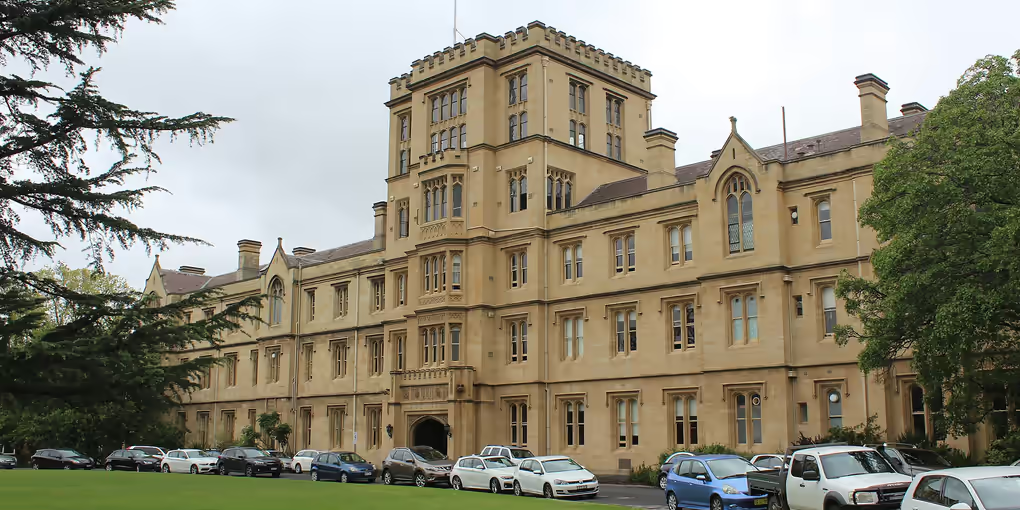
University of Divinity – University Guide for GCC and Southeast Asian Students
Overview
The University of Divinity is Melbourne’s collegiate theological university — a specialist institution of roughly 1,600 students whose teaching happens primarily through member colleges drawn from varied Christian traditions. It is not a broad-discipline Melbourne university like Monash or the University of Melbourne, and it should not be shortlisted as if it were.
For GCC and Southeast Asian families exploring faith-based higher education in Australia, Divinity tends to appeal when:
- The student wants theology, biblical studies or divinity at university award level
- Ministry, religious education or counselling pathways sit inside the intended vocation
- The family prefers a collegiate Melbourne network rather than a single denominational mega-campus
- Indicative undergraduate study often sits in a lower fee band — commonly around A$14,000–A$20,000 equivalent when calculated from per-unit charges (always confirm with the member college)
- The household is willing to check each college’s CRICOS status and overseas-student availability before lodging an application
If your child wants engineering, commerce or clinical health in Melbourne, look elsewhere. If they want serious theological study inside a diverse Christian college federation, keep reading.
Rankings snapshot (latest major league tables)
University of Divinity is rarely the subject of mainstream global ranking conversations. Quality signals are different:
- Specialist theological standing within Australian higher education for divinity and ministry awards
- Member-college reputation across Catholic, Anglican, Uniting, Baptist, Lutheran and other traditions represented in the federation
- Graduate outcomes in ministry, religious education and counselling-related roles, which matter more to sending churches than QS overall ranks
- Research and publication activity in theology that is meaningful within the field even when invisible in generalist league tables
Practical takeaway for parents: compare member colleges on academic strength, tradition, English requirements and visa eligibility. The university name alone does not describe the day-to-day student experience.
Popular degrees for GCC and Southeast Asian students
Particularly strong and popular for
- Theology and divinity — core awards for students seeking rigorous academic formation
- Biblical studies — language-aware and text-focused pathways at several colleges
- Ministry — integrative awards combining classroom theology with supervised practice
- Religious education — relevant for students aiming at Christian schooling or parish education roles
- Counselling (where offered through member colleges) — for students linking pastoral care with professional helping skills
Less commonly chosen (from this region)
- Secular STEM, business and law degrees — outside the university’s remit
- Clinical medicine, nursing or physiotherapy (choose a health university)
- Large creative-industry programmes dependent on commercial studio networks
Why these courses appeal to GCC and SEA families
- Per-unit fee structures can make full-time theology study more affordable than typical Australian international packages — when the college enrols overseas students
- Melbourne’s multicultural setting supports students from Gulf and Southeast Asian church communities
- The collegiate model lets families match tradition and spirituality more precisely than a generic university chaplaincy
- Awards remain academically serious — essays, languages and supervised practice are not light electives
- Graduates often return to church, school or counselling contexts where the college’s endorsement carries weight
Campus type and location
- City: Melbourne, Victoria (member colleges across Greater Melbourne and related sites)
- Type: Collegiate theological university — study through a member college, not one central mega-campus
- Setting: Urban and inner-suburban college sites within a large multicultural capital
Most students experience “campus” as their college library, chapel, classrooms and nearby cafes — with Melbourne’s wider city available for transport, part-time work and church networks.
Why location matters for international families
- Melbourne living costs are higher than regional Australia, even if tuition per unit looks modest
- College sites differ in commute time from CBD rental areas — map housing against the specific college
- Overseas-student enrolment is not automatic across every member college or award
- Families comparing Divinity with Australian University of Theology should note the Melbourne collegiate concentration versus a wider national affiliated-college map
For GCC and Southeast Asian students, Melbourne’s size is an advantage for community life — and a budgeting challenge if rent is underestimated.
One planning detail families often miss: intensives and block units can temporarily change commute patterns. A student who rents near one college for weekly seminars may still need short-stay arrangements or longer travel weeks when an intensive runs at another member site — check the unit timetable before signing a twelve-month lease.
Student demographic and culture
With about 1,600 students across the federation, cohorts are intimate. Culture tends to feel:
- Theologically engaged and tradition-conscious, yet more ecumenically varied than single-denomination campuses
- Adult-learner friendly — many classmates may be mature-age or already in ministry
- Academically discursive: seminars and supervised reading matter as much as large lectures
- Quieter socially than Melbourne’s large public universities, with college community carrying most of the relational load
Male to female balance
Differs by award and college tradition:
- Some ministry tracks still enrol more men in particular traditions
- Religious education and counselling-related cohorts often enrol more women
- Biblical studies and general theology can be relatively balanced depending on the college
Who tends to thrive at the University of Divinity
Students who usually do well are those who:
- Are motivated by theology, ministry, religious education or counselling, not by campus brand prestige
- Can self-manage study in a college-based rather than mega-university environment
- Are ready to verify overseas-student rules before paying deposits
- Enjoy Melbourne’s church and cultural diversity
- Can handle substantial reading and reflective writing
Students seeking a classic Australian undergraduate social scene with dozens of clubs and large lecture halls will usually feel mismatched.
Accommodation options
The University of Divinity generally does not operate like a residential undergraduate mega-campus. Housing is typically:
- Private rental or share houses near the member college
- Limited college-linked residential options where a particular college offers them
- Homestay arrangements organised privately or through community contacts in some cases
Confirm housing support with the chosen college early — availability is uneven.
Mature-age classmates who already live locally can make the housing search look deceptively easy. School-leaver internationals arriving without a local network should start earlier, ask the college for written housing guidance, and avoid signing long leases until the teaching site and intensive calendar are confirmed.
Cost and budgeting notes for international families
- Melbourne rent is the budget line that surprises families who focused only on low per-unit tuition
- Allow for tram/train travel between residence, college and placement sites
- Theology book costs and occasional residential intensives can add up
- OSHC is compulsory for subclass 500 visa holders
- Counselling or ministry placements may require checks or professional indemnity arrangements — ask early
For tuition figures, deposits and scholarships, see Fee structure below.
Fee structure
Tuition at the University of Divinity is generally charged per unit, and published rates are often similar for domestic and overseas students on the same unit — a distinctive feature versus many Australian international fee models. Full-time undergraduate study commonly works out around A$14,000–A$20,000 per year depending on load and unit mix; postgraduate taught study often lands around A$17,000–A$27,000. Always confirm current per-unit AUD prices and full-year load assumptions with the member college.
International tuition fees (indicative, 2026/27, in AUD)
| Level | Typical annual tuition (full-time equivalent) |
|---|---|
| Undergraduate theology / biblical studies / ministry | Commonly around A$14,000–A$20,000 per year |
| Postgraduate taught divinity / ministry / religious education | Often around A$17,000–A$24,000 per year |
| Counselling-related or specialised postgraduate awards | Can approach A$20,000–A$27,000 per year depending on unit mix |
Useful points for parents:
- Model fees from the unit list, not from a single headline “international package” copied from another university.
- Confirm whether intensives, supervision or placement units carry surcharges.
- Overseas enrolment permission can be more restrictive than the fee schedule itself — check both.
Deposit, CoE and payment timing
Before any deposit, ensure the selected member college and award can enrol overseas students and issue a Confirmation of Enrolment (CoE) for the Student visa (subclass 500).
When eligible:
- Offer issued for a CRICOS-registered course through the relevant provider arrangements
- Deposit or first tuition payment completed as required
- CoE issued
- Subclass 500 visa lodged
- Ongoing unit fees paid each teaching period according to college practice
Scholarships and fee reductions (high-level)
Support may include:
- Limited college bursaries for ministry candidates
- Denominational sponsorship arranged by a sending church
- Occasional academic prizes after enrolment rather than large upfront international scholarships
Practical tip: ask for a sample full-time unit load costed in AUD for the intended award and intake — that spreadsheet is more useful than a marketing range.
Living costs beyond tuition
Even with lower tuition, Melbourne living costs remain significant. Budget for:
- Rent and utilities
- Food, transport and personal expenses
- OSHC
- Books, intensives and placement travel
- Flights into Melbourne
A useful family rule of thumb: if the per-unit tuition looks attractively low, re-run the annual budget with Melbourne rent at a realistic inner-suburb rate before treating Divinity as “the cheap option.”
Also confirm whether any compulsory intensives require short-term accommodation away from the student’s usual rental — those weeks are easy to miss in a spreadsheet built only from weekly rent.
Admission procedure
Undergraduate applications
Apply directly via the relevant member college (or approved agent) for the University of Divinity award — not through UCAS.
Typical requirements include:
- Year-12-equivalent secondary education, assessed for the specific award
- English language evidence — commonly around IELTS 6.5 overall (no band below 6.0); confirm college by college
- Transcripts, passport bio page and application form
- A statement of theological or vocational interest
- References — often pastoral as well as academic for ministry awards
Postgraduate applications
Typical postgraduate requirements include:
- A recognised bachelor’s degree (theology or another field, depending on the award)
- Transcripts, CV and references
- English evidence around IELTS 6.5, sometimes higher for counselling-linked programmes
- For some awards, evidence of ministry, teaching or helping experience
Step-by-step pathway for international families
- Shortlist member colleges by Christian tradition, Melbourne location and award availability.
- Confirm overseas-student eligibility and CoE capacity in writing.
- Cost a full-time unit load in AUD plus Melbourne living costs.
- Apply directly to the college with academic and pastoral documents.
- Accept the offer and pay required fees once eligibility is clear.
- Receive the CoE and apply for the subclass 500 visa.
- Secure housing near the college and prepare for any placement compliance steps.
Intakes and timing
- Teaching commonly aligns with Semester 1 (February) and Semester 2 (July), with some intensive units outside standard weeks.
- College calendars are not identical — lock dates before booking flights.
Documents checklist (typical)
- Academic transcripts and certificates
- Passport copy
- English test results
- Pastoral and/or academic references
- Personal or vocational statement
- Proof of funds
- Written overseas-enrolment / CoE confirmation from the college
For GCC and SEA applicants: national curriculum results are assessed individually. More important than grade conversion, for many families, is confirming the award is actually open to overseas students that year.
If overseas enrolment is unavailable on the first-choice award, ask the college whether an alternative Divinity award at the same college — or a different member college in Melbourne — can host the student without forcing a complete change of vocation. Parallel-check one conventional Melbourne university only if the student might pivot to education, counselling outside the collegiate model, or a secular degree.
Academic intensity and social life
Expect seminar discussion, close marking of essays, possible biblical language work, and supervised ministry or counselling practice depending on the award. Assessment is writing-heavy; students who dislike sustained reading struggle early.
What students can generally expect:
- Small classes and high expectation of preparation
- College chapel and community rhythms that differ by tradition
- A Melbourne city life that exists outside the college if students pursue it
- Peer groups that may include mature-age learners alongside school-leaver internationals
Social life in practice
Social life is college-centred and often quieter than at large Melbourne universities. International students who join a local church community usually build a wider circle faster than those who wait for a conventional campus club culture that may not exist at scale.
Melbourne’s wider student city still helps: libraries, interfaith events, language communities and part-time work exist independently of the collegiate timetable. The students who settle best treat the college as their academic home and Melbourne as their broader living environment, rather than expecting one institution to supply both at the scale of a 40,000-student university.
Sports, societies and wider profile
Extracurricular offerings are modest:
- College community events, retreats and theological societies
- Occasional inter-college academic seminars and public lectures
- Informal sport through Melbourne community clubs rather than a large university league programme
- Networks through churches, schools and counselling placements
Professional and formational networks matter more here than jersey colours.
Students aiming at religious education or counselling should also track professional association requirements early — some post-study registration or membership steps sit outside the university award itself and need separate planning.
Careers and employer reputation
Reputation is strongest with churches, Christian schools, mission agencies and pastoral-care employers.
Where Divinity can be especially sensible
- Students preparing for ministry, theological study or religious education
- Applicants interested in counselling-related awards offered through member colleges
- Families wanting Melbourne-based collegiate theological study across varied Christian traditions
- Students who need a lower tuition structure than typical international packages — subject to overseas enrolment rules
Where families should be realistic
- This is not a pathway into generalist corporate graduate schemes
- Visa eligibility can block otherwise suitable academic offers
- Career plans should be tested with the sending church or intended employer before relocation
Used well, the University of Divinity is a Melbourne collegiate theology choice — academically serious, structurally unusual, and only suitable when vocation and visa logistics both line up. Compared with larger Catholic or Christian universities that also offer nursing or education, Divinity remains a specialist theology-and-ministry ecosystem; do not shortlist it as a softer-entry version of a multi-faculty Melbourne degree.
Who should shortlist the University of Divinity?
Consider shortlisting if your child:
- Wants theology, biblical studies, ministry, religious education or counselling in Melbourne
- Prefers a member-college community within a multi-tradition federation
- Is prepared to check CRICOS and CoE eligibility carefully
- Can budget for Melbourne living costs even if tuition looks comparatively modest
- Has a post-study plan inside church, Christian education or pastoral-care contexts
Consider other options first if your child:
- Wants a large multi-faculty Melbourne university experience
- Needs a simple, single-campus international enrolment process
- Is undecided about theological versus secular professional study
How Tutopiya helps
Tutopiya works with students considering the University of Divinity and other Australian options by:
- Building the English academic writing stamina theology and counselling essays require
- Helping families compare member colleges on tradition, fees, location and visa rules
- Supporting direct applications with documents, references and vocational statements
- Explaining per-unit AUD fee modelling, deposits and CoE steps for the subclass 500 visa
- Providing counselling that separates specialist divinity study from general Melbourne university shortlists
- Issuing reference letters for tutoring and homeschooling students where Tutopiya has supported the academic programme
- Connecting families with unpaid internship and work-experience opportunities (where available) that can strengthen applications and pastoral-care profiles
If you’d like tailored advice for your child’s situation, you can talk to Tutopiya’s team about a joined-up plan covering both exam preparation and university admissions.
Ready to Excel in Your Studies?
Get personalised help from Tutopiya's expert tutors. Whether it's IGCSE, IB, A-Levels, or any other curriculum — we match you with the perfect tutor and your first session is free.
Book Your Free TrialWritten by
Tutopiya Team
Related Articles

Heriot-Watt University Dubai – University Guide for GCC and Southeast Asian Students
Detailed guidance for international students from the Gulf and Southeast Asia considering Heriot-Watt University Dubai, including fees, admissions, campus life, accommodation and graduate outcomes.

University of Birmingham Dubai – University Guide for GCC and Southeast Asian Students
Detailed guidance for international students from the Gulf and Southeast Asia considering University of Birmingham Dubai, including fees, admissions, campus life, accommodation and graduate outcomes.

Abu Dhabi University – University Guide for GCC and Southeast Asian Students
Detailed guidance for international students from the Gulf and Southeast Asia considering Abu Dhabi University (ADU), including fees, admissions, campus life, accommodation and graduate outcomes.