
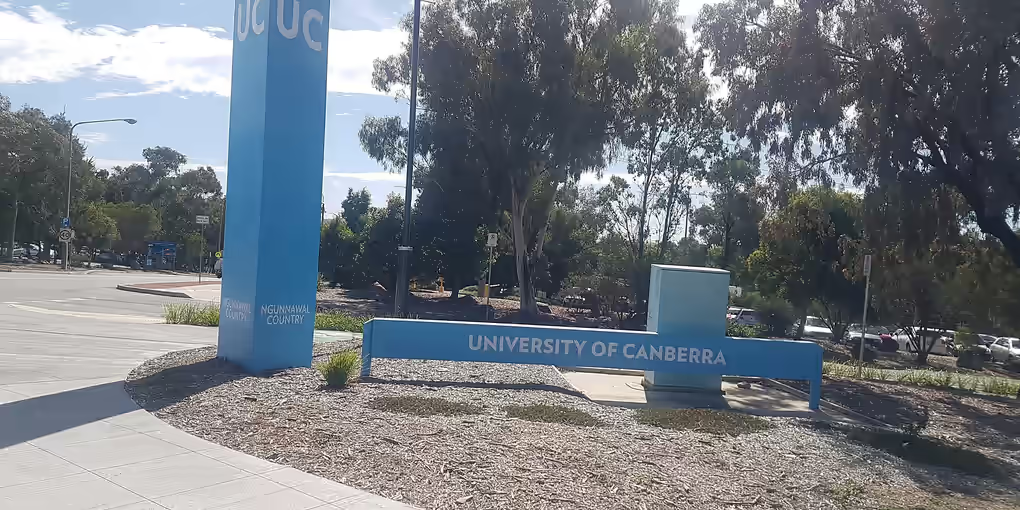
University of Canberra – University Guide for GCC and Southeast Asian Students
Overview
The University of Canberra (UC) occupies a genuinely distinctive spot in the Australian higher education landscape: a mid-sized, single-campus university located in Bruce, a planned suburb of Australia’s national capital, minutes from Parliament House, the High Court and dozens of government departments and embassies. For GCC and Southeast Asian families weighing up a large, competitive Sydney or Melbourne campus against something calmer and more purpose-built, Canberra offers a clean, safe, well-organised alternative with an unusually direct line into public-sector and diplomatic careers.
UC has built its reputation around a specific cluster of practically minded, career-oriented disciplines:
- Business, Government and Public Administration — benefiting directly from Canberra’s status as the seat of the Australian government
- Information Technology and Cybersecurity — supported by strong ties to Canberra’s dense concentration of government and defence-related tech employers
- Health Sciences (Nursing, Physiotherapy, Sport and Exercise Science) — home to a dedicated health precinct with strong clinical partnerships
- Communication and Journalism — with genuine access to the national press gallery and government communications sector
- International tuition typically in the A$30,000–A$40,000 band per year depending on programme (always confirm on the official course page)
Families whose child is drawn to government, policy, health or technology careers — and who value a compact, safe, well-planned city over Australia’s larger metropolises — often find UC a sensible and underrated shortlist option.
Rankings snapshot (latest major league tables)
UC is a younger university relative to Australia’s sandstone institutions, having gained full university status in 1990, and its rankings profile reflects a focused rather than broad-based reputation:
- QS World University Rankings — UC typically sits in the broad #400–#500 global band, a solid position given its size and relatively recent university status
- Young University rankings — UC is frequently recognised among the world’s stronger universities under 50 years old
- Times Higher Education — UC has performed particularly well in specific measures tied to graduate employability and government/industry links
- Sport Science and Health — consistently well-regarded nationally, supported by the university’s dedicated health precinct and elite sport partnerships
- Government, Policy and Public Administration — while not always broken out separately in global tables, UC’s proximity and access to Australian government departments give this cluster a practical credibility that ranking tables alone don’t capture
Practical takeaway for parents: UC’s global ranking position undersells its practical value in specific fields — government, public policy, health sciences and IT/cybersecurity — where its location in the national capital provides direct, hard-to-replicate access that a headline ranking number won’t show.
Popular degrees for GCC and Southeast Asian students
Particularly strong and popular for
- Business and Government — a distinctive combination benefiting from Canberra’s concentration of public-sector employers and policy institutions
- Information Technology and Cybersecurity — closely linked to Canberra’s defence and government technology sector, one of Australia’s densest tech-employment clusters
- Nursing and Health Sciences — supported by a purpose-built health precinct and strong clinical placement partnerships across the ACT
- Sport and Exercise Science — benefiting from UC’s partnerships with national sporting institutes based in Canberra
- Communication and Journalism — genuine proximity to the national press gallery and government communications roles
Less commonly chosen (from this region)
- Medicine — UC does not run its own standalone medical school
- Large-scale engineering programmes, which are offered at a smaller scale than at technology-focused universities
- Creative arts and design at the scale offered by dedicated art and design schools
Why these courses appeal to GCC and SEA families
- Direct proximity to government, embassies and policy institutions, giving business, government and communication students internship and networking access that is difficult to replicate elsewhere in Australia
- A dedicated health precinct with hospital and clinical partnerships built specifically around UC’s health science programmes
- Cybersecurity and IT benefit from Canberra’s concentration of government and defence-related technology employers
- A safe, well-planned, compact city that many families find easier to navigate and manage for a first experience of living abroad
- Fees that sit competitively relative to Sydney and Melbourne for comparable programmes
Campus type and location
- City: Canberra, Australian Capital Territory (ACT)
- Type: Single, purpose-built suburban campus
- Setting: Bruce, a northern Canberra suburb, close to the Australian Institute of Sport and a short drive from the city centre and Parliamentary Triangle
Canberra is a planned city, laid out with clear zoning, generous green space and comparatively light traffic — a marked contrast to the density of Sydney or Melbourne. UC’s campus itself is compact and self-contained, with most teaching buildings, accommodation and recreational facilities within easy walking distance of each other.
Why location matters for international families
- Proximity to government and embassies gives business, policy and communication students a genuine, practical advantage for internships and networking that few other Australian universities can offer
- Canberra is notably safer and calmer than Australia’s largest cities, a point many GCC and SEA families weigh heavily for a first study-abroad experience
- The city is smaller in scale, meaning students wanting constant big-city energy, extensive nightlife or a very large part-time job market will need to plan trips to Sydney (around three hours by road) for that experience
- Public transport within Canberra is efficient for a city of its size, and the compact campus reduces daily commuting for most students
For GCC and Southeast Asian students used to warmer climates, it’s worth preparing for Canberra’s distinct four-season climate, including cold winters with occasional frost — a genuine adjustment for students coming from tropical or desert climates.
Student demographic and culture
UC enrols around 14,000 students, with a well-established and actively supported international community, including strong Gulf, South Asian and Southeast Asian representation. The culture tends to feel:
- Calm, organised and safety-conscious, reflecting Canberra’s broader civic character
- Career-minded, with many students already oriented toward government, health or technology sector employment
- Close-knit relative to larger Australian universities, with reasonably sized class groups in most programmes
- Supportive of international students through a dedicated international office and structured orientation programme
Male to female balance
Varies clearly by programme:
- Nursing and Health Sciences cohorts lean noticeably more female
- IT, Cybersecurity and Sport Science cohorts lean more male, though this is gradually narrowing
- Business and Government tends to sit closer to balanced
Who tends to thrive at University of Canberra
Students who usually do well here are those who:
- Are genuinely interested in government, policy, health sciences, IT/cybersecurity or communication
- Value a safe, calm, well-organised city over the intensity of a larger metropolis
- Want a compact, walkable campus rather than a sprawling or highly dispersed one
- Are motivated by direct access to government and public-sector employers for internships and early career contacts
- Are prepared to adapt to a genuine four-season climate, including a proper winter
Students whose priority is a large, fast-paced city social scene or an extensive part-time job market may find Canberra’s scale limiting compared to Sydney or Melbourne.
Accommodation options
UC operates on-campus student accommodation directly, which is relatively unusual for an Australian university and a genuine convenience for international students. Typical arrangements include:
- University-managed on-campus residences, within walking distance of teaching buildings
- Standard and en-suite room options across several accommodation villages
- Private rental housing in Canberra suburbs, more common from second year onward
Because UC’s campus and accommodation sit together in one compact precinct, most students avoid a daily commute entirely in their first year — a genuine advantage over universities with dispersed or off-site housing.
Cost and budgeting notes for international families
- Canberra’s living costs are generally lower than Sydney and comparable to or slightly below Melbourne
- Winter clothing is a genuine, necessary budget item given Canberra’s cold winters — often underestimated by families from warmer climates
- Occasional travel to Sydney (around three hours) for shopping, flights or bigger events is worth budgeting for
- Standard costs: accommodation, food, personal expenses and arrival flights
For tuition figures, deposits and scholarships, see Fee structure below.
Fee structure
For GCC and Southeast Asian families, University of Canberra typically sits in a moderate international fee band — commonly A$30,000–A$40,000 per year for undergraduate study, varying by faculty. These figures are indicative only; always confirm the latest figures on the official course page and offer letter.
International tuition fees (indicative, 2026/27, in AUD)
| Level | Typical annual tuition |
|---|---|
| Undergraduate — Business, Government, Communication, Arts | Commonly around A$30,000–A$34,000 per year |
| Undergraduate — IT, Cybersecurity, Sport Science | Commonly around A$33,000–A$37,000 per year |
| Undergraduate — Nursing, Health Sciences | Commonly around A$34,000–A$40,000 per year |
| Postgraduate taught | Often around A$32,000–A$40,000 per year (varies by programme) |
Useful points for parents:
- Nursing and clinical health programmes carry additional costs for placement requirements (uniforms, immunisations, background checks) beyond headline tuition.
- IT and Cybersecurity fees can shift between years depending on optional lab-based or capstone project modules.
- Postgraduate research degrees are priced separately from taught programmes.
Deposit, CoE and payment timing
Students needing a Confirmation of Enrolment (CoE) for a Student visa (subclass 500) should expect the University of Canberra to request a deposit after accepting an offer. The amount and deadline are stated in the offer letter.
Families should plan for:
- Offer received (conditional or unconditional)
- Deposit paid by the stated deadline
- CoE issued once payment and any conditions are confirmed
- Student visa (subclass 500) application lodged using the CoE
- Remaining tuition settled by semester through the university’s payment options
Scholarships and fee reductions (high-level)
University of Canberra offers a number of international scholarship routes, including:
- Merit-based international scholarships tied to academic profile
- Faculty-specific scholarships within Business, IT and Health Sciences
- Early-application fee incentives available for some intakes
Practical tip: scholarship amounts and eligibility windows change by intake — treat published figures as planning guides and confirm specifics through the offer and scholarship communications.
Living costs beyond tuition
Australia’s Department of Home Affairs sets a minimum living-cost financial requirement for the subclass 500 visa. Families should budget separately for:
- Accommodation for the academic year (moderate relative to Sydney)
- Food, transport and personal expenses
- Overseas Student Health Cover (OSHC), compulsory for the visa
- Winter clothing and occasional travel to Sydney or Melbourne
- Flights and arrival costs
Admission procedure
Undergraduate applications
Most international undergraduate applicants apply directly to the University of Canberra or through an approved education agent.
Typical requirements include:
- Completion of secondary schooling to a standard broadly equivalent to the Australian Year 12 (national GCC/SEA curricula are individually assessed)
- Meeting the course-specific entry standard — Nursing and some Sport Science routes are typically more competitive
- Academic transcripts, certificates and passport details
- English language evidence where required
- For Nursing and some health programmes, additional health clearance or background-check documentation ahead of clinical placements
English language for most undergraduate courses is commonly around IELTS 6.0–6.5 overall, with Nursing and Journalism sometimes requiring a higher overall score. Always check the exact course page for the intended intake.
Postgraduate applications
Postgraduate taught applications are usually made directly to the university, via the course page or an approved education agent.
Typical requirements include:
- A relevant bachelor’s degree with a specified minimum grade average
- Academic transcripts and degree certificate
- A CV and, for some programmes, a personal statement
- English language evidence — commonly around IELTS 6.5, higher for some professional or clinical routes
- Additional evidence of relevant work experience for select postgraduate programmes in Government and Public Administration
Step-by-step pathway for international families
- Shortlist the course — check entry requirements, fees, placement/clinical elements and intake month.
- Strengthen academics and English early — particularly important for Nursing, which is more competitive.
- Apply directly or through an approved agent with certified transcripts and supporting documents.
- Receive an offer — conditional or unconditional.
- Accept the offer and pay the deposit — required before a CoE can be issued.
- Receive the CoE and apply for the subclass 500 student visa through the Department of Home Affairs.
- Arrange on-campus accommodation — booking early is worthwhile given the convenience of UC’s on-site housing.
Intakes and timing
- Semester 1 (February) is the main intake across nearly all undergraduate and postgraduate programmes.
- A Semester 2 (July) intake is available for many courses — check individual course pages.
- Applications are generally assessed on a rolling basis, but Nursing and popular Health Science places can fill ahead of the stated deadline.
Documents checklist (typical)
- Academic transcripts and certificates
- Passport copy
- English language test results (if required)
- CV (postgraduate applicants)
- Health clearance and background-check documentation (Nursing and Health Science applicants)
- Proof of funds where requested ahead of the formal visa application stage
For GCC and SEA applicants: national curriculum results are assessed against the university’s country-specific equivalency guidance. Where grades fall short of direct entry, UC’s foundation and pathway programmes provide an alternative route into first year.
Academic intensity and social life
Academic demands vary noticeably by faculty at UC. Nursing and Health Sciences combine lectures with substantial supervised clinical placement hours; IT and Cybersecurity blend theory with hands-on lab and project work, often tied to real government or industry case studies; Business and Government follow a more conventional lecture-seminar structure with case-study and policy-analysis components.
Assessment methods also vary: expect clinical competency assessments in Nursing, technical projects and capstone work in IT/Cybersecurity, and essays, case studies and policy briefs in Business and Government.
What students can generally expect:
- Smaller class sizes than Australia’s largest universities, particularly in specialist health and technology programmes
- Genuine access to government-linked guest lecturers, internships and case studies in Business, Government and Communication
- A close relationship between academic staff and students, aided by the compact campus
- A social calendar built around campus life and Canberra’s civic and cultural institutions rather than big-city nightlife
Social life in practice
Because UC’s campus and accommodation sit together in one precinct, social life happens organically through residences, clubs and the Students’ Association — a genuine advantage for international students settling in quickly. Canberra’s national institutions (museums, galleries, the National Arboretum) also provide a distinctive backdrop for student life that is less about nightlife and more about culture, sport and the outdoors.
Sports, societies and wider profile
University of Canberra’s sports and societies scene benefits directly from the city’s national sporting infrastructure:
- UC Capitals and UC Vikings — elite university-linked sporting programmes with genuine pathways into national-level competition
- Partnerships with the Australian Institute of Sport, based nearby, giving Sport Science students unusually direct access to elite training environments
- Government, policy and technology-focused student societies, reflecting Canberra’s civic identity
- Cultural and faith societies supporting the international student community, including established Gulf and Southeast Asian student groups
For GCC and SEA students, joining a government, technology or sport-related society is one of the fastest ways to build both friendships and genuinely useful professional contacts specific to Canberra’s institutional landscape.
Careers and employer reputation
University of Canberra’s employer reputation is strongest in the fields tied directly to the national capital’s institutional landscape, rather than as a broad, generalist prestige brand.
Where UC can be especially sensible
- Students targeting government, policy or public administration careers, where Canberra’s institutional proximity is a genuine, practical advantage
- Applicants interested in IT and cybersecurity, given the concentration of government and defence-related technology employers in the ACT
- Students genuinely drawn to health sciences, supported by a dedicated clinical precinct and strong placement partnerships
- Families wanting a safe, calm, well-organised city as a first study-abroad location
Where families should be realistic
Canberra’s smaller scale means students chasing large-city finance, media or creative-industry internships will need to travel and plan placements proactively rather than relying on on-campus proximity to major private-sector employers. Families should evaluate:
- How placement and internship support works for the specific course
- Travel time and cost to reach Sydney or Melbourne for interviews or larger industry events
- Whether the student’s career goals align with UC’s strengths in government, health and technology
Used well, University of Canberra works best as a specialist-sector-focused, lifestyle-conscious choice — a strong fit for families who have already identified government, health or technology as the goal and want a calmer, more personal environment to pursue it in.
Who should shortlist University of Canberra?
Consider shortlisting University of Canberra if your child:
- Is genuinely interested in business, government, IT/cybersecurity, health sciences or communication
- Would benefit from a safe, calm, well-planned city as a first study-abroad experience
- Wants a compact, walkable campus with on-site accommodation
- Values direct access to government and public-sector employers for internships and networking
- Is comfortable adapting to Canberra’s genuine four-season climate
Consider other options first if your child:
- Needs constant access to a large metropolitan social or job market
- Is targeting a subject UC doesn’t specialise in at scale, such as medicine or large-scale engineering
- Would prefer a warmer, more consistently mild climate year-round
How Tutopiya helps
Tutopiya works with students aiming for University of Canberra and other Australian universities by:
- Strengthening grades in subjects relevant to entry — particularly mathematics, biology, business and computer science for UC’s most competitive programmes
- Building competitive academic profiles early enough for realistic university shortlists
- Preparing for English language goals and application requirements where relevant
- Helping families understand fees, deposits, scholarships and application timelines
- Providing university counselling that weighs subject fit, location and career outcomes honestly rather than by ranking alone
- Issuing reference letters for tutoring and homeschooling students where Tutopiya has supported the student’s academic programme — useful for direct-entry applications when school references are limited or unavailable
- Connecting families with unpaid internship and work-experience opportunities (where available) to strengthen applications before and during the admissions process
If you’d like tailored advice for your child’s situation, you can talk to Tutopiya’s team about a joined-up plan covering both exam preparation and university admissions.
🎓 Free tool
Build your personalised shortlist for University of Canberra →
See entry requirements matched to your own grades, tuition, deadlines and reach/target/safety tiering — free, no signup needed to browse.
Ready to Excel in Your Studies?
Get personalised help from Tutopiya's expert tutors. Whether it's IGCSE, IB, A-Levels, or any other curriculum — we match you with the perfect tutor and your first session is free.
Book Your Free TrialWritten by
Tutopiya Team
Related Articles

Heriot-Watt University Dubai – University Guide for GCC and Southeast Asian Students
Detailed guidance for international students from the Gulf and Southeast Asia considering Heriot-Watt University Dubai, including fees, admissions, campus life, accommodation and graduate outcomes.

University of Birmingham Dubai – University Guide for GCC and Southeast Asian Students
Detailed guidance for international students from the Gulf and Southeast Asia considering University of Birmingham Dubai, including fees, admissions, campus life, accommodation and graduate outcomes.

Abu Dhabi University – University Guide for GCC and Southeast Asian Students
Detailed guidance for international students from the Gulf and Southeast Asia considering Abu Dhabi University (ADU), including fees, admissions, campus life, accommodation and graduate outcomes.