
University of Adelaide – University Guide for GCC and Southeast Asian Students
Overview
If your search still returns the University of Adelaide, you are not looking at the wrong university — you are looking at a legacy name. In January 2026 the University of Adelaide and the University of South Australia combined to open as Adelaide University, a single public institution that now handles new offers, Confirmation of Enrolment paperwork and active course pages. Families from the Gulf and Southeast Asia who type the old name into Google should treat this guide as a bridge: it explains the heritage brand you recognise, then points you clearly to where applications happen today.
Historically, the University of Adelaide was a Group of Eight research university with a legacy QS position around the global #82 mark. Its reputation was built around:
- Engineering — a long Go8-calibre faculty with industry depth across South Australia
- Health and biomedical sciences — including clinical and research pathways tied to Adelaide’s hospital and medical precincts
- Business — a substantial undergraduate and postgraduate portfolio
- Computer science — growing alongside the state’s defence, space and tech ecosystem
- Agriculture and wine science — distinctive South Australian strengths linked to the state’s primary industries
- International tuition under the successor university typically in the A$32,000–A$52,000 band per year (always confirm on the current Adelaide University course page)
Bottom line for 2026 applicants: do not treat the University of Adelaide as a separate university you can still apply to. Shortlist and apply through Adelaide University, while using this article to understand the North Terrace heritage campus, former subject strengths and Adelaide living context.
Rankings snapshot (latest major league tables)
Older league tables and alumni materials will still show the University of Adelaide as a standalone Go8 name. That historical signal remains useful for understanding quality — it is not the live ranking brand for new enrolment.
- Legacy QS (pre-merger) — the University of Adelaide typically sat around #82 globally, firmly inside the world’s top 100 and among Australia’s stronger research universities
- Engineering, health and biomedical sciences — historically the clearest subject-level strengths families from the GCC and SEA associated with the Adelaide name
- Agriculture and wine science — niche areas where Adelaide carried outsized national recognition relative to its city size
- Adelaide University (from 2026) — launched into the global top 100 band (QS around #82 in early combined reporting); always check the current Adelaide University ranking and subject tables rather than archived University of Adelaide pages
Practical takeaway for parents: legacy Go8 prestige still informs how employers and alumni networks talk about Adelaide degrees, but offers, CoEs and CRICOS course codes for new students sit under Adelaide University. Compare the live course page, not a 2024 PDF still branded “University of Adelaide.”
Popular degrees for GCC and Southeast Asian students
Particularly strong and popular for (heritage strengths now under Adelaide University)
- Engineering — civil, mechanical, electrical, chemical and related streams with a strong research and industry tradition on and around the North Terrace precinct
- Health and biomedical sciences — including pathways that historically drew international students seeking Adelaide’s medical and research density
- Business and commerce — broad undergraduate and postgraduate options retained and expanded in the merged portfolio
- Computer science and related technology degrees — increasingly relevant given Adelaide’s defence, space and digital growth
- Agriculture and wine science — genuinely distinctive Australian offerings tied to South Australia’s primary-production economy
Less commonly chosen (from this region)
- Pure creative-arts or fashion routes better served by specialist design schools in larger east-coast cities
- Highly niche programmes that were never Adelaide’s core identity and may now sit elsewhere in the merged course map
- Assuming a separate “University of Adelaide only” medical or research pathway still exists under that legal name for new starters
Why these courses still appeal to GCC and SEA families
- Recognised research heritage — the former Go8 brand remains a useful quality signal when explaining Adelaide to relatives and employers
- North Terrace location — a genuine CBD heritage campus experience, walkable to cultural institutions and the city’s medical and professional precincts
- Subject niches such as wine science and agriculture that are hard to replicate in purely metropolitan east-coast universities
- Adelaide living costs that are typically more manageable than Sydney or Melbourne for a comparable research-university experience
- Clear successor pathway — families can keep the academic identity they researched while applying through the active Adelaide University portal
Campus type and location
- City: Adelaide, South Australia
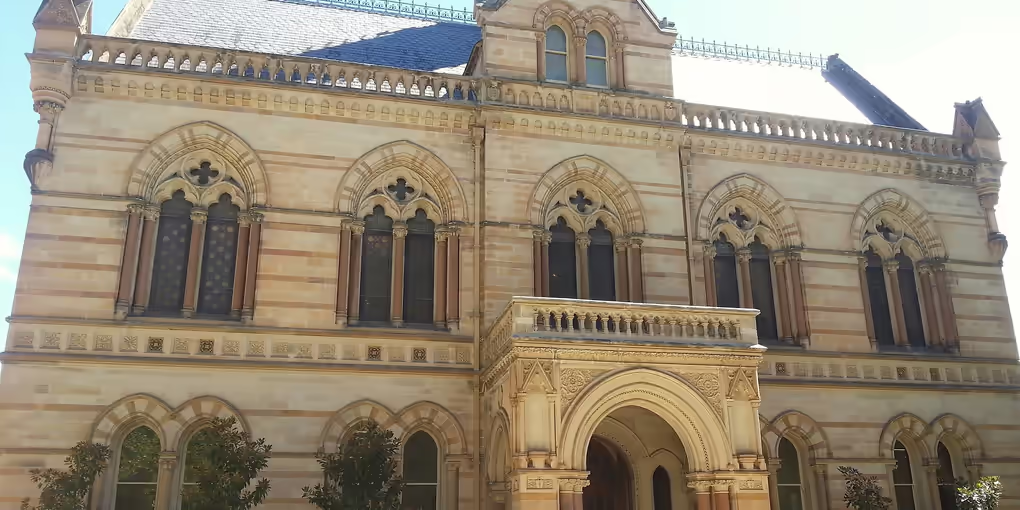
- Heritage campus most families mean: North Terrace — the historic sandstone and parkland-edge precinct long associated with the University of Adelaide
- Type today: teaching and research sites within the broader Adelaide University multi-campus network (including sites that formerly sat under UniSA)
- Setting: Adelaide CBD and inner suburbs, with South Australia’s wine regions and agricultural hinterland within easy reach for specialist fieldwork
Families should confirm which Adelaide University campus delivers their intended 2026 programme. North Terrace remains the emotional and architectural heart of the old University of Adelaide story, but the merged university’s course map is wider than that single site. Specialist agriculture and wine science teaching has historically also drawn on precincts beyond the CBD, so fieldwork logistics deserve a direct question before enrolment.
Why location matters for international families
- Adelaide is a compact, walkable capital — safer and less overwhelming than Sydney or Melbourne for many first-time study-abroad students
- Living costs are generally lower than Australia’s two largest cities, which matters across a three- or four-year degree
- South Australia’s health, defence, space, mining-services and wine industries give engineering, science and business students real local internship context
- Flights to Asia and the Gulf are available, but Adelaide has fewer direct long-haul options than Sydney or Melbourne — families should plan connection times honestly
For GCC and Southeast Asian students used to heat and humidity, Adelaide’s Mediterranean climate — hot dry summers, cool winters — is usually an easier adjustment than inland NSW highlands, though summer heat still needs planning.
Student demographic and culture
Before the merger, the University of Adelaide educated a substantial onshore international cohort within a research-intensive Go8 culture: academically serious, CBD-connected and less “mega-campus anonymous” than Australia’s largest east-coast universities. That culture continues inside Adelaide University’s inherited North Terrace community, now alongside students and programmes that formerly sat under UniSA.
Expect a mix of:
- Research-oriented students drawn by the former Go8 reputation
- Professionally focused cohorts in engineering, health, business and IT
- A growing international community across GCC, Southeast Asia, China, India and beyond
- Campus life that sits close to Adelaide’s festivals, parklands and café culture rather than a remote regional town
Male to female balance
Varies by discipline in the usual Australian pattern:
- Engineering and computer science cohorts lean more male
- Health and biomedical pathways often sit closer to balanced or lean female depending on the specific degree
- Business tends to sit nearer balanced
Who tends to thrive here
Students who usually do well with this Adelaide heritage pathway are those who:
- Want a research-university academic culture without Sydney/Melbourne living costs
- Are drawn to engineering, health/biomedical, business, CS, agriculture or wine science
- Value a safe, mid-sized capital city with a genuine CBD campus feel
- Are comfortable applying to Adelaide University as the legal destination while still identifying with the Adelaide research tradition
- Can navigate a transition year calmly — reading 2026 course pages carefully rather than relying on older University of Adelaide PDFs alone
Students who insist on studying at a university that still exists legally under the University of Adelaide name for new applications will need to update their shortlist: that legal pathway no longer operates separately.
Accommodation options
International students heading to Adelaide University programmes delivered on or near the historic North Terrace precinct typically choose from:
- University-linked or partner residential colleges and halls close to the CBD
- Purpose-built student accommodation in the Adelaide CBD and North Adelaide
- Private share-houses and apartments in inner suburbs once students know the city
Because North Terrace sits in the city centre, first-year commuting is often short compared with outer-suburban campuses — a practical advantage for new arrivals. Students whose timetable sits at a different Adelaide University site should match housing to that campus rather than assuming everything happens on North Terrace.
Cost and budgeting notes for international families
- Adelaide rents are generally more affordable than Sydney and Melbourne, but CBD student housing still needs early booking for February intakes
- Budget for Overseas Student Health Cover (OSHC), which is compulsory for the subclass 500 visa
- Allow for occasional travel to Melbourne or Sydney for family visits, conferences or larger industry events
- Specialist programmes in agriculture or wine science may involve fieldwork travel costs beyond headline tuition
For tuition figures, deposits and scholarships, see Fee structure below — and confirm everything on the Adelaide University offer letter, not archived University of Adelaide fee schedules.
Fee structure
New international fee schedules for 2026 sit under Adelaide University. As a planning guide, GCC and Southeast Asian families should expect roughly A$32,000–A$52,000 per year for undergraduate study and roughly A$34,000–A$58,000 for many postgraduate taught programmes, depending on faculty. These figures are indicative only; always confirm on the official Adelaide University course page and offer letter.
International tuition fees (indicative, 2026/27, in AUD)
| Level | Typical annual tuition |
|---|---|
| Undergraduate — Business, Arts-related classroom programmes | Commonly around A$32,000–A$40,000 per year |
| Undergraduate — Computer science, many science streams | Commonly around A$38,000–A$46,000 per year |
| Undergraduate — Engineering, health/biomedical laboratory programmes | Commonly around A$42,000–A$52,000 per year |
| Postgraduate taught | Often around A$34,000–A$58,000 per year (varies widely by programme) |
Useful points for parents:
- Laboratory-heavy engineering, health and science degrees sit toward the upper end of the band.
- Older “University of Adelaide” fee PDFs should be discarded for planning — use Adelaide University’s current published fees.
- Fees typically rise modestly each year; the offer letter states the schedule that applies to your child.
Deposit, CoE and payment timing
Students needing a Confirmation of Enrolment (CoE) for a Student visa (subclass 500) receive that document from Adelaide University, not from a separate University of Adelaide admissions office. Expect a deposit or initial tuition instalment after accepting an eligible offer.
Families should plan for:
- Offer received from Adelaide University (conditional or unconditional)
- Deposit paid by the stated deadline
- CoE issued once payment and conditions are confirmed
- Student visa (subclass 500) application lodged using that CoE
- Remaining tuition settled through Adelaide University’s payment options
Scholarships and fee reductions (high-level)
Adelaide University continues international scholarship routes that draw on both predecessor universities’ traditions, including:
- Merit-based international scholarships assessed with the application
- Faculty awards in engineering, health, business and science
- Progression or alumni-linked discounts in some postgraduate pathways
Practical tip: scholarship windows and amounts change by intake — treat published figures as planning guides and confirm specifics in the offer and scholarship communications.
Living costs beyond tuition
Australia’s Department of Home Affairs sets a minimum living-cost requirement for the subclass 500 visa. Adelaide’s actual day-to-day costs are often more manageable than Sydney’s, but families should still budget separately for:
- Accommodation for the academic year
- Food, local transport and personal expenses
- OSHC for the full visa length
- Fieldwork or lab-related extras where relevant
- Flights and arrival costs
Admission procedure
Undergraduate applications
Most international undergraduate applicants for 2026+ apply directly to Adelaide University or through an approved education agent. There is no UCAS-style central UK application for Australian universities, and there is no separate new-applicant portal for the legacy University of Adelaide name.
Typical requirements include:
- Completion of secondary schooling to a standard broadly equivalent to Australian Year 12 (national GCC/SEA curricula are assessed individually)
- Meeting the course-specific entry standard published on the Adelaide University course page
- Academic transcripts, certificates and passport details
- English language evidence where required
English language for many undergraduate courses is commonly around IELTS 6.5 overall (often no band below 6.0), with some health and education pathways asking for higher scores. Always check the exact Adelaide University course page for the intended intake.
Postgraduate applications
Postgraduate taught applications are made directly to Adelaide University, via the course page or an approved agent.
Typical requirements include:
- A relevant bachelor’s degree with the stated minimum grade average
- Academic transcripts and degree certificate
- A CV and, for many programmes, a statement of purpose
- English language evidence — commonly around IELTS 6.5, higher for some professional routes
- Additional documentation for research degrees
Step-by-step pathway for international families
- Search the legacy name if needed, then open the matching Adelaide University course page for 2026.
- Confirm campus, fees, English and entry scores on the live page — ignore outdated University of Adelaide PDFs.
- Apply directly or through an approved agent with certified transcripts and supporting documents.
- Receive an Adelaide University offer — conditional or unconditional.
- Accept the offer and pay the deposit — required before a CoE can be issued.
- Receive the CoE and apply for the subclass 500 student visa.
- Arrange Adelaide accommodation early, especially for CBD and North Terrace-adjacent housing.
Intakes and timing
- Semester 1 (February/March) is the main intake for most undergraduate and postgraduate programmes.
- A Semester 2 (July) intake is available for many, though not all, courses.
- Competitive engineering, health and business streams can fill — apply early rather than relying on late availability.
Documents checklist (typical)
- Academic transcripts and certificates
- Passport copy
- English language test results (if required)
- CV / personal statement (especially postgraduate)
- Academic references where requested
- Proof of funds ahead of the visa stage
For GCC and SEA applicants: country-specific equivalencies are published by Adelaide University. Where grades fall short of direct entry, foundation or diploma pathway options linked to the merged university may be available — confirm which pathway awards credit into the intended degree.
Academic intensity and social life
The North Terrace heritage experience remains academically serious: engineering and biomedical degrees combine heavy laboratory and project loads; business programmes lean on case work and quantitative modules; agriculture and wine science blend classroom theory with South Australian industry fieldwork. Assessment typically mixes exams, lab reports, group projects and major final-year work.
What students can generally expect inside the successor university:
- Research-informed teaching with access to facilities built under both predecessor institutions
- A CBD campus rhythm for North Terrace-based study, with cafés, libraries and cultural venues close by
- Larger combined student numbers than either predecessor alone — Adelaide University enrols on a substantially bigger scale
- A social calendar shaped by Adelaide’s festival culture, parklands and student societies rather than east-coast mega-city nightlife
Social life in practice
Adelaide’s scale works in students’ favour: friends are easier to meet than in a sprawling megacity, yet the city still offers restaurants, beaches within reach, and a genuine weekend culture. International students often cite the balance — serious study without the cost and anonymity of Sydney — as the reason they would choose Adelaide again. During the merger transition year, students should also allow a little extra patience for timetable and enrolment systems while staff continue integrating services from both founding universities.
Sports, societies and wider profile
Student life around the former University of Adelaide precinct has long included:
- Club sport and recreational fitness linked to university facilities and Adelaide’s parklands
- Engineering, science and business societies with employer networking calendars
- Cultural and faith societies supporting GCC and Southeast Asian communities
- Festival-season volunteering and city events that are unusual for a capital of Adelaide’s size
Joining a faculty society early remains one of the fastest ways for international students to convert a new city into a workable support network. Parents comparing North Terrace life with Sydney campuses often underestimate how much of Adelaide student culture happens outdoors — along the River Torrens, in the parklands and at beach suburbs a short tram or bus ride away.
For GCC and SEA students in particular, faith societies and country networks are well established in Adelaide and often provide the soft landing that academic clubs alone cannot. Combining one faculty society with one cultural society remains the simplest first-semester plan.
Careers and employer reputation
Employers across Australia and the Asia-Pacific still recognise the University of Adelaide name on older CVs and alumni networks. For graduates completing degrees under Adelaide University, the practical advice is to be clear on transcripts and LinkedIn about the awarding institution while confidently referencing the research and industry heritage of the North Terrace tradition where relevant.
Where this pathway can be especially sensible
- Students targeting engineering, health/biomedical, business, CS, agriculture or wine science
- Families wanting Go8-heritage academic signalling with Adelaide’s lower living costs
- Applicants who prefer a safe mid-sized capital over Sydney or Melbourne intensity
- Students happy to apply through Adelaide University while still valuing the legacy brand story
Where families should be realistic
- New applications are not lodged to a separate 2026 University of Adelaide entity
- Some course structures, campus locations and unit codes changed during the merger — verify every detail
- Adelaide’s graduate market is strong in state-linked sectors but thinner than Sydney for certain global finance and media roles
Used well, searching “University of Adelaide” should lead families to a confident Adelaide University application with eyes open about campus, fees and subject fit. Keep older rankings as context for quality, then make every money and visa decision against the live Adelaide University offer letter.
If relatives still say “University of Adelaide,” that is fine in conversation — just make sure deposits, CoEs and visas are processed under Adelaide University.
Keep a short written checklist of campus, course code, AUD tuition and CoE timing before any deposit is paid.
Who should shortlist the University of Adelaide (via Adelaide University)?
Consider this pathway if your child:
- Has been researching the University of Adelaide / Go8 Adelaide brand and still wants that academic identity
- Is interested in engineering, health/biomedical, business, computer science, agriculture or wine science
- Wants a North Terrace / Adelaide CBD study experience with manageable living costs
- Is ready to apply to Adelaide University as the legal destination for 2026+
- Values a safer, mid-sized Australian capital for a first degree abroad
Consider other options first if your child:
- Needs a university that still exists as a separate legal applicant destination under the University of Adelaide name alone
- Requires a denser Sydney/Melbourne internship market from year one
- Is chasing a subject that Adelaide University does not offer in the form they want — confirm the live course list first
How Tutopiya helps
Tutopiya works with students aiming for Adelaide University (including families who first searched the University of Adelaide) and other Australian universities by:
- Strengthening grades in subjects relevant to entry — particularly mathematics, sciences and English for engineering, health and business pathways
- Building competitive academic profiles early enough for realistic Australian shortlists
- Preparing for English language goals and direct-application requirements
- Helping families understand fees in AUD, deposits, scholarships, CoE timing and subclass 500 visa steps
- Providing university counselling that explains the merger clearly so parents do not apply to a closed legacy portal
- Issuing reference letters for tutoring and homeschooling students where Tutopiya has supported the student’s academic programme — useful for direct-entry applications when school references are limited or unavailable
- Connecting families with unpaid internship and work-experience opportunities (where available) to strengthen applications before and during the admissions process
If you’d like tailored advice for your child’s situation, you can talk to Tutopiya’s team about a joined-up plan covering both exam preparation and university admissions.
Ready to Excel in Your Studies?
Get personalised help from Tutopiya's expert tutors. Whether it's IGCSE, IB, A-Levels, or any other curriculum — we match you with the perfect tutor and your first session is free.
Book Your Free TrialWritten by
Tutopiya Team
Related Articles

Heriot-Watt University Dubai – University Guide for GCC and Southeast Asian Students
Detailed guidance for international students from the Gulf and Southeast Asia considering Heriot-Watt University Dubai, including fees, admissions, campus life, accommodation and graduate outcomes.

University of Birmingham Dubai – University Guide for GCC and Southeast Asian Students
Detailed guidance for international students from the Gulf and Southeast Asia considering University of Birmingham Dubai, including fees, admissions, campus life, accommodation and graduate outcomes.

Abu Dhabi University – University Guide for GCC and Southeast Asian Students
Detailed guidance for international students from the Gulf and Southeast Asia considering Abu Dhabi University (ADU), including fees, admissions, campus life, accommodation and graduate outcomes.