
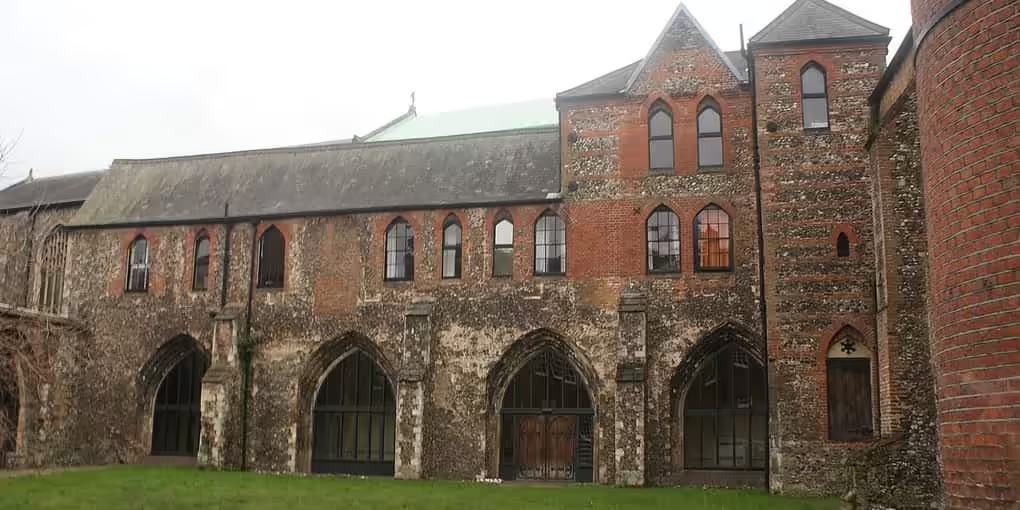
Norwich University of the Arts – University Guide for GCC and Southeast Asian Students
Overview
Norwich University of the Arts (NUA) is a specialist creative arts university in Norwich, East Anglia — a historic cathedral city with a distinctive cultural identity. For families from the GCC and Southeast Asia, NUA is often shortlisted for:
- A focused creative arts education rather than a generalist multi-faculty university
- Competitive international fees typically in the mid-£17k–£19k band
- Strengths in fine art, graphic design, games art, fashion, film, architecture/interior design and animation
- Portfolio-heavy admissions that reward creative talent and preparation
- An East Anglia city lifestyle — smaller, calmer and more affordable than London
If your child is serious about a creative career in art, design, fashion, film or games — and wants specialist studio teaching in a dedicated arts institution — NUA deserves serious consideration alongside Falmouth, Arts University Bournemouth and other specialist creative universities.
Rankings snapshot (latest major league tables)
NUA is not positioned as a generalist research university and does not compete on Russell Group prestige metrics. Its appeal lies in specialist creative teaching, industry links and graduate employment in the creative industries.
In recent UK league tables and creative-sector assessments, NUA often receives strong recognition for:
- Fine art and illustration — studio-based teaching with exhibition culture
- Graphic design and visual communication — industry-facing creative programmes
- Games art and animation — growing profile among UK games-industry pathways
- Fashion and textiles — creative design with commercial framing
- Film and moving image — production-focused creative routes
- Architecture and interior design — creative-technical pathways within an arts university setting
Globally, NUA tends to appear outside general university rankings rather than inside them — specialist arts institutions are often assessed differently. For many GCC and SEA families, the more useful question is whether the course specialism, portfolio standards and creative facilities match the student’s artistic ambitions.
Practical takeaway for parents: NUA rewards students who are committed to creative careers and can demonstrate talent through portfolios — not those seeking a generalist university experience or elite research prestige.
Popular degrees for GCC and Southeast Asian students
NUA offers a focused portfolio of creative arts programmes. International interest from the Gulf and Southeast Asia tends to cluster around visually creative and digital-media pathways.
Particularly strong and popular for
- Fine art — painting, sculpture and interdisciplinary studio practice with exhibition opportunities
- Graphic design and visual communication — branding, typography and commercial design pathways
- Games art and animation — industry-aligned digital creative routes popular with students targeting games and media careers
- Fashion design and textiles — creative design with studio and workshop teaching
- Film and moving image — production-focused film, video and screen-based creative work
- Architecture and interior design — creative-technical routes within a specialist arts environment
- Animation — character, motion and visual storytelling pathways
Less commonly chosen (from this region)
- Business, STEM or generalist humanities degrees (NUA does not offer these)
- Students seeking a large multi-faculty university with broad non-creative options
- Applicants without a genuine creative portfolio or artistic commitment
Why these courses appeal to GCC and SEA families
Many families from these regions value:
- Specialist creative teaching in dedicated studio environments
- Smaller cohorts and personal contact with creative staff
- Portfolio-based admissions that reward talent over pure exam scores (though academics still matter)
- Norwich’s calmer, more affordable lifestyle compared with London
- Clear pathways into creative industries — design, fashion, film, games and animation
Campus type and location
- City: Norwich, Norfolk, East Anglia, England
- Type: Specialist creative arts university with city-centre campus buildings integrated into Norwich’s historic core
- Setting: Historic cathedral city (~140,000+ residents in the city; wider county larger) with a strong arts and cultural identity
NUA’s teaching spaces — studios, workshops, digital labs and exhibition areas — are spread across Norwich city centre rather than a single sprawling suburban campus. Students live and study within a compact, walkable historic city.
Why location matters for international families
Norwich offers:
- A calmer, culturally rich city — cathedral, museums, independent shops and arts venues
- Lower living costs than London — accommodation and daily expenses are typically more affordable
- A tight-knit creative community where NUA students are highly visible
- Train links to London (~2 hours) for exhibitions, internships and industry events
- Norwich Airport for regional travel
For GCC and Southeast Asian students who want focused creative study without London intensity or cost, Norwich’s East Anglia lifestyle is a genuine selling point.
Student demographic and culture
NUA teaches roughly 3,000–4,000 students — small and specialist by UK standards, which shapes an intimate, studio-focused culture.
The university welcomes international learners, with students from many countries alongside UK creative cohorts.
The culture tends to feel:
- Studio-centric and creative
- Collaborative rather than hyper-competitive
- Exhibition and portfolio-driven
- Smaller-scale and personal compared with large city universities
- Arts-community oriented within Norwich’s cultural scene
Male to female balance
Varies by subject:
- Fashion, fine art and graphic design cohorts often lean more female
- Games art and animation may have more balanced or male-leaning cohorts
- Film and architecture programmes vary by intake
Who tends to thrive at NUA
Students who usually do well here are those who:
- Are genuinely committed to creative careers in art, design, fashion, film or games
- Can build and present a strong portfolio for admissions
- Prefer specialist studio teaching over generalist university breadth
- Enjoy a smaller city with cultural depth rather than metropolitan intensity
- Are comfortable investing in art materials, equipment and creative production costs
Students who need large-scale city nightlife, broad non-creative degree options or elite Russell Group prestige may prefer other options first.
Accommodation options
University-managed and partner accommodation is available for students, with many first-year international students choosing halls in or near Norwich city centre. Options typically include:
- Standard single rooms in halls
- En-suite rooms in newer residences
- Self-catered contracts depending on the hall
Private rented accommodation across Norwich is also available — the city’s rental market is generally more affordable than London or Manchester.
Cost and budgeting notes for international families
Living in Norwich is generally more affordable than London, though UK Student Visa financial evidence requirements still apply. Families should plan for:
- Accommodation for the academic year (often £5,000–£7,500+ depending on room type and location)
- Food, personal expenses and local transport
- Art materials, software, camera/film equipment and studio supplies — creative programmes incur ongoing costs beyond tuition
- Warm clothing (East Anglia weather is cooler than the Gulf or much of Southeast Asia)
- Flights and arrival costs
- Occasional travel to London for exhibitions, industry events or internships
For tuition figures, deposits and scholarships, see Fee structure below.
Fee structure
For GCC and Southeast Asian families, NUA typically sits in a mid-to-upper mid-range fee band for international students — reflecting specialist creative facilities and studio-based teaching, while Norwich living costs help offset the comparison with London creative universities.
Always confirm the latest figures on the official course page and offer letter, because fees can change by intake and programme.
International tuition fees (indicative, 2026/27)
| Level | Typical annual tuition |
|---|---|
| Undergraduate — studio-based creative programmes | Around £17,000–£19,000 per year |
| Postgraduate taught — creative MA routes | Commonly around £17,500–£19,000 per year (varies by programme) |
Useful points for parents:
- All NUA programmes are studio and workshop intensive — fees reflect specialist creative facilities.
- There is less variation between “classroom” and “lab” bands than at generalist universities because the entire institution is creative-focused.
- Budget additionally for materials, equipment and production costs throughout the degree.
Deposit, CAS and payment timing
If a student needs a CAS (Confirmation of Acceptance for Studies) for a UK Student Visa, NUA typically requires a deposit after an offer is accepted. The exact amount and deadline appear in the offer letter — plan for this early.
Families should plan for:
- Offer received (conditional or unconditional)
- Deposit payment by the deadline stated in the offer
- CAS issued for the visa application
- Remaining tuition paid according to university payment options
Scholarships and fee reductions (high-level)
NUA offers international scholarship and bursary routes that can reduce net cost for strong applicants. Typical examples families should ask about include:
- Merit-based or creative-talent scholarships (amounts vary by portfolio strength and intake)
- Country- or region-specific awards where advertised
- Progression discounts for students continuing from NUA undergraduate to postgraduate study
Practical tip: scholarship eligibility and deadlines change by intake. Treat published ranges as planning guides, then confirm what appears in the student’s offer and scholarship communications.
Living costs beyond tuition — Norwich vs London
Norwich living costs are typically meaningfully lower than London for comparable student lifestyles:
| Expense area | Norwich (indicative) | London (indicative comparison) |
|---|---|---|
| Student accommodation (en-suite hall) | Often £120–£180/week | Often £250–£350+/week |
| Monthly food and personal expenses | Often £220–£350 | Often £350–£550+ |
| Local transport | Lower — compact, walkable city | Higher — London travel costs add up quickly |
| Creative materials and equipment | Budget £500–£1,500+/year depending on course | Similar material costs, but higher overall living overhead |
Families should still budget separately for portfolio production, exhibition costs, software licences and travel to London for industry events.
Admission procedure
NUA’s admissions process is portfolio-heavy — creative talent and preparation matter as much as, or more than, pure exam grades for many programmes. Families should start portfolio work early.
Undergraduate applications
Most international undergraduate applicants apply through:
- UCAS (standard route for Year 1 entry), and/or
- University/international application channels or approved in-country representatives
Typical requirements include:
- Completion of around 12 years of schooling with a qualification equivalent to UK A Levels (or accepted national equivalents from GCC/SEA systems)
- Meeting the course-specific academic tariff — though creative portfolios often carry significant weight
- A personal statement focused on creative motivation, influences and career goals
- Supporting documents (transcripts, passport details, references as required)
- English language evidence where needed
- Portfolio submission — typically 10–20 pieces of work (varies by course) demonstrating range, skill and creative thinking
- Interview or portfolio review — often conducted online for international applicants
English language for many undergraduate courses is commonly around IELTS 6.0 overall (with minimum band scores, often no band below 5.5). Always check the exact course page.
Postgraduate applications
Postgraduate taught applications are usually made directly to the university (via the course page) or through approved representatives.
Typical requirements include:
- A relevant bachelor’s degree or equivalent creative qualification
- Academic transcripts and degree certificate
- Personal statement / CV focused on creative practice
- References (often academic or professional/creative)
- English language evidence — commonly around IELTS 6.5
- Portfolio demonstrating advanced creative work
- Interview for most programmes
Step-by-step pathway for international families
- Shortlist the course — confirm entry requirements, fees and portfolio specifications (each course has detailed portfolio guidance).
- Build the portfolio early — start 12–18 months before application; include sketchbooks, personal projects and course-relevant work.
- Prepare academics and English — strengthen IGCSE/A Level (or equivalent) profiles; book IELTS/accepted alternatives if needed.
- Submit the application — via UCAS for undergraduate routes, or direct/representative routes for postgraduate.
- Submit portfolio and attend interview — online portfolio reviews are common for international applicants.
- Receive an offer — conditional (e.g. pending grades/English) or unconditional.
- Accept the offer and pay the deposit — required for CAS in most visa cases.
- Receive CAS and apply for the Student Visa — usually no earlier than six months before the course start date.
- Arrange accommodation and arrival — plan for art materials and equipment purchases in the first term.
Intakes and timing
- September is the main intake for most undergraduate and postgraduate programmes.
- Selected postgraduate courses may offer January entry — check individual programme pages.
- Undergraduate UCAS timelines matter: equal-consideration deadlines are usually in January for September entry — but portfolio preparation should begin much earlier.
Documents checklist (typical)
- Academic transcripts and certificates
- Passport copy
- Personal statement (creative focus)
- Reference(s)
- English language test results (if required)
- Portfolio (essential for virtually all programmes)
- Sketchbooks and work-in-progress documentation where requested
For GCC and SEA applicants: NUA assesses creative potential through portfolio review. Strong tutoring or homeschooling portfolios supported by Tutopiya reference letters can be valuable when formal school art departments are unavailable.
Academic intensity and social life
Academic expectations are studio-intensive and creatively demanding — students produce continuous work for critiques, exhibitions and portfolio development rather than sitting primarily in lecture halls.
What students can expect:
- Regular studio crits, tutorials and workshops
- Exhibition opportunities and degree shows
- Industry guest speakers and creative partnerships
- Cross-disciplinary collaboration within the arts university community
- A compact city where creative student life is concentrated in Norwich’s cultural venues
Social life in practice
Norwich’s social scene is calmer and more arts-oriented than Manchester or Leeds. Students build friendships through studio collaboration, societies, exhibitions and the city’s cafes, galleries and cultural events. Parents should discuss expectations openly — this is not a big-city nightlife destination, but it offers a rich creative community.
Sports, societies and wider profile
NUA offers societies spanning cultural groups, creative clubs, faith communities and social activities. The focus is on creative community rather than elite varsity sport.
The wider profile is that of a specialist UK creative arts university with:
- Strong exhibition and degree-show culture
- Industry links across design, fashion, film, games and animation
- A visible presence in Norwich’s arts scene
- Less association with general university rankings than with creative-sector reputation
For GCC and SEA students, connecting with international peers and Norwich’s creative community can be especially valuable in the first term.
Careers and employer reputation
NUA’s employer reputation is strongest in the creative industries — design studios, fashion houses, games companies, animation studios, film production and freelance creative practice — rather than as a generic prestige brand.
Where NUA can be especially sensible
- Students committed to creative careers in art, design, fashion, film, games or animation
- Families who want specialist studio teaching rather than creative courses bolted onto a generalist university
- Applicants with strong portfolios who may not fit ultra-selective academic-only pathways
- Students who prefer Norwich’s calmer, affordable lifestyle over London intensity
Where families should be realistic
NUA will not carry generalist prestige weight in non-creative sectors. Creative careers can be competitive and portfolio-driven — families should evaluate:
- The specific course’s industry links and graduate showcase record
- Whether the student is genuinely committed to a creative career path
- Internship and networking plans (students may travel to London for industry opportunities)
- Post-study work goals and location preferences
Used well, NUA can be an excellent “specialist creative education + affordable city + portfolio-driven career” choice.
Who should shortlist Norwich University of the Arts?
Consider shortlisting NUA if your child:
- Wants specialist teaching in fine art, graphic design, games art, fashion, film, architecture/interior or animation
- Can build a strong creative portfolio for admissions
- Values studio-intensive, small-cohort teaching over generalist university breadth
- Prefers Norwich’s East Anglia lifestyle — cultural, calmer and more affordable than London
- Is genuinely committed to a creative industry career
Consider other options first if your child:
- Needs broad non-creative degree options or a large multi-faculty university
- Requires constant metropolitan nightlife and big-city intensity
- Is not prepared for portfolio-heavy admissions and ongoing creative production costs
- Seeks elite Russell Group prestige signalling for non-creative career paths
How Tutopiya helps
Tutopiya works with students aiming for Norwich University of the Arts and other UK universities by:
- Strengthening grades in IGCSE and International A-Level subjects that support creative applications — especially art, design, English and any required academic prerequisites
- Supporting portfolio development through structured creative project guidance and critique preparation
- Building competitive academic profiles early enough for realistic university shortlists alongside portfolio work
- Preparing for portfolio reviews, interviews and English language goals
- Helping families understand fees, deposits, scholarships, Norwich living costs, materials budgets and application timelines
- Providing university counselling that weighs creative course fit, portfolio standards, lifestyle and progression honestly
- Issuing reference letters for tutoring and homeschooling students where Tutopiya has supported the student’s academic programme — useful for UCAS applications and direct-entry paperwork when school references are limited or unavailable
- Connecting families with unpaid internship and work-experience opportunities (where available) to strengthen personal statements, portfolios and graduate CVs before and during university applications
If you’d like tailored advice for your child’s situation, you can talk to Tutopiya’s team about a joined-up plan covering both exam preparation and university admissions.
🎓 Free tool
Build your personalised shortlist for Norwich University of the Arts →
See entry requirements matched to your own grades, tuition, deadlines and reach/target/safety tiering — free, no signup needed to browse.
Ready to Excel in Your Studies?
Get personalised help from Tutopiya's expert tutors. Whether it's IGCSE, IB, A-Levels, or any other curriculum — we match you with the perfect tutor and your first session is free.
Book Your Free TrialWritten by
Tutopiya Team
Related Articles

Heriot-Watt University Dubai – University Guide for GCC and Southeast Asian Students
Detailed guidance for international students from the Gulf and Southeast Asia considering Heriot-Watt University Dubai, including fees, admissions, campus life, accommodation and graduate outcomes.

University of Birmingham Dubai – University Guide for GCC and Southeast Asian Students
Detailed guidance for international students from the Gulf and Southeast Asia considering University of Birmingham Dubai, including fees, admissions, campus life, accommodation and graduate outcomes.

Abu Dhabi University – University Guide for GCC and Southeast Asian Students
Detailed guidance for international students from the Gulf and Southeast Asia considering Abu Dhabi University (ADU), including fees, admissions, campus life, accommodation and graduate outcomes.