
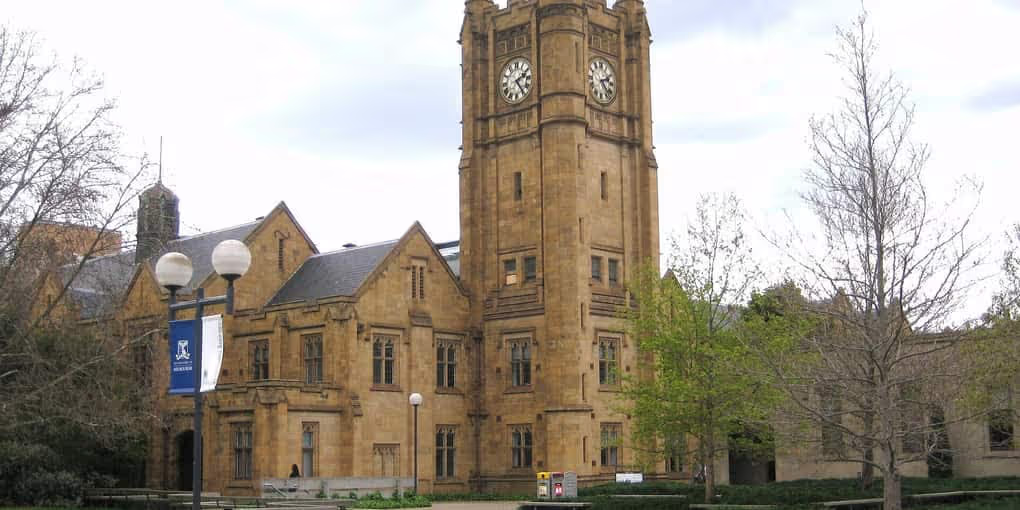
Monash University – University Guide for GCC and Southeast Asian Students
Overview
Monash University is a Group of Eight powerhouse in Melbourne — especially compelling for engineering, pharmacy, business and health, with one of Australia’s largest and most internationally connected student communities.
Monash University’s strongest international signals sit in:
- Engineering and IT — one of Monash’s largest international enrolment areas, with strong Asia-Pacific employer recognition
- Pharmacy and pharmaceutical sciences — a globally recognised Monash flagship, including the Parkville pharmacy precinct
- Medicine and health — competitive clinical pathways with major Melbourne hospital partnerships
- Business and economics — large undergraduate and postgraduate cohorts with regional alumni networks
- Law and education — professionally oriented pathways within a Group of Eight setting
- International tuition typically in the A$40,000–A$56,000 band for undergraduate study (always confirm on the official course page)
For GCC and Southeast Asian families comparing Australian options on subject fit, city lifestyle and total cost — not ranking alone — Monash is often worth a serious shortlist conversation.
Rankings snapshot (latest major league tables)
Monash University sits typically around the global top 40–50 in major global tables. Subject reputation and professional accreditation usually matter more than a single headline number:
- Overall standing — typically around the global top 40–50
- Monash regularly sits just behind Melbourne in Australian global rankings
- Pharmacy, engineering and business subject rankings are major parent decision drivers
Practical takeaway for parents: Use rankings as a filter, then decide on campus city, course accreditation and total multi-year cost for Monash.
Popular degrees for GCC and Southeast Asian students
Particularly strong and popular for
- Engineering — broad undergraduate and postgraduate routes across Clayton and related campuses
- Pharmacy / Pharmaceutical Sciences — among Monash’s clearest global subject signals
- Business and Commerce — popular with SEA students seeking a Go8 business pathway in Melbourne
- IT and Computer Science — high-demand STEM routes with strong graduate employment messaging
- Medicine and Biomedical Science — competitive health pathways — confirm entry route and fees carefully
- Law — a professionally framed Go8 law option for internationally mobile families
Less commonly chosen (from this region)
- Tiny boutique private-university experiences — Monash is large-scale by design
- Lowest-cost Victorian teaching-only options better matched to Federation or VU
- A quiet single-campus regional lifestyle
Why these courses appeal to GCC and SEA families
- Go8 prestige with massive subject breadth — suits families who want both ranking signal and course choice
- Pharmacy reputation — is genuinely distinctive among Australian universities
- Large SEA alumni and student networks — help with settling in and later career contacts
- Engineering and business employer recognition across Asia — supports mobility after graduation
- Multiple Melbourne campuses — let students match faculty to location (Clayton, Caulfield, Parkville and others)
Campus type and location
- City: Melbourne (Clayton) with Caulfield, Parkville pharmacy, Peninsula and international campuses
- Type: Group of Eight research university
- Setting: Australia’s largest university by enrolment, with Clayton as the main research campus in south-east Melbourne
Australia’s largest university by enrolment, with Clayton as the main research campus in south-east Melbourne. Checking the campus listed on the official course page is essential before budgeting for accommodation.
Why location matters for international families
Location shapes the real student experience at Monash:
- Clayton is south-east Melbourne — not CBD; use campus buses/trains
- Caulfield suits business and some arts/design pathways
- Melbourne winters are cold relative to GCC/SEA climates
- Living costs are Melbourne-high; start housing search early
For GCC and Southeast Asian families, Monash’s city and climate are often as important as its ranking when deciding whether Australia — and this campus — is the right fit.
Student demographic and culture
Monash University Monash University attracts a mix of domestic and international students, including growing cohorts from Southeast Asia and an increasing number of Gulf families. Expect:
- Large-scale, ambitious, research-intensive and highly international
- A practical, professionally oriented tone in many programmes
- Established international-student support for visas, enrolment and wellbeing
- Peer communities that form around courses, societies and shared housing
Male to female balance
Varies clearly by faculty:
- Engineering, IT and some STEM pathways often lean more male
- Nursing, Education, health and many Business majors sit closer to balanced or lean female
- Most students find peer groups quickly once teaching starts
Who tends to thrive at Monash
Students who usually do well here are those who:
- Want Go8 prestige with engineering, pharmacy, business or medicine pathways
- Are comfortable in a very large university
- Value strong Asia-Pacific alumni networks
- Can budget for Melbourne living plus Go8-level fees
Students whose priorities sit outside Monash’s clearer strengths — or who need a very different city experience — should compare carefully against other Australian options before deciding.
Accommodation options
University-managed and affiliated housing options exist around Monash’s teaching sites, with private share-houses and purpose-built student apartments common nearby. Typical arrangements include:
- On-campus or university-partnered halls near major teaching locations
- Self-catered student apartments in the campus city or suburb
- Private shared housing, especially from second year onward
Because popular suburbs fill quickly before Semester 1, families should start the housing search alongside the offer and visa process — and only after confirming which campus delivers the intended course.
Cost and budgeting notes for international families
- Living costs depend on whether the campus sits in a major capital or a regional city
- Budget for public transport, initial setup costs and seasonal clothing or climate needs
- A contingency for flights and arrival transfers is useful for GCC and SEA families
For tuition figures, deposits and scholarships, see Fee structure below.
Fee structure
For GCC and Southeast Asian families, Monash typically sits in a mid-range international fee band — commonly A$40,000–A$56,000 per year for undergraduate study, varying by faculty. Monash is Group of Eight pricing — expect upper Australian public fee bands, with pharmacy/medicine higher still. These figures are indicative only; always confirm the latest figures on the official course page and offer letter.
International tuition fees (indicative, 2026/27, in AUD)
| Level | Typical annual tuition |
|---|---|
| Undergraduate — Business, Education, classroom-based programmes | Commonly around A$40,000–A$48,000 per year |
| Undergraduate — Nursing, Health, IT | Commonly around A$42,000–A$52,000 per year |
| Undergraduate — Engineering, laboratory-heavy Science | Commonly around A$48,000–A$56,000 per year |
| Postgraduate taught | Often around A$40,000–A$60,000 per year (varies widely by programme) |
Useful points for parents:
- Engineering and laboratory-based science generally sit toward the higher end of the range.
- Clinical, placement-heavy or specialised professional programmes may carry additional costs — ask the faculty directly.
- Fees typically increase modestly each year of study; the offer letter states the exact schedule.
Deposit, CoE and payment timing
Students needing a Confirmation of Enrolment (CoE) for a Student visa (subclass 500) should expect Monash to request an initial tuition deposit after accepting an offer. The exact amount and deadline appear in the offer letter. Since January 2025, most subclass 500 applications must include a valid CoE at the time of lodgement.
Families should plan for:
- Offer received (conditional or unconditional)
- Deposit or initial tuition instalment paid by the stated deadline
- CoE issued once payment and any conditions are confirmed
- Student visa (subclass 500) application lodged using the CoE
- Remaining tuition settled by study period through the university’s payment portal
Scholarships and fee reductions (high-level)
Monash typically offers international scholarship routes that may include:
- Merit-based international awards assessed at application or offer stage
- Faculty-linked scholarships in high-enrolment international fields
- Pathway or progression discounts where foundation or diploma students continue into a degree
Practical tip: scholarship names and amounts change by intake — treat published figures as planning guides and confirm specifics through the offer and scholarship communications.
Living costs beyond tuition
Australia’s Department of Home Affairs sets a minimum living-cost financial requirement for the subclass 500 visa (around A$29,710 for the primary applicant as of 2026 guidance, in addition to tuition and travel). Full Melbourne budget required; Clayton-area housing is competitive in peak intake periods.
Families should budget separately for:
- Accommodation for the academic year
- Food, local transport and personal expenses
- Overseas Student Health Cover (OSHC), compulsory for the visa
- Flights and arrival costs
- Course-specific placement travel or materials where relevant
Admission procedure
Undergraduate applications
Most international undergraduate applicants apply directly to Monash University or through an approved education agent — not through UCAS.
Typical requirements include:
- Completion of secondary schooling to a standard broadly equivalent to Australian Year 12, assessed against Monash’s country-by-country entry guidance (national GCC/SEA curricula are individually assessed)
- Meeting the course-specific entry standard
- Academic transcripts, certificates and passport details
- English language evidence where required
English language for most undergraduate courses is commonly around IELTS 6.5–7.0, higher for medicine and some health programmes. Always check the exact course page for the intended intake, especially for health and education programmes. Students who fall short of direct entry can often progress through Monash College / foundation pathways where available.
Postgraduate applications
Postgraduate taught applications are made directly to Monash University, via the course page or an approved education agent.
Typical requirements include:
- A relevant bachelor’s degree with a grade average meeting the programme threshold
- Academic transcripts and degree certificate
- A CV and, for many programmes, a personal statement
- English language evidence
- Academic references for research-intensive or doctoral applications
Step-by-step pathway for international families
- Shortlist the course on the Monash site — confirm campus, fees, accreditation and intake month.
- Strengthen academics and English early — especially for competitive health, engineering and business routes.
- Apply directly or through an approved agent with certified transcripts and supporting documents.
- Receive an offer — conditional or unconditional.
- Accept the offer and pay the required deposit — needed before a CoE can be issued.
- Receive the CoE and apply for the subclass 500 student visa through the Department of Home Affairs.
- Arrange accommodation near the correct campus and organise OSHC before travel.
Intakes and timing
- Semester 1 (February) is the main intake across most undergraduate and postgraduate programmes.
- A Semester 2 (July) intake is available for many, though not all, courses — always confirm for the specific programme.
- Early application helps families resolve campus, scholarship and visa questions before timelines tighten.
Documents checklist (typical)
- Academic transcripts and certificates
- Passport copy
- English language test results (if required)
- CV and personal statement (especially postgraduate applicants)
- Academic references (for research-intensive and doctoral applicants)
- Proof of funds where requested ahead of the formal visa application stage
For GCC and SEA applicants: national curriculum results are assessed against Monash’s equivalency guidance. Where grades fall short of direct entry, foundation or diploma pathway routes may be available for some subject areas — confirm which campus delivers the pathway and the destination degree.
Academic intensity and social life
Academic demands vary by faculty at Monash. Professionally oriented degrees combine lectures with projects and placements; STEM routes add labs and quantitative assessment; business and social science lean toward coursework, case analysis and group work.
What students can generally expect:
- A lecture-and-tutorial structure in high-enrolment subjects
- Applied projects, labs or placements depending on the faculty
- An international peer group that makes cultural transition easier
- A social calendar shaped by campus societies and the surrounding city or region
Social life in practice
Campus clubs, cultural societies and faith groups are usually the fastest way for new international students to build community. City campuses add cafes, sport and part-time work options; regional campuses often compensate with tighter-knit student communities and outdoor lifestyle.
Sports, societies and wider profile
Monash supports academic, cultural and hobby clubs through its student association, plus recreational sport and country-specific societies. For GCC and SEA students, joining a faculty or cultural society early is one of the fastest ways to decode campus life.
Typical offerings include:
- Academic, cultural and hobby clubs through the student association
- Recreational and competitive sport
- Cultural and country-specific societies supporting GCC and Southeast Asian students
- Leadership, volunteering and peer-mentoring programmes
Careers and employer reputation
Monash’s graduate outcomes are strongest where its teaching strengths meet local and regional employer demand — exceptional Asia-Pacific recognition in engineering, pharmacy, business, IT and health.
Where Monash can be especially sensible
- Students targeting fields among Monash’s clearer strengths listed above
- Families wanting a strong subject fit in Melbourne
- Applicants who value professional accreditation and placements as much as league-table prestige
Where families should be realistic
Families should evaluate:
- Whether the campus city matches the student’s personality and the family’s budget
- How internship and placement support works in the chosen faculty
- Whether the student’s career target depends on a different city’s network density from year one
Used well, Monash University works best as a subject-and-city fit choice — particularly for students whose goals align with the strengths above — rather than a ranking-only shortlist decision.
Who should shortlist Monash University?
Consider shortlisting Monash if your child:
- Wants Go8 prestige with engineering, pharmacy, business or medicine pathways
- Is comfortable in a very large university
- Values strong Asia-Pacific alumni networks
- Can budget for Melbourne living plus Go8-level fees
Consider other options first if your child:
- Wants a small, intimate campus
- Needs the lowest-cost Victorian degree
How Tutopiya helps
Tutopiya works with students aiming for Monash University and other Australian universities by:
- Strengthening grades in subjects relevant to entry — particularly mathematics, sciences, English and business for Engineering, Health and CS pathways
- Building competitive academic profiles early enough for realistic university shortlists across Australian campuses
- Preparing for English language goals, personal statements and interviews where relevant
- Helping families understand fees, deposits, scholarships and application timelines, including CoE and subclass 500 visa sequencing
- Providing university counselling that weighs subject fit, campus location and career outcomes honestly rather than by ranking alone
- Issuing reference letters for tutoring and homeschooling students where Tutopiya has supported the student’s academic programme — useful for direct-entry applications when school references are limited or unavailable
- Connecting families with unpaid internship and work-experience opportunities (where available) to strengthen applications and personal statements before and during the admissions process
If you’d like tailored advice for your child’s situation, you can talk to Tutopiya’s team about a joined-up plan covering both exam preparation and university admissions.
🎓 Free tool
Build your personalised shortlist for Monash University →
See entry requirements matched to your own grades, tuition, deadlines and reach/target/safety tiering — free, no signup needed to browse.
Ready to Excel in Your Studies?
Get personalised help from Tutopiya's expert tutors. Whether it's IGCSE, IB, A-Levels, or any other curriculum — we match you with the perfect tutor and your first session is free.
Book Your Free TrialWritten by
Tutopiya Team
Related Articles

Heriot-Watt University Dubai – University Guide for GCC and Southeast Asian Students
Detailed guidance for international students from the Gulf and Southeast Asia considering Heriot-Watt University Dubai, including fees, admissions, campus life, accommodation and graduate outcomes.

University of Birmingham Dubai – University Guide for GCC and Southeast Asian Students
Detailed guidance for international students from the Gulf and Southeast Asia considering University of Birmingham Dubai, including fees, admissions, campus life, accommodation and graduate outcomes.

Abu Dhabi University – University Guide for GCC and Southeast Asian Students
Detailed guidance for international students from the Gulf and Southeast Asia considering Abu Dhabi University (ADU), including fees, admissions, campus life, accommodation and graduate outcomes.