
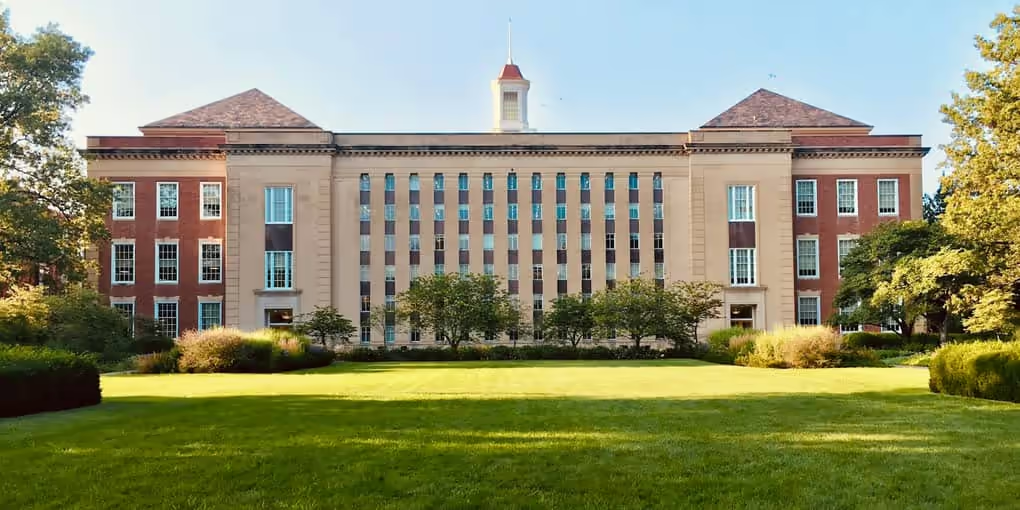
De Montfort University – University Guide for GCC and Southeast Asian Students
Overview
De Montfort University (widely known as DMU) is one of the UK’s most international student communities by proportion, based in Leicester, a genuinely diverse Midlands city that has hosted large South Asian, Gulf and international communities for decades. For families from the GCC and Southeast Asia, that existing familiarity often makes the transition noticeably smoother than at less internationally established campuses.
DMU teaches from a single consolidated city-centre campus in Leicester, redeveloped in recent years into a landscaped, largely pedestrianised “Campus Square.” For families comparing UK options, De Montfort is usually shortlisted for:
- Fashion and textile design — one of DMU’s flagship strengths, with a strong industry reputation and an annual graduate fashion show
- Cyber security and computing — supported by the university’s Cyber Technology Institute, a genuine specialist strength
- Business, criminology and forensic science — practical, career-facing degrees with strong local and regional employer links
- International tuition typically in the £16,000–£18,000 band for most undergraduate programmes (always confirm on the official course page)
If your family wants a large, established international community, a single walkable campus and genuinely strong niche specialisms, De Montfort deserves a place on a realistic shortlist.
Rankings snapshot (latest major league tables)
De Montfort is not typically positioned as a prestige-first destination in the way families might approach older civic or Russell Group universities. Its strengths are concentrated in specific applied and creative fields rather than spread evenly across every subject.
In recent major UK tables it often sits in the UK mid-table, with stronger recognition in areas such as:
- Fashion and textile design — a long-standing flagship department with genuine industry recognition, including at London Fashion Week showcases
- Cyber security — recognised by the National Cyber Security Centre as an Academic Centre of Excellence in Cyber Security Education, a notable specialist credential
- Criminology and forensic science — practical, career-oriented programmes with strong graduate outcomes in policing and legal sectors
- Art, design and media — supported by well-resourced studio and production facilities
- Business and law — solid, employability-focused teaching
- Health and life sciences — including pharmacy, which carries its own professional accreditation route
Globally, DMU tends to sit in broader mid-ranked international bands. For most GCC and SEA families, the more useful comparison is department-level reputation — particularly in fashion and cyber security — rather than the overall university position.
Practical takeaway for parents: for fashion and cyber security specifically, DMU’s specialist reputation is genuinely stronger than its general league-table position — worth checking department-level recognition directly.
Popular degrees for GCC and Southeast Asian students
De Montfort’s portfolio spans fashion, computing, business, law, health and criminology, with clusters of genuine strength that consistently attract international interest.
Particularly strong and popular for
- Fashion Design and Fashion Buying and Merchandising — taught with strong industry links and a flagship annual graduate fashion show attended by industry scouts
- Cyber Security and Computer Science — backed by the Cyber Technology Institute, popular with students aiming for careers in a fast-growing global sector
- Criminology and Forensic Science — practical, evidence-based programmes with access to dedicated forensic facilities
- Business and Accounting and Finance — career-facing degrees with placement-year options
- Law (LLB) — structured legal education with mooting and practical skills components
- Architecture and the Built Environment — professionally accredited routes into the construction and design sectors
Less commonly chosen (from this region)
- Medicine and dentistry — De Montfort does not run its own medical or dental school
- Ultra-competitive, research-led pure sciences where a Russell Group university may offer a stronger academic pathway
- Highly theoretical humanities where employability framing is less central to the course design
Why these courses appeal to GCC and SEA families
- Fashion design at DMU carries genuine industry weight, giving students a credible route into an internationally competitive creative sector
- The Cyber Technology Institute’s recognised status gives cyber security graduates a specialist credential valued by employers across the Gulf’s growing tech sector
- Leicester’s large, established international and South Asian community eases cultural adjustment for many GCC and SEA families
- The single, walkable campus simplifies daily life for first-year international students
- International fees that sit in a moderate band relative to London and many larger English cities
Campus type and location
- City: Leicester, East Midlands, England
- Type: Single consolidated city-centre campus
- Setting: A landscaped, largely pedestrianised campus redeveloped as “Campus Square,” directly adjoining Leicester’s city centre
DMU’s campus brings together teaching buildings, the library, students’ union and much of its accommodation within a compact, walkable area — a genuine advantage for international students who prefer a straightforward daily routine over navigating a sprawling multi-site university.
Why location matters for international families
Leicester’s setting offers several practical advantages:
- Leicester is one of the UK’s most ethnically diverse cities, with long-established South Asian, Gulf and wider international communities, extensive halal food options and multiple mosques
- Living costs are noticeably lower than London, while the city still offers a full range of shops, restaurants and cultural life
- London is roughly one hour away by train, and Birmingham around 30–40 minutes — useful for internships, networking and weekend access without daily commuting costs
- The compact campus keeps commute times short for the large majority of students living in university or nearby private accommodation
For many GCC and Southeast Asian students, Leicester’s existing international character and DMU’s large international cohort make settling in noticeably easier than at less internationally established UK cities.
Leicester is also a genuinely well-connected regional hub, sitting roughly midway between London and the north of England, which some families use to their advantage when planning visits, internships or graduate job searches across a wider catchment than the city itself.
Student demographic and culture
De Montfort teaches around 28,000 students, one of the larger single-campus student populations in the UK, with a long history of recruiting internationally — DMU has historically had one of the highest proportions of international students among UK universities of its type. The culture tends to feel:
- Genuinely diverse and cosmopolitan, reflecting Leicester’s wider demographic mix
- Practical and career-oriented, particularly in fashion, cyber security, criminology and business
- Campus-centred, with most student life happening within walking distance of Campus Square
- Supportive of international students through an established, experienced international office
Male to female balance
Varies clearly by subject:
- Fashion design, fashion buying and merchandising often lean more female
- Cyber security, computer science and forensic science often lean more male, though this is narrowing
- Business, law and criminology tend to sit closer to balanced
Who tends to thrive at De Montfort
Students who usually do well here are those who:
- Want applied, career-facing degrees in fashion, computing, business, law or criminology
- Are interested in cyber security as a fast-growing global career sector
- Value being part of a large, established international student community
- Prefer a single consolidated campus over navigating multiple city sites
- Appreciate Leicester’s cultural and religious familiarity for GCC and South and Southeast Asian students
Students whose main priority is elite ranking signalling or a very small, intimate university community may prefer other options as a first choice.
Accommodation options
University-managed accommodation is available on and around Campus Square, with options typically including:
- Standard single rooms in halls
- En-suite rooms in newer residences
- Self-catered contracts on most hall agreements, alongside private shared housing across Leicester for returning students
Because the campus is compact and largely pedestrianised, most halls sit within a short walk of teaching buildings, keeping daily commutes minimal.
Cost and budgeting notes for international families
Living in Leicester is generally more affordable than London, Manchester or Bristol. Families should still plan for:
- Accommodation for the academic year
- Fashion and design materials, portfolio and show-related costs for creative courses
- Food, personal expenses and occasional London or Birmingham travel
- Flights and arrival costs
- A modest allowance for fabric or materials top-ups during the run-up to the annual fashion show
For tuition figures, deposits and scholarships, see Fee structure below.
Fee structure
For GCC and Southeast Asian families, De Montfort is often considered a moderate UK option for international tuition — typically in the £16,000–£18,000 band for many undergraduate programmes, though exact figures vary by course and intake. Always confirm the latest figures on the official course page and offer letter.
International tuition fees (indicative, 2026/27)
| Level | Typical annual tuition |
|---|---|
| Undergraduate — classroom-based programmes (Business, Law, Criminology) | Commonly around £16,000–£17,000 per year |
| Undergraduate — studio, lab or specialist programmes (Fashion, Cyber Security, Forensic Science) | Commonly around £17,000–£18,000 per year |
| Postgraduate taught | Often around £17,500–£19,000 per year (varies by programme) |
Useful points for parents:
- Fashion design carries additional materials, textiles and show-related costs beyond headline tuition.
- Cyber security and forensic science may involve specialist lab access fees on some programmes.
- Postgraduate fees vary by school and professional accreditation requirements.
Deposit, CAS and payment timing
If a student needs a CAS (Confirmation of Acceptance for Studies) for a UK Student Visa, De Montfort typically requires a deposit after an offer is accepted. The exact amount and deadline appear in the offer letter — plan for this early.
Families should plan for:
- Offer received (conditional or unconditional)
- Deposit payment by the deadline stated in the offer
- CAS issued for the visa application
- Remaining tuition paid according to the university’s payment options
Scholarships and fee reductions (high-level)
De Montfort offers international scholarship routes that can reduce net cost for strong applicants. Typical examples families should ask about include:
- Merit-based international scholarships tied to academic profile and intake
- Faculty-specific bursaries within fashion, computing or business
- Alumni progression discounts for students continuing from De Montfort undergraduate to postgraduate study
Practical tip: scholarship eligibility and deadlines change by intake. Treat published ranges as planning guides, then confirm what appears in the student’s offer and scholarship communications.
Living costs beyond tuition
East Midlands living costs are generally lower than London, but UK Student Visa financial evidence requirements still apply. Families should budget separately for:
- On-campus or private accommodation
- Food, transport and daily expenses
- Materials or equipment specific to fashion, cyber security or forensic science courses
- Flights and arrival costs, plus occasional travel to London or Birmingham
Admission procedure
De Montfort’s admissions process is generally accessible compared with the most selective Russell Group universities, though fashion design typically requires a portfolio and cyber security or forensic science may ask for stronger science grades.
Undergraduate applications
Most international undergraduate applicants apply through:
- UCAS (standard route for Year 1 entry), and/or
- University or approved in-country representative channels
Typical requirements include:
- Completion of around 12 years of schooling with a qualification broadly equivalent to UK A Levels (national GCC/SEA curricula are assessed individually)
- Meeting the course-specific academic tariff — fashion design routes typically require a portfolio, and cyber security or forensic science may ask for stronger mathematics or science grades
- A personal statement and supporting documents (transcripts, passport details, references as required)
- English language evidence where needed
English language for many undergraduate courses is commonly around IELTS 6.0–6.5 overall (with minimum band scores), though law and some professional programmes may ask for higher scores. Always check the exact course page.
Postgraduate applications
Postgraduate taught applications are usually made directly to the university (via the course page) or through approved representatives.
Typical requirements include:
- A relevant bachelor’s degree at a level broadly equivalent to a UK second-class honours degree
- Academic transcripts and degree certificate
- Personal statement and CV where requested
- Portfolio for fashion, design and some creative routes
- English language evidence — commonly around IELTS 6.5, with higher requirements for law and some professional programmes
Step-by-step pathway for international families
- Shortlist the course — confirm entry requirements, fees, intake month and any placement year option.
- Prepare academics, English and (where relevant) a portfolio — strengthen IGCSE/A Level or equivalent profiles early, particularly mathematics for cyber security.
- Submit the application — via UCAS for undergraduate routes, or direct/representative routes for postgraduate.
- Receive an offer — conditional (e.g. pending grades, English or portfolio) or unconditional.
- Accept the offer and pay the deposit — required for CAS in most visa cases.
- Receive CAS and apply for the Student Visa — usually no earlier than six months before the course start date.
- Arrange accommodation and arrival — on-campus housing around Campus Square is often the simplest first-year option.
Intakes and timing
- September is the main intake for most undergraduate and postgraduate programmes.
- Selected postgraduate courses may offer January entry — check individual programme pages.
- UCAS equal-consideration deadlines are usually in January for September entry, with later applications possible subject to availability.
Documents checklist (typical)
- Academic transcripts and certificates
- Passport copy
- Personal statement
- Reference(s)
- English language test results (if required)
- Portfolio (for fashion, design and selected creative courses)
For GCC and SEA applicants: national curriculum results are assessed against De Montfort’s equivalency guidance. Where grades fall short of direct entry, foundation-year routes may be available for some subject areas.
Academic intensity and social life
Academic expectations vary by department at De Montfort. Fashion design involves intensive studio hours, pattern-cutting and a demanding lead-up to the annual graduate show; cyber security and computer science combine lectures with hands-on lab and coding work; business, law and criminology follow a more conventional lecture-and-seminar structure with case studies and mooting.
Forensic science and pharmacy students spend significant time in dedicated laboratory sessions alongside standard lectures, giving these courses a noticeably heavier practical workload than the university’s business-facing degrees.
What students can generally expect:
- Studio-based, practical assessment in creative subjects alongside conventional exams and coursework in business, law and computing
- Access to dedicated fashion studios, cyber security labs and forensic science facilities
- A social calendar built around Campus Square, the students’ union and Leicester’s wider city-centre life
- A genuinely diverse peer group reflecting Leicester’s international character
Social life in practice
Because DMU’s campus is compact and adjoins Leicester city centre directly, social life happens naturally across halls, societies, the students’ union and the surrounding city — without the fragmentation of a multi-site university. Leicester’s established international communities also mean cultural societies, food options and places of worship are readily accessible from day one, which many GCC and SEA students find reassuring.
Sports, societies and wider profile
De Montfort offers a wide range of clubs and societies reflecting both its size and its diverse student population:
- Fashion and design societies with strong showcase and networking culture ahead of the annual graduate show
- Cyber security and computing societies, including hackathons and industry-linked events
- Standard university sports (rugby, football, netball, cricket) alongside cultural, faith and volunteering groups
- Well-established South Asian, Middle Eastern and wider international cultural societies
For GCC and SEA students, cultural societies and the international office’s welcome programme can be especially useful in the first term, given Leicester’s existing international community.
Careers and employer reputation
De Montfort’s employer reputation is strongest in its specialist subject areas — fashion, cyber security, criminology and forensic science — rather than as a generic prestige brand.
Where De Montfort can be especially sensible
- Students targeting fashion design or fashion buying and merchandising, where DMU’s industry links and annual show carry genuine weight
- Applicants interested in cyber security, supported by a nationally recognised centre of excellence in a fast-growing global sector
- Students considering criminology, forensic science or law with a practical, career-facing framing
- Families who want a large, internationally established community and a lower cost of living than London
Where families should be realistic
De Montfort will not carry the same brand weight as top Russell Group names in highly competitive prestige markets (investment banking, magic-circle law, etc.). That does not mean weak outcomes — it does mean families should evaluate:
- The specific course’s placement rate and employer partnerships
- Whether the sector (fashion, cyber security, criminal justice) matches the student’s genuine interests
- Post-study work goals and location preferences, given DMU’s regional (rather than London-centric) employer network
Used well, De Montfort can be an excellent “specialist subject + diversity + value” choice.
Who should shortlist De Montfort University?
Consider shortlisting De Montfort if your child:
- Wants a genuinely industry-connected fashion design education
- Is interested in cyber security or computer science as a fast-growing global career sector
- Would benefit from Leicester’s large, established international community
- Prefers a single, walkable city-centre campus over multiple dispersed sites
- Values moderate international fees compared with London universities
Consider other options first if your child:
- Needs the strongest possible prestige signal for ultra-competitive pathways
- Is targeting medicine, dentistry or a subject De Montfort doesn’t specialise in
- Would prefer a smaller, more intimate university community over a large single-campus population
How Tutopiya helps
Tutopiya works with students aiming for De Montfort University and other UK universities by:
- Strengthening grades in IGCSE and International A-Level subjects that matter for entry — especially mathematics, computing, art and business pathways
- Building competitive academic profiles and portfolios early enough for realistic university shortlists
- Preparing for portfolio submissions, English language goals and interviews where relevant
- Helping families understand fees, deposits, scholarships and application timelines
- Providing university counselling that weighs ranking, cost, course fit, location and progression honestly
- Issuing reference letters for tutoring and homeschooling students where Tutopiya has supported the student’s academic programme — useful for UCAS applications and direct-entry paperwork when school references are limited or unavailable
- Connecting families with unpaid internship and work-experience opportunities (where available) to strengthen personal statements, portfolios and graduate CVs before and during university applications
If you’d like tailored advice for your child’s situation, you can talk to Tutopiya’s team about a joined-up plan covering both exam preparation and university admissions.
🎓 Free tool
Build your personalised shortlist for De Montfort University →
See entry requirements matched to your own grades, tuition, deadlines and reach/target/safety tiering — free, no signup needed to browse.
Ready to Excel in Your Studies?
Get personalised help from Tutopiya's expert tutors. Whether it's IGCSE, IB, A-Levels, or any other curriculum — we match you with the perfect tutor and your first session is free.
Book Your Free TrialWritten by
Tutopiya Team
Related Articles

Heriot-Watt University Dubai – University Guide for GCC and Southeast Asian Students
Detailed guidance for international students from the Gulf and Southeast Asia considering Heriot-Watt University Dubai, including fees, admissions, campus life, accommodation and graduate outcomes.

University of Birmingham Dubai – University Guide for GCC and Southeast Asian Students
Detailed guidance for international students from the Gulf and Southeast Asia considering University of Birmingham Dubai, including fees, admissions, campus life, accommodation and graduate outcomes.

Abu Dhabi University – University Guide for GCC and Southeast Asian Students
Detailed guidance for international students from the Gulf and Southeast Asia considering Abu Dhabi University (ADU), including fees, admissions, campus life, accommodation and graduate outcomes.