
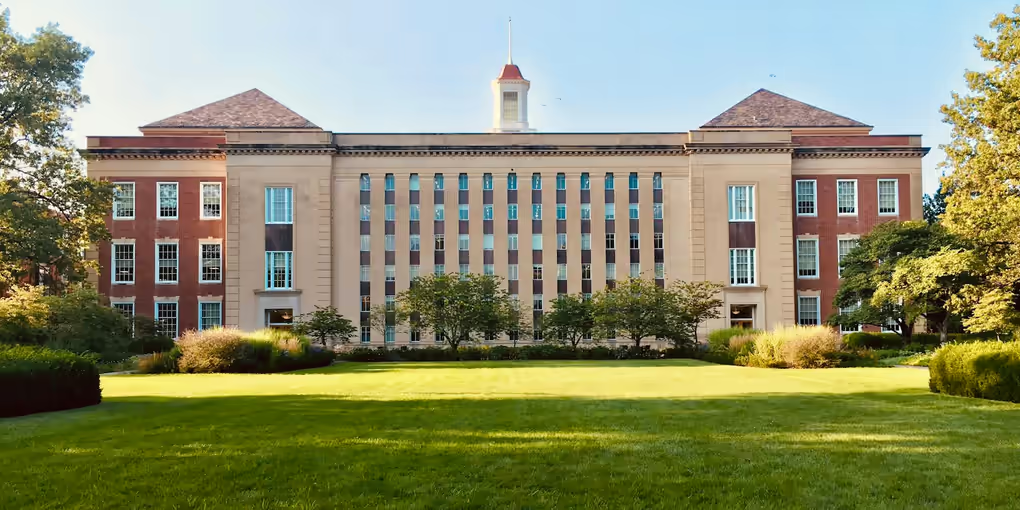
Avondale University – University Guide for GCC and Southeast Asian Students
Overview
Avondale University is one of Australia’s smallest higher-education communities — roughly 1,300 students — and that scale is the point, not a drawback. Rooted in a Seventh-day Adventist heritage and based primarily at Lake Macquarie / Cooranbong on the New South Wales Central Coast, with selected study options linked to Sydney, Avondale suits families who want a quiet, values-shaped campus rather than a large metropolitan lecture theatre.
For GCC and Southeast Asian families, Avondale usually enters the conversation for these reasons:
- Nursing — a professionally framed pathway with clinical placement expectations typical of Australian nursing degrees
- Education — primary and secondary teaching routes within a close pastoral community
- Business — smaller cohorts than city business schools, with personal staff access
- Theology and ministry — central to Avondale’s identity for students preparing for church, chaplaincy or faith-based leadership roles
- Science — undergraduate science pathways that benefit from small-group laboratory teaching
- International tuition commonly in the A$37,800–A$51,120 band depending on discipline (always confirm on the official course page; music and some specialist fields sit higher)
Families who want a safe, residential, faith-aware Australian experience — without sacrificing registered nursing or teaching pathways — often find Avondale worth a careful look.
Rankings snapshot (latest major league tables)
Avondale does not chase global league-table headlines the way Group of Eight research universities do. Its reputation is local, professional and community-based:
- Teaching quality and student support — consistently the signals families hear from alumni and agents, rather than a single QS overall rank
- Nursing and Education — assessed by Australian professional and registration frameworks more than by international research rankings
- Theology and ministry — recognised within Adventist and related church networks across Australia, the Pacific and parts of Asia
- Graduate employability in vocational fields — nursing and teaching graduates typically move into structured workforce pathways rather than broad corporate graduate schemes
Practical takeaway for parents: read Avondale as a specialist small university — judge it on nursing, education, theology or science fit, campus safety and pastoral support, not on a global top-100 position it was never designed to hold.
Popular degrees for GCC and Southeast Asian students
Particularly strong and popular for
- Bachelor of Nursing — the programme international families ask about most often, with clinical placements in regional and metro health settings
- Education (teaching) — a natural fit for students who want smaller practicum cohorts and closer mentoring
- Business — accessible entry relative to large city universities, with a personal teaching style
- Theology and ministry — for students whose vocation is church leadership, mission or Adventist institutional service
- Science — laboratory-based undergraduate science in a low-distraction environment
Less commonly chosen (from this region)
- Large-scale engineering, architecture or research-intensive biomedical science better served by major metropolitan universities
- Fashion, media production or creative industries that depend on Sydney CBD studio networks
- Highly competitive medicine pathways — Avondale is not a medical school
Why these courses appeal to GCC and SEA families
- Tiny cohorts mean lecturers know students by name — a genuine advantage for first-time study abroad
- Nursing and teaching lead toward Australian registration pathways when English, clinical and character requirements are met
- A faith-aware campus rhythm (including Adventist heritage practices) can feel familiar to families from Christian communities in the Gulf and Southeast Asia
- Living costs around Lake Macquarie are typically calmer than inner Sydney
- Selected Sydney-linked options give some programmes metro access without forcing a full CBD lifestyle
Campus type and location
- Primary campus: Lake Macquarie / Cooranbong, New South Wales — a leafy, residential setting inland from the Central Coast shoreline
- Additional options: selected programmes and study arrangements connected to Sydney
- Type: Private Christian university on a compact, close-knit campus
- Nearest major city: Newcastle is the practical urban hub; Sydney is reachable for weekends and flights
The Cooranbong campus feels more like a residential college town than a city university. Students live, study and socialise within a short walk of most facilities — which is exactly why some families choose it, and why others prefer a busier metro campus.
Why location matters for international families
- Quiet coastal NSW near Newcastle suits students who want nature, safety and focus over nightlife
- Part-time work and internship density are lower than Sydney or Melbourne — plan career experience deliberately
- Weekend travel to Sydney is realistic for shopping, flights and family visits, but daily life is regional
- Families should confirm whether their intended course runs fully at Lake Macquarie or involves Sydney delivery before applying
For GCC and Southeast Asian students used to dense urban campuses, Avondale requires an honest lifestyle conversation: this is a deliberate slow-down, not a temporary version of a capital-city degree.
Student demographic and culture
With around 1,300 students, Avondale’s culture is shaped by Adventist heritage, residential living and a strong emphasis on community wellbeing. The atmosphere tends to feel:
- Close-knit and pastoral — staff and students interact far more than at anonymous mega-campuses
- Values-conscious, with chapel, service and wellbeing activities woven into campus life (open to students of varied backgrounds who respect the community ethos)
- Academically focused rather than status-driven
- Quieter socially than Sydney CBD universities, with friendships forming through halls, sport and course cohorts
Male to female balance
Varies by field:
- Nursing and Education cohorts often lean female, matching national patterns
- Theology, ministry and some science streams can sit closer to balanced or lean male depending on intake
- Business tends toward a more even mix
Who tends to thrive at Avondale
Students who usually settle well here are those who:
- Want a residential, village-scale university rather than a sprawling city campus
- Are pursuing nursing, teaching, theology, business or science with close academic mentoring
- Are comfortable with — or at least respectful of — a Christian campus culture
- Prefer safety and structure for a first degree abroad
- Can initiate their own networking when they need Sydney-based experience
Students who need constant metropolitan energy, large society scenes or dense part-time job markets often shortlist Newcastle, Sydney or Brisbane universities instead.
Accommodation options
Avondale’s residential character is one of its practical strengths for international arrivals. Typical arrangements include:
- On-campus residential halls and college-style housing close to teaching buildings
- Meal-plan options on some residential contracts — useful for first-year settlers
- Limited private rental nearby for returning students who want more independence
Because the campus is compact, commute times are short — a real advantage compared with Sydney students travelling across suburbs daily.
Cost and budgeting notes for international families
Living costs at Lake Macquarie / Cooranbong are generally lower than Sydney or Melbourne, but families should still plan for:
- Occasional travel into Newcastle or Sydney for appointments, flights or social trips
- Clinical placement travel and uniforms for Nursing students
- Clothing for a mild coastal NSW climate that is cooler and wetter than many Gulf or tropical SEA cities in winter
- Overseas Student Health Cover (OSHC), compulsory for the subclass 500 visa
- A contingency for placement immunisations and background checks
For tuition figures, deposits and scholarships, see Fee structure below.
Fee structure
For GCC and Southeast Asian families, Avondale typically sits in a mid-to-upper private-university fee band — commonly A$37,800–A$51,120 per year for full-time international undergraduate study, with published semester rates around A$18,920 for several education, nursing, science and business pathways. Music and some specialist fields can cost materially more. These figures are indicative only; always confirm the latest AUD amounts on the official course page and offer letter.
International tuition fees (indicative, 2026/27, in AUD)
| Level | Typical annual tuition |
|---|---|
| Undergraduate — Education, Business, Theology (many streams) | Commonly around A$37,800–A$42,000 per year |
| Undergraduate — Nursing and Science | Commonly around A$37,800–A$45,000 per year |
| Undergraduate — Music and selected specialist fields | Can approach or exceed A$50,000–A$51,120 per year |
| Postgraduate taught | Often around A$38,000–A$52,000 per year (varies by programme) |
Useful points for parents:
- Nursing typically adds placement-related costs (uniforms, immunisations, checks) beyond tuition.
- Fee schedules can differ between Lake Macquarie and any Sydney-linked delivery — check the exact course and location.
- Postgraduate ministry, education and health pathways are priced separately from undergraduate study.
Deposit, CoE and payment timing
Students needing a Confirmation of Enrolment (CoE) for a Student visa (subclass 500) should expect Avondale to request an initial tuition deposit after accepting an offer. The amount and deadline appear in the offer letter.
Families should plan for:
- Offer received (conditional or unconditional), confirming campus and course
- Deposit or initial tuition instalment paid by the stated deadline
- CoE issued once payment and conditions are confirmed
- Student visa (subclass 500) application lodged using the CoE
- Remaining tuition settled by semester through the university’s payment options
Scholarships and fee reductions (high-level)
Avondale periodically offers international fee support such as:
- Merit-based tuition reductions tied to academic results
- Church-linked or mission-related bursaries for theology and ministry students in some intakes
- Early-acceptance incentives when published for a given year
Practical tip: scholarship windows change by intake — treat published AUD figures as planning guides and confirm through the offer and scholarship office.
Living costs beyond tuition
Australia’s Department of Home Affairs sets a minimum living-cost requirement for the subclass 500 visa. Actual spending at Avondale is usually more manageable than Sydney, but families should still budget separately for:
- Residential accommodation and meals where applicable
- Food, local transport and personal expenses
- OSHC for the full visa period
- Placement and practicum costs for Nursing and Education
- Flights into Newcastle or Sydney airports
Admission procedure
Undergraduate applications
Most international undergraduate applicants apply directly to Avondale University or through an approved education agent — not through UCAS.
Typical requirements include:
- Secondary schooling broadly equivalent to Australian Year 12 (GCC and SEA national curricula are assessed individually)
- Meeting the course-specific academic standard — Nursing and Education places are more contested than some arts or ministry streams
- Academic transcripts, certificates and passport details
- English language evidence where required
- For Nursing and Education, early awareness of health clearances, immunisations and Working with Children Check equivalents ahead of placements
English language for most undergraduate courses is commonly around IELTS 6.5 overall (no band below 6.0), with Nursing and Education sometimes requiring higher scores linked to professional registration. Always check the exact course page for the intended intake.
Postgraduate applications
Postgraduate taught applications are usually made directly to Avondale, via the course page or an approved agent.
Typical requirements include:
- A relevant bachelor’s degree, with prerequisites for teaching, nursing or ministry pathways where applicable
- Academic transcripts and degree certificate
- A CV and, for ministry or education routes, a statement of purpose or vocation reflection
- English language evidence — commonly around IELTS 6.5, higher for some professionally regulated programmes
- References where requested for theology or counselling-related awards
Step-by-step pathway for international families
- Confirm the course and delivery location — Lake Macquarie versus any Sydney-linked arrangement.
- Strengthen academics and English early — especially for Nursing and Education.
- Apply directly or through an approved agent with certified documents.
- Receive an offer — conditional or unconditional.
- Accept the offer and pay the deposit — required before a CoE can be issued.
- Receive the CoE and apply for the subclass 500 student visa.
- Arrange residential housing and placement prerequisites — Nursing and Education students should start paperwork early.
Intakes and timing
- Semester 1 (February) is the main intake for most undergraduate and postgraduate programmes.
- A Semester 2 (July) start is available for some courses — confirm course by course.
- Popular Nursing and Education places can fill ahead of soft deadlines — early application helps.
Documents checklist (typical)
- Academic transcripts and certificates
- Passport copy
- English language test results (if required)
- Personal statement or vocation statement (especially theology/ministry)
- Immunisation and background-check documentation (Nursing, Education)
- Proof of funds ahead of the visa application stage
For GCC and SEA applicants: country equivalency tables determine direct entry. Where results fall short, pathway or foundation options may be available — confirm current arrangements with Avondale directly.
Academic intensity and social life
Academic load at Avondale is serious but delivered in small groups. Nursing balances theory with clinical blocks that can feel intense in placement weeks; Education combines campus coursework with school practicums; Theology and ministry emphasise reading, reflection and supervised ministry practice; Science students spend meaningful time in labs rather than anonymous mega-lectures.
Assessment patterns typically include written exams and essays, clinical or practicum evaluations, ministry practicum reports, and laboratory write-ups in science.
What students can generally expect:
- High staff accessibility and pastoral follow-up when assessment pressure rises
- Structured placement weeks that reshape the weekly timetable in Nursing and Education
- A quieter evening social scene than capital-city campuses
- Community events, sport and faith-linked activities as the main social fabric
Social life in practice
Friendships form quickly because nearly everyone studies and lives on the same compact footprint. International students often describe the first semester as surprisingly easy to settle into socially — the trade-off is less “city night out” variety, so students who need urban stimulation usually plan regular Newcastle or Sydney trips.
Sports, societies and wider profile
Avondale’s extracurricular scene matches its size:
- Campus sport and recreational fitness rather than large national university league programmes
- Student leadership, service and mission-oriented groups reflecting Adventist heritage
- Discipline clubs within Nursing, Education and Theology that double as peer-support networks
- Cultural and international student gatherings that help newcomers find community quickly
For GCC and SEA students, joining a course cohort group or campus service activity is usually the fastest route into friendships and informal mentoring.
Careers and employer reputation
Avondale’s employer recognition is strongest in the professional and faith-linked pathways it specialises in.
Where Avondale can be especially sensible
- Students targeting nursing or teaching who want small cohorts and intensive pastoral support
- Applicants preparing for ministry, chaplaincy or Adventist institutional roles
- Families prioritising a safe, residential, values-aware Australian campus for a first degree abroad
- Students who thrive academically when staff know them personally
Where families should be realistic
Avondale is not a broad research-intensive university. Families should evaluate:
- Whether the career goal truly sits in nursing, education, theology, business or science
- How the student will access Sydney-based internships if those matter for the intended career
- Whether the Adventist-heritage campus culture is a genuine fit, not just a convenient fee comparison
Used well, Avondale works best as a small, vocation-focused choice — particularly powerful when the family already values Christian community and a calm NSW coastal setting.
Who should shortlist Avondale University?
Consider shortlisting Avondale if your child:
- Wants a small, residential campus near Lake Macquarie rather than a mega-city university
- Is focused on nursing, education, theology, ministry, business or science
- Would benefit from close staff contact and a structured pastoral environment
- Is comfortable studying within a Seventh-day Adventist heritage community (students of other backgrounds are welcome when they respect campus ethos)
- Prefers lower urban intensity than Sydney for the undergraduate years
Consider other options first if your child:
- Needs daily access to a large metropolitan internship and nightlife scene
- Is aiming for medicine, elite research STEM or large-scale engineering
- Would feel constrained by a quiet, faith-aware campus culture
How Tutopiya helps
Tutopiya works with students aiming for Avondale University and other Australian universities by:
- Strengthening grades in subjects that matter for Avondale entry — especially biology, English and mathematics for Nursing and Education routes
- Building realistic shortlists that weigh small Christian campuses against larger metro alternatives
- Preparing for English language goals and direct-application requirements
- Helping families interpret AUD fees, deposits, scholarships and CoE timing for the subclass 500 visa
- Providing university counselling that treats campus culture and vocation fit as seriously as rankings
- Issuing reference letters for tutoring and homeschooling students where Tutopiya has supported the academic programme — useful for direct-entry applications when school references are limited
- Connecting families with unpaid internship and work-experience opportunities (where available) to strengthen applications and early career readiness
If you’d like tailored advice for your child’s situation, you can talk to Tutopiya’s team about a joined-up plan covering both exam preparation and university admissions.
🎓 Free tool
Build your personalised shortlist for Avondale University →
See entry requirements matched to your own grades, tuition, deadlines and reach/target/safety tiering — free, no signup needed to browse.
Ready to Excel in Your Studies?
Get personalised help from Tutopiya's expert tutors. Whether it's IGCSE, IB, A-Levels, or any other curriculum — we match you with the perfect tutor and your first session is free.
Book Your Free TrialWritten by
Tutopiya Team
Related Articles

Heriot-Watt University Dubai – University Guide for GCC and Southeast Asian Students
Detailed guidance for international students from the Gulf and Southeast Asia considering Heriot-Watt University Dubai, including fees, admissions, campus life, accommodation and graduate outcomes.

University of Birmingham Dubai – University Guide for GCC and Southeast Asian Students
Detailed guidance for international students from the Gulf and Southeast Asia considering University of Birmingham Dubai, including fees, admissions, campus life, accommodation and graduate outcomes.

Abu Dhabi University – University Guide for GCC and Southeast Asian Students
Detailed guidance for international students from the Gulf and Southeast Asia considering Abu Dhabi University (ADU), including fees, admissions, campus life, accommodation and graduate outcomes.