

How to Motivate a Child Who Resists Tuition
Quick answer: To motivate a child who resists tuition, start by understanding why they are pushing back - it is almost always fear or resentment, not laziness. Involve them in the decision, frame tuition as support rather than punishment, and let them meet the tutor before committing to anything. A reluctant child who connects with the right tutor and experiences a few small wins will usually swap dread for willingness faster than you would expect.
Few things wear parents down like the nightly tuition battle - the sighs, the slammed doors, the “I don’t need it” from a child who plainly does. Before you brace for another argument, it helps to know that resistance is rarely about the tuition itself. It is about how your child feels, and once you address that, the fight tends to fade.
Why children resist tuition (it is rarely laziness)
Push past the sulk and you usually find one of a few real reasons.
- Fear of failing again. A child who has struggled protects themselves by not trying. If they never attempt it, they cannot fail - and refusing tuition is part of that armour.
- Tuition feels like punishment. If extra lessons only ever appear after bad grades, the child learns to see them as a penalty for being “not good enough.”
- More of the same. If school teaching is not clicking, why would more of it? Children dread being made to sit through the exact style that already confuses them.
- Lost free time. After a full school day and CCAs, tuition can feel like the theft of the little downtime they have.
- No say in it. Being handed a decision, with a stranger arriving at the door, breeds resentment in any child.
Naming the real reason is half the solution. A frightened child needs reassurance; a resentful one needs a voice; a bored one needs a different kind of teacher.
What actually motivates a reluctant child
Involve them in the decision
A child who helped choose is far more invested than one who was told. Explain the why, ask what they find hardest, and let them weigh in on when and how. Even small ownership changes the whole dynamic.
Reframe tuition as support, not punishment
Language matters. “You are getting help because I know this is hard, not because you are bad at it” lands very differently from “Your grades are terrible, so now you have tuition.” Position the tutor as someone in your child’s corner.
Start with small, winnable goals
Resistance melts with success. A tutor who opens with something achievable, so the child experiences understanding rather than confusion, breaks the failure loop. Those small wins are the real motivator - far more than any lecture from you. This is exactly why weak students respond so well to the right one-to-one help; see home tuition for weak students in Singapore.
Let rapport do the heavy lifting
Sometimes the entire problem is fit. A patient tutor who connects with your child, explains things in a way that finally makes sense, and treats them with respect can dissolve months of resistance in a handful of lessons. Which is why letting your child meet the tutor first matters so much.
A calm plan for the reluctant child
Try this sequence instead of a head-on push.
| Step | What to do | Why it helps |
|---|---|---|
| 1. Listen | Ask why they do not want it, without arguing | Reveals the real reason - fear, boredom or resentment |
| 2. Reframe | Present tuition as support, not a penalty | Removes the shame attached to it |
| 3. Involve | Let them help decide subject, timing, tutor | Ownership replaces resentment |
| 4. Lower stakes | Agree to one no-pressure lesson, not a package | ”Just meet someone” is easy to say yes to |
| 5. Let them judge | Ask if they felt understood afterwards | Their buy-in is what sustains it |
Notice the theme: reduce fear, hand over some control, and keep the first step small.
The lowest-pressure way to get the first “yes”
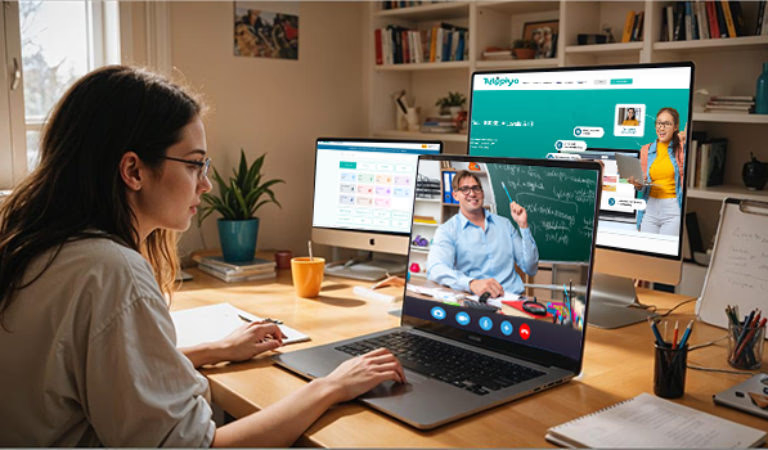
The hardest yes is the first one. A long, paid package is a big, scary commitment for a reluctant child - and for you. Shrink it. A single, no-obligation first lesson your child can do from the sofa at home is far easier to agree to than a stranger arriving at the door for a locked-in arrangement.
This is why the Tutopiya hybrid model suits reluctant children so well. Your child meets a matched, Singapore-based tutor in a free online trial first - no payment, no commitment, no pressure - and simply sees whether they connect. If they do not, you stop, no harm done. If they do, lessons move to in-person at home, you pay by card on a monthly plan with no cash, credits are deducted only for completed lessons, and every class comes with a full report so you can see the shift in engagement for yourself. Removing the “locked in” feeling is often all it takes to get a resistant child to give it one honest try.
When resistance is really a signal
Sometimes a child resisting tuition is telling you something true: the current help is not working, or is not the right kind. Do not always read pushback as defiance. If a child dreads a specific tutor, it may be a fit problem worth fixing rather than a motivation problem to muscle through. For choosing a better match, see how to find a good home tutor in Singapore.
The bottom line
A child who resists tuition is usually frightened, resentful, or bored - not lazy. Motivate them by listening first, reframing tuition as support, giving them a real say, and shrinking that first step to a single low-pressure lesson with a tutor they might genuinely like. Get the fit and the framing right, and the nightly battle quietly disappears.
Dreading the argument? Start with a free online trial from home and let your reluctant child meet a matched Singapore-based tutor with no pressure and no commitment.
Frequently asked questions
Why does my child resist tuition so much? +
Resistance is usually fear, not laziness. A child who has struggled often protects themselves by refusing - if they do not try, they cannot fail again. Others feel tuition is a punishment for bad grades, or dread more of the same teaching that already is not working. Understanding the reason behind the pushback is the first step to easing it.
Should I force my child to have tuition? +
Forcing rarely works and often deepens the resistance. It is far better to involve your child in the decision, explain tuition as support rather than punishment, and let them meet the tutor first. A child who feels some ownership and connects with the tutor will engage; one who feels dragged in will resist every lesson.
How can the right tutor reduce my child's resistance? +
A tutor who builds rapport, starts with small wins, and treats the child with patience can dissolve resistance fast. Many children push back because past help felt judgemental or confusing. When a child feels understood and experiences understanding something they had given up on, dread often turns into willingness within a few lessons.
What if my child refuses to even try a tutor? +
Lower the stakes. A no-pressure, low-commitment first lesson - ideally free and from home - is much easier to agree to than a long package. Frame it as just meeting someone, with no obligation to continue. Removing the sense of being locked in often gets a reluctant child to give it one honest try.
How do I get a reluctant child to try tuition without pressure? +
Start with a free online trial from home - no payment, no commitment, and your child simply meets a matched Singapore-based tutor for one lesson. If they do not connect, you stop. It is the lowest-pressure way to get a reluctant child to try. View home tutors and book a free trial here.
Written by
Tutopiya Singapore Education Desk
Singapore home tuition - PSLE, O-Level & A-Level (MOE syllabus)
The Tutopiya Singapore Education Desk covers home tuition, the MOE syllabus and exam preparation for Singapore families - from PSLE through the GCE O-Level and A-Level.
Related Articles
A-Level Project Work (PW) Home Tuition in Singapore
Project Work (PW) tuition in Singapore helps JC students structure research, the written report and the oral presentation - a tutor guides the work without doing it for them.

Assessment Books vs Home Tuition in Singapore
Assessment books vs tuition in Singapore - when the ten-year-series and self-study is enough, when a home tutor is worth it, and how to combine both effectively.

DSA Preparation with Home Tuition in Singapore
How Direct School Admission (DSA-Sec and DSA-JC) works in Singapore, what tuition can and cannot do, and how a home tutor supports the academic and portfolio side.