
Learning Loss During School Closures: What Happens When Students Are Suddenly Forced to Learn From Home
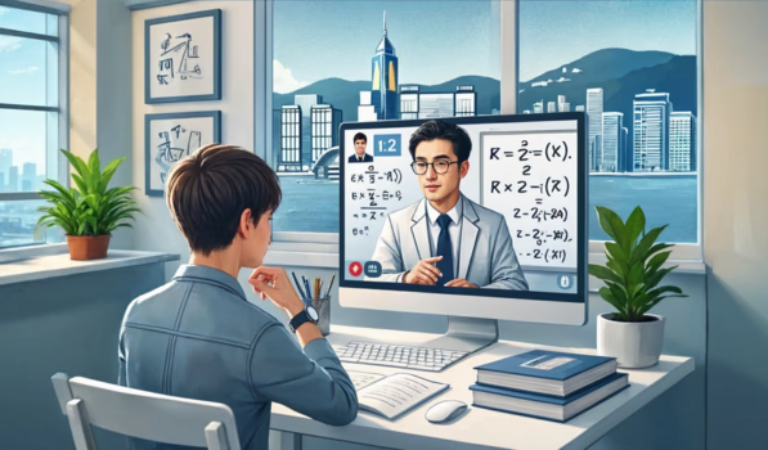
School closures caused by fuel shortages or national emergencies often push students into unstructured home learning environments with little preparation. Research from previous disruptions shows that students can lose weeks of learning momentum within days of routine breakdowns.
Is your school prepared for sudden home learning?
Recent geopolitical tensions and fuel crises have shown how quickly students can be pushed into home learning with minimal notice.
Many international schools are now exploring structured digital pathways that allow teachers to maintain routine, assign work, and track learning even when classrooms are closed.→ Explore how schools are using AI Buddy to reduce learning loss
Loss of Daily Academic Routine
Students depend on:
- Timetabled lessons
- Regular homework cycles
- Physical presence of teachers and peers
When closures linked to regional tensions and energy crises occur, this routine disappears almost overnight. Without replacement structures, time-on-task drops sharply, and students struggle to rebuild productive habits.
Decline in Student Motivation
At home, students face:
- Competing distractions (devices, family responsibilities, noise).
- Uncertainty about how long closures will last.
- Anxiety about exams and future pathways.
Without visible systems and expectations, motivation quickly erodes—especially in middle and upper secondary years. Short closures can trigger long-term motivational damage.
Fragmented Learning Resources
In many schools, emergency home learning looks like:
- PDFs on email
- Links on WhatsApp
- Occasional live video sessions
This fragmentation forces students to act as their own curriculum coordinators. Those without strong organisational skills or parental support are at an immediate disadvantage.
Lack of Accountability Systems
When students learn from home:
- Attendance tracking is weak or limited to logging into a video call.
- Assignment submission is inconsistent, with no central record.
- Leaders lack visibility into which classes or students are disengaged.
During recent Middle East–related disruptions to fuel supply and schooling, many leaders found that they simply did not know who was learning and who was not.
Structured Digital Learning Pathways
To reduce learning loss during closures, schools need:
- Clear, step-by-step learning pathways per subject, with topics, resources, and practice embedded.
- Built-in assessments that students complete at home, generating real data.
- Teacher dashboards showing progress by class, group, and individual.
- Student-friendly interfaces that make it easy to know “What should I do today?”
This transforms home learning from a loose set of activities into a coherent academic journey.
How one school built continuity from home
At Huanui College in New Zealand, AI Buddy became the white-labelled, school-branded platform through which teachers assigned work, students revised, and leaders monitored progress. What began as one-to-one tutoring support evolved into a full digital backbone that reduced learning loss risk whenever students were learning away from campus.
AI-Enabled Study Discipline
AI-enabled platforms like AI Buddy help rebuild and sustain study discipline:
- Personalised practice keeps students engaged at the right level of difficulty.
- Regular quizzes and assignments create natural accountability loops.
- Learning analytics alert teachers when students disengage or struggle.
In the Huanui College partnership, AI Buddy became the central focus point for classroom and homework activity, ensuring continuity even when circumstances changed.
What Schools Are Doing Differently
Forward-thinking schools are no longer assuming that learning will “pause and resume” around closures. Instead, they are designing academic systems that keep students on a clear pathway whether they are on campus or at home.
These systems allow schools to:
- Preserve daily routines through structured digital tasks.
- Keep students engaged with interactive content and practice.
- Give teachers and leaders real-time visibility into learning.
- Minimise learning loss during any period of closure.
Platforms like AI Buddy are increasingly being used as part of this design, helping schools turn home learning from a stopgap into a structured extension of the classroom.
For schools in volatile regions, the takeaway is straightforward: structured, AI-enabled digital pathways are the best defence against learning loss during sudden closures.
Exploring Learning Continuity for Your School
If your school is exploring ways to minimise learning loss during closures, we would be happy to share how international schools are using AI Buddy to support students at home across Cambridge and Edexcel curricula.
Schools interested in learning more can schedule a brief introductory discussion with our academic team.
Written by
Mahira Kitchil
Project Head of AI Buddy
Mahira works closely with school leaders across multiple regions, studying and observing their academic priorities and partnering with them to design and successfully drive school-wide digital rollouts.
Related Articles

Crisis-Proofing Education: How Schools Can Build Learning Systems That Survive Global Disruptions
What resilient schools in the Middle East and beyond are doing to protect learning from pandemics, wars, and energy crises using hybrid, analytics-driven systems.

Exam Revision Without Structure: The Biggest Risk for IGCSE and A-Level Students During School Closures
Why unstructured revision and random past paper practice put IGCSE and A-Level students at risk during school closures—and how AI-supported systems can help.

Fuel Shortages and School Closures: How International Schools Can Maintain Learning Continuity During National Disruptions
How international schools in the Middle East and Asia can protect learning continuity during fuel shortages, transport disruptions, and sudden school closures.